
Loading, please wait...
LOT 0726
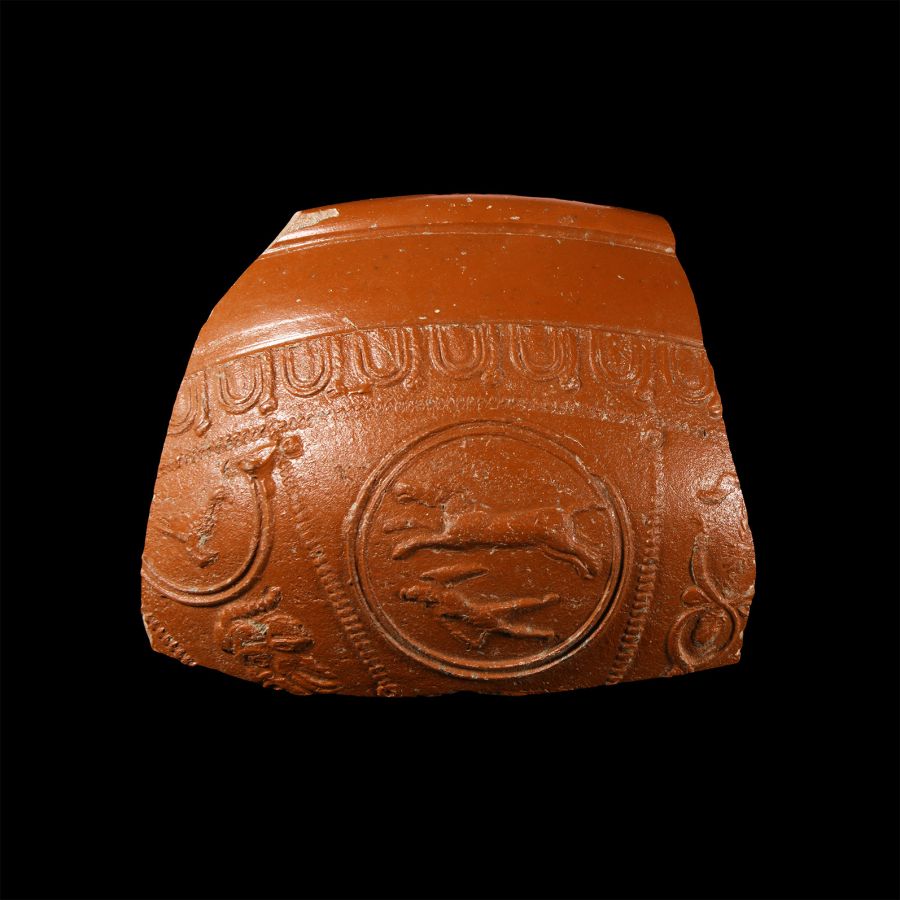
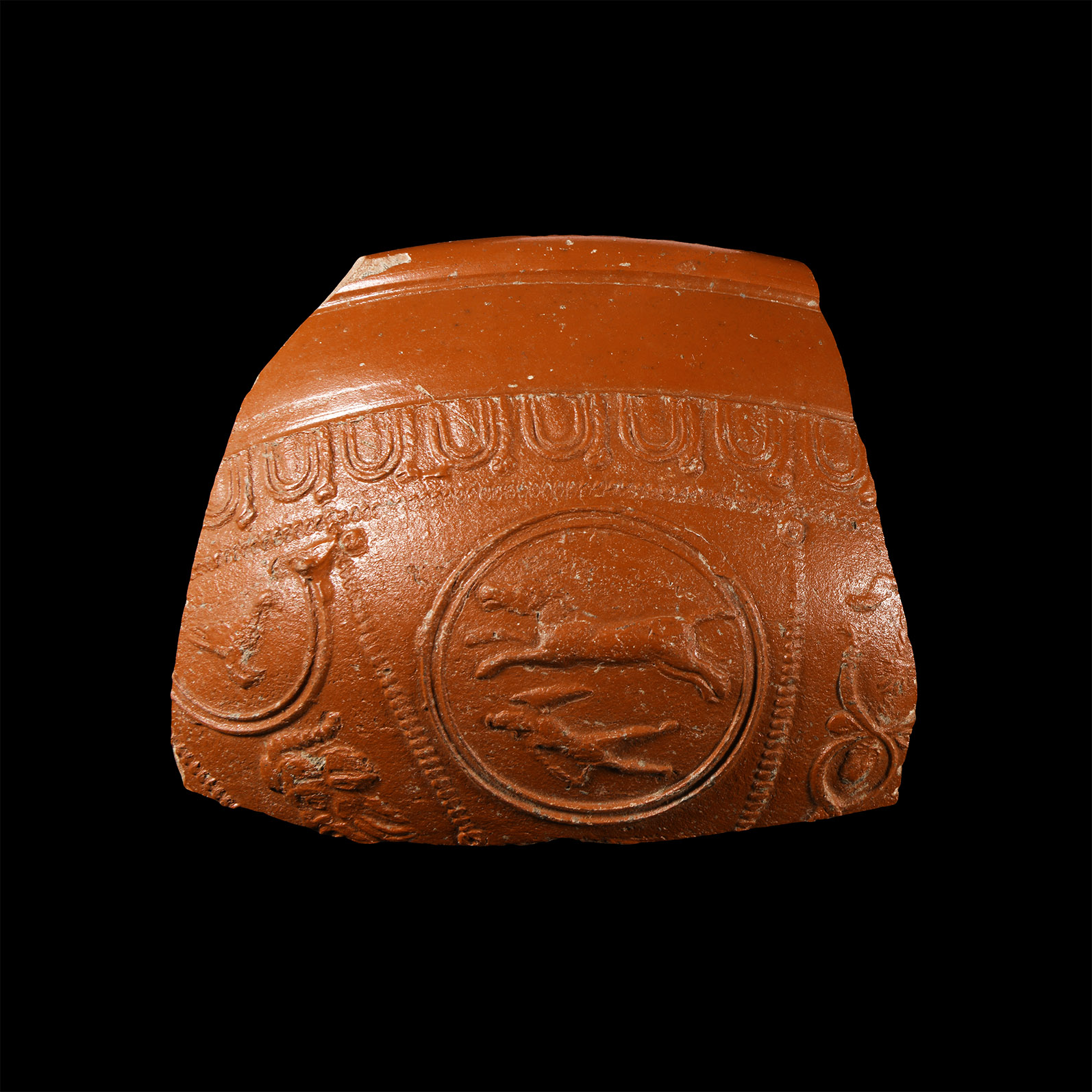
Roman Red Ware Bowl Fragment with Gladiator
2ND CENTURY A.D.
3 7/8 in. (71.9 grams, 98 mm).
From the upper part of a vessel, displaying a bird, a satyr head and a caduceus, a leaping wild horse and a gladiator within a roundel.
ProvenanceAcquired 1960s-1990s.
From the late Alison Barker collection, a retired London barrister.
Cf. Beutler, F. et al., Der Adler Roms. Carnuntum und die Armee der Cäsaren, Bad-Deutsch-Altenburg, 2017, item 697, for similar fragment.
FootnotesThese kind of fragments are often found in military camps. In addition to simple cooking pots, jugs, plates and mortars, the household effects of a contubernium (the smallest organised unit of soldiers in the Roman army composed of eight legionaries) also included finer eating and drinking utensils. To avoid confusion, many soldiers marked their dishes with their names and, if necessary, repaired them with the help of lead clips.
CONDITIONTimeLine Auctions follows a vetting process to ensure the authenticity and legality of all items, reinforcing our commitment to integrity and responsible trading. Each antiquity, antique, and coin lot undergoes thorough examination by a vetting committee of at least ten external specialists, professional trade association members, scientists, and archaeologists: Our Vetting Process
AUCTIONS:
TimeLine is a leading auction house specialising in antiquities, ancient art, collectables, natural history, coins, medals, and books. Our auctions offer museums, collectors, historians, and enthusiasts the opportunity to acquire unique and historically significant pieces.
-
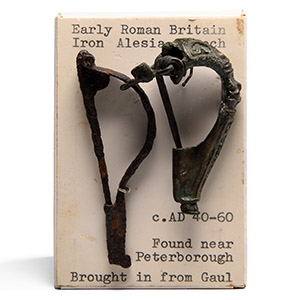
Roman Bronze Hattatt Collection Brooch Group
1st century B.C.-1st century A.D.Sold for (Inc. bp): £182
Comprising: an iron Alesia-type brooch with deep tapering bow, long foot with recurved integral knop, curled hinge; the type of Gaulish origin; mounted on a custom-made display panel stand with Hattatt collection description and further information on a label to the reverse; inked collection number to the reverse of the bow; the other a bronze trumpet brooch with moulded arc decorations on the head, sprung pin moving freely, tapering body with acanthus motif; horizontal ribbing and zigzag motifs, plain underfoot; retaining swivel chain loop with traces of red enamel; collection number to the reverse of the bow. 25.6 grams total, 63-70 mm (82 grams total, 85 mm high including stand)
Alesia type found near Peterborough, Cambridgeshire, UK; trumpet type found in Northamptonshire, UK.
Hattatt remarks of the Alesia brooch: 'In remarkably fine condition for iron, this could well have been worn by one of the Roman invaders.' -
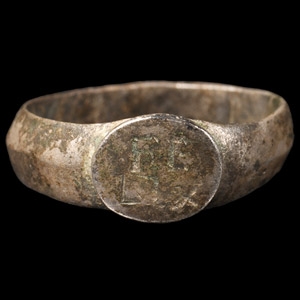
Roman Silver Ring with FELIX
1st century A.D.Sold for (Inc. bp): £169
Carinated hoop, stud bezel with incised with the Roman name 'FE/LIX'. 3.39 grams, 21.24 mm overall, 16.82 mm internal diameter (approximate size British M 1/2, USA 6 1/4, Europe 13.09, Japan 12)
Acquired on the EU art market around 2000. From the collection of a North American gentleman. -
.jpg)
Roman Gemstone with Winged Deities
Circa 1st-2nd century A.D.Sold for (Inc. bp): £494
Comprising a rock crystal cloison with intaglio scene of a winged kneeling male with outstretched arms receiving a winged baby from a seated winged female; accompanied by a museum-quality impression. 3.42 grams, 21 mm
Ex property of a London gentleman; acquired by his father in the 1970s; thence by descent.
