
Loading, please wait...
LOT 0739
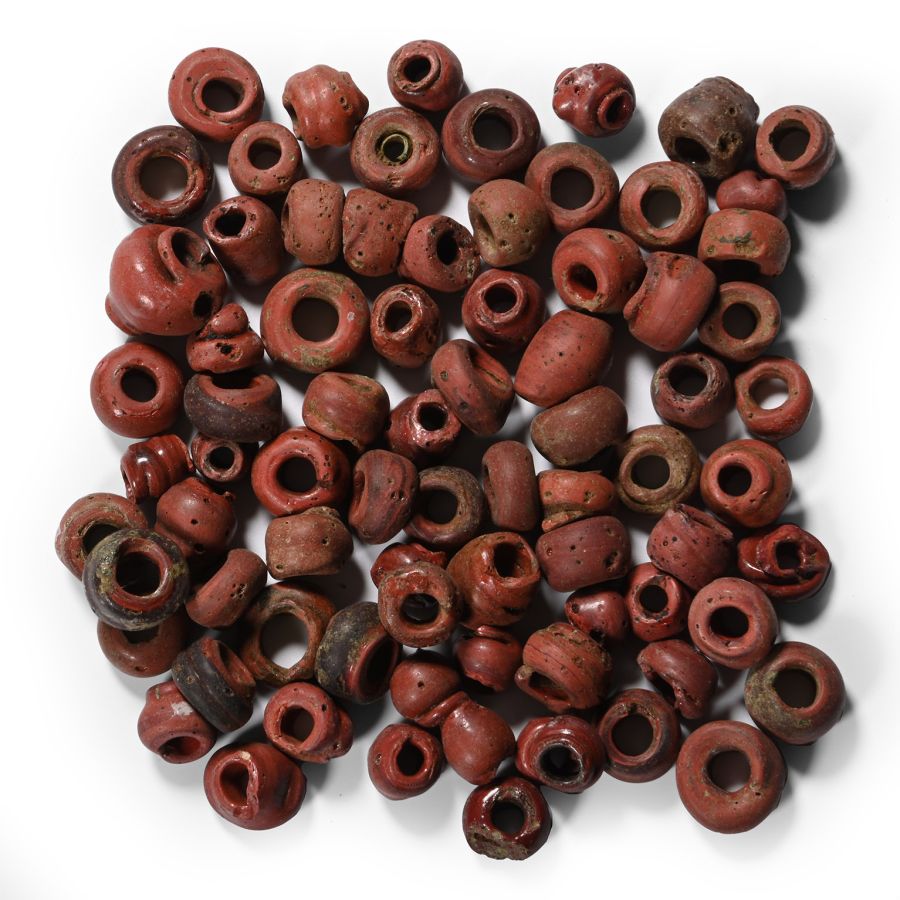
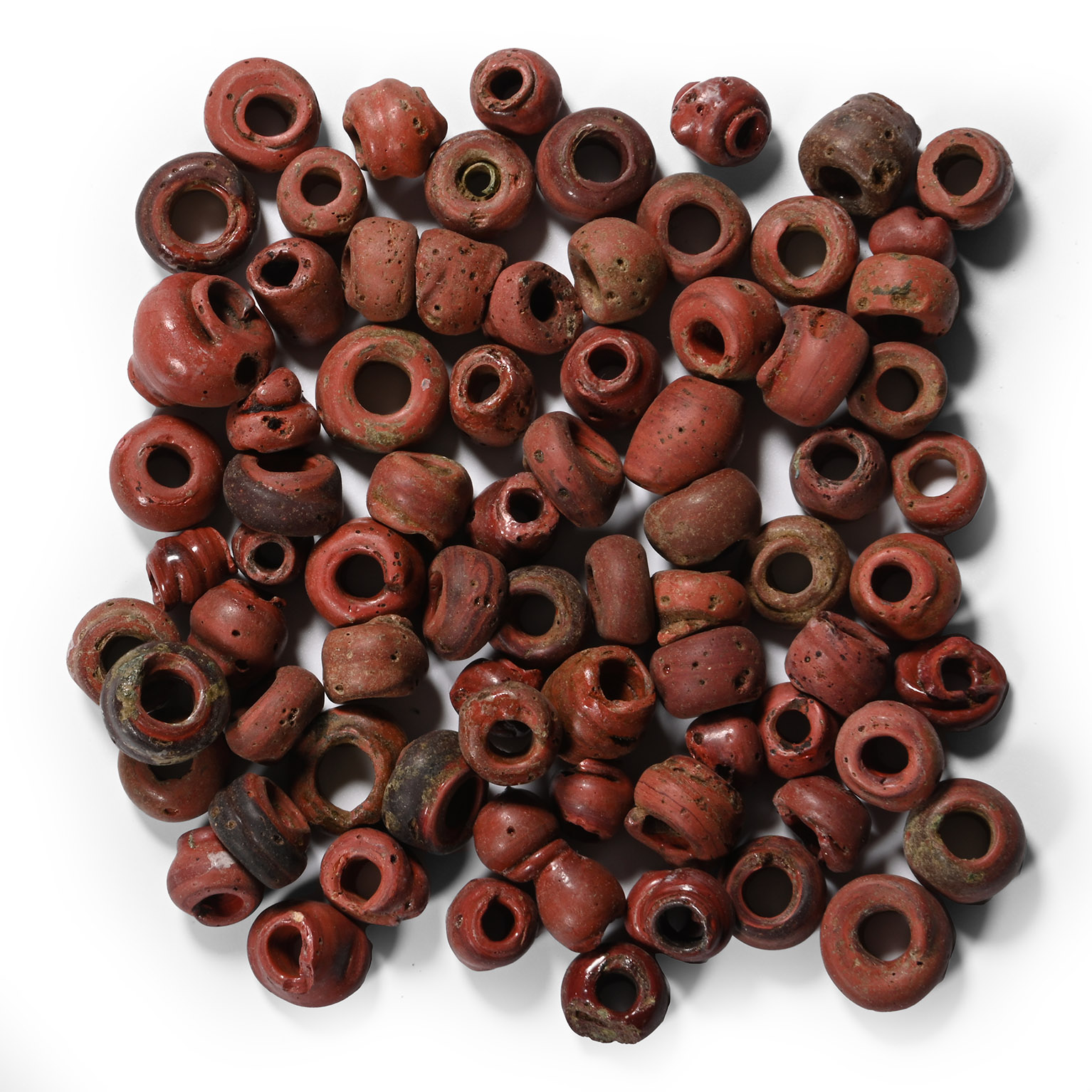
Roman Red Glass Bead Group
1ST-4TH CENTURY A.D. OR LATER
1/4 - 5/8 in. (62 grams total, 7-15 mm).
Comprising mainly opaque annular and oblate beads with flange to each end. [77, No Reserve]
ProvenanceUK gallery, early 2000s.
This lot is accompanied by an illustrated lot declaration signed by the Head of the Antiquities Department, Dr Raffaele D'Amato.
Cf. Boschetti, C., Gratuze, B., Cavalieri, M., Schibile, N., ‘Production or Consumption? Glass Beads from the Roman Villa of Aiano, Tuscany,’ in European Journal of Archaeology, 25 (2) fig.4 for similar beads.
LiteratureThe mass production of glass in Ancient Rome prompted the development of glass jewellery of unique qualities. The ancient Romans considered jewellery to be an essential accessory, being a public display of the wealth of high social classes. Roman jewellery at first followed trends set by the Etruscans, using gold and glass beads, but as the power and spread of the Roman Empire increased, jewellery designs became increasingly elaborate, incorporating elements from different cultural styles.
CONDITIONTimeLine Auctions follows a vetting process to ensure the authenticity and legality of all items, reinforcing our commitment to integrity and responsible trading. Each antiquity, antique, and coin lot undergoes thorough examination by a vetting committee of at least ten external specialists, professional trade association members, scientists, and archaeologists: Our Vetting Process
AUCTIONS:
TimeLine is a leading auction house specialising in antiquities, ancient art, collectables, natural history, coins, medals, and books. Our auctions offer museums, collectors, historians, and enthusiasts the opportunity to acquire unique and historically significant pieces.
-
.jpg)
Roman Marble Statue Fragment with Dog
2nd-3rd century A.D.Sold for (Inc. bp): £12,350
Trapezoidal in plan base fragment with figures carved in the round: tree with bands of horizontal ribbing; left foot, ankle and calf of a male wearing open-toed sandal and military-style boot, the upper part decorated with the skin of a lion cub; body of a dog sitting at heel beside the tree. 13.9 kg, base: 30 cm long
Acquired in the mid 1980s-1990s. Private collection, Switzerland, thence by descent. Private collection, since the late 1990s. Accompanied by an academic report by Dr Raffaele D’Amato. This lot has been checked against the Interpol Database of stolen works of art and is accompanied by search certificate number no.12578-232182. This lot has been cleared against the Art Loss Register database, and is accompanied by an illustrated lot declaration signed by the Head of the Antiquities Department, Dr Raffaele D'Amato.
The military boot cothurnus worn here by a hunter or a military commander, was widely used by commanders of the Roman army, and sometimes by actors playing military heroes. Officers wore splendid closed cothurni of various colours, like those realised in blue leather and worn by an officer represented on a fresco from Stabiae (D’Amato-Sumner, 2009, p.13). -
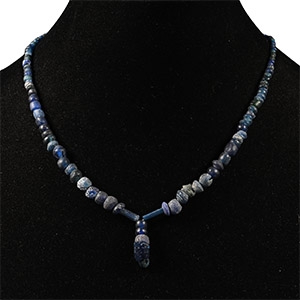
Roman Blue Glass Bead Necklace String
1st-4th century A.D. and laterSold for (Inc. bp): £85
Restrung to a Y-shape comprising mainly graduated oblate beads, central feature composed of oblate and annular beads with a reused bracelet fragment. 16.66 grams, 37 cm
Ex London, UK, collection, 1990s. This lot is accompanied by an illustrated lot declaration signed by the Head of the Antiquities Department, Dr Raffaele D'Amato. -
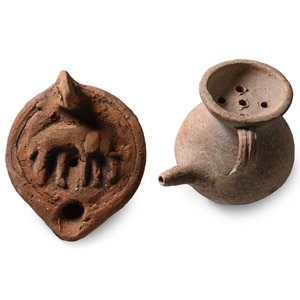
Western Asiatic and Roman Ceramic Vessel Group
3rd century B.C.-4th century A.D.Sold for (Inc. bp): £117
Comprising: a small strainer or feeding vessel with bulbous body and everted neck, the top pierced with five holes, strap handle and a small tubular spout; a discoid oil lamp in coarseware with a stylised elephant above a small filler hole. 312 grams total, 9.6-11.1 cm
with Galerie Rhéa, Zurich, Switzerland. This lot is accompanied by an illustrated lot declaration signed by the Head of the Antiquities Department, Dr Raffaele D'Amato.
