
Loading, please wait...
LOT 1409
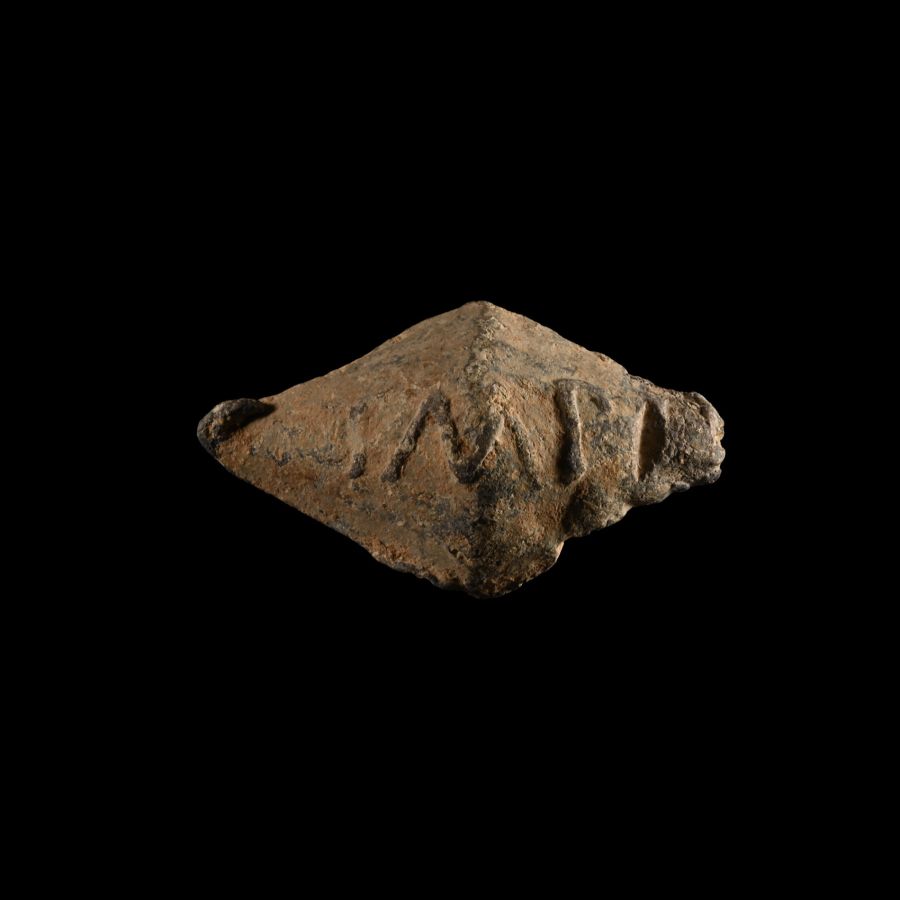
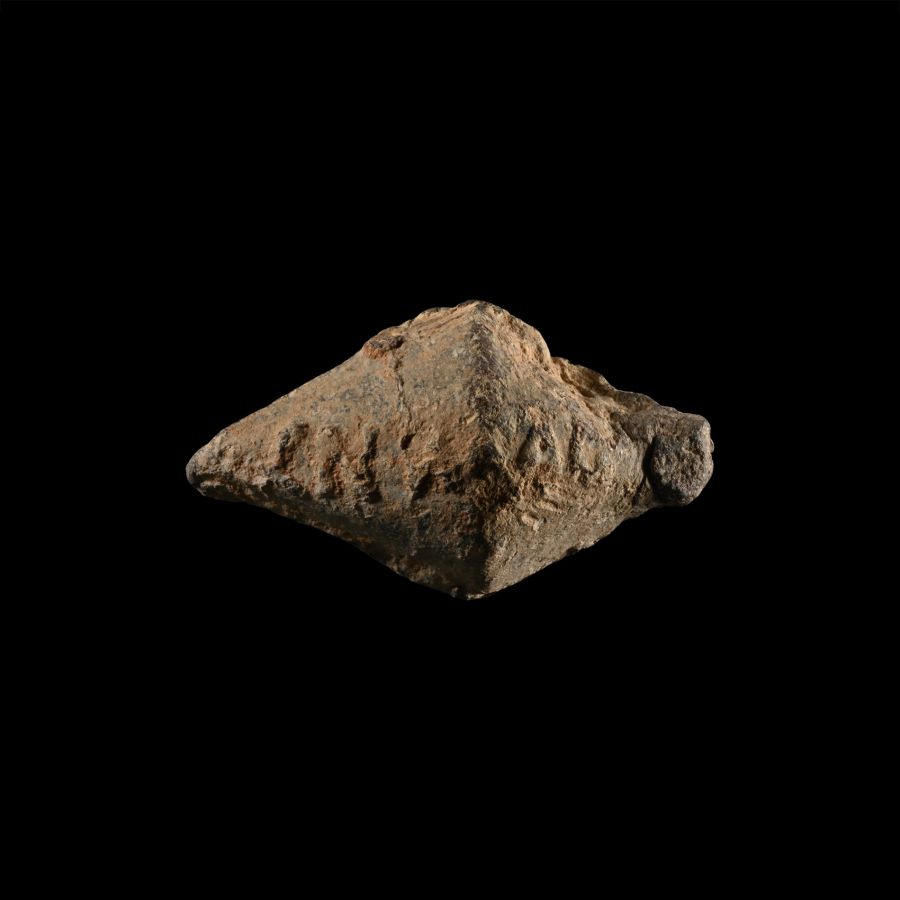
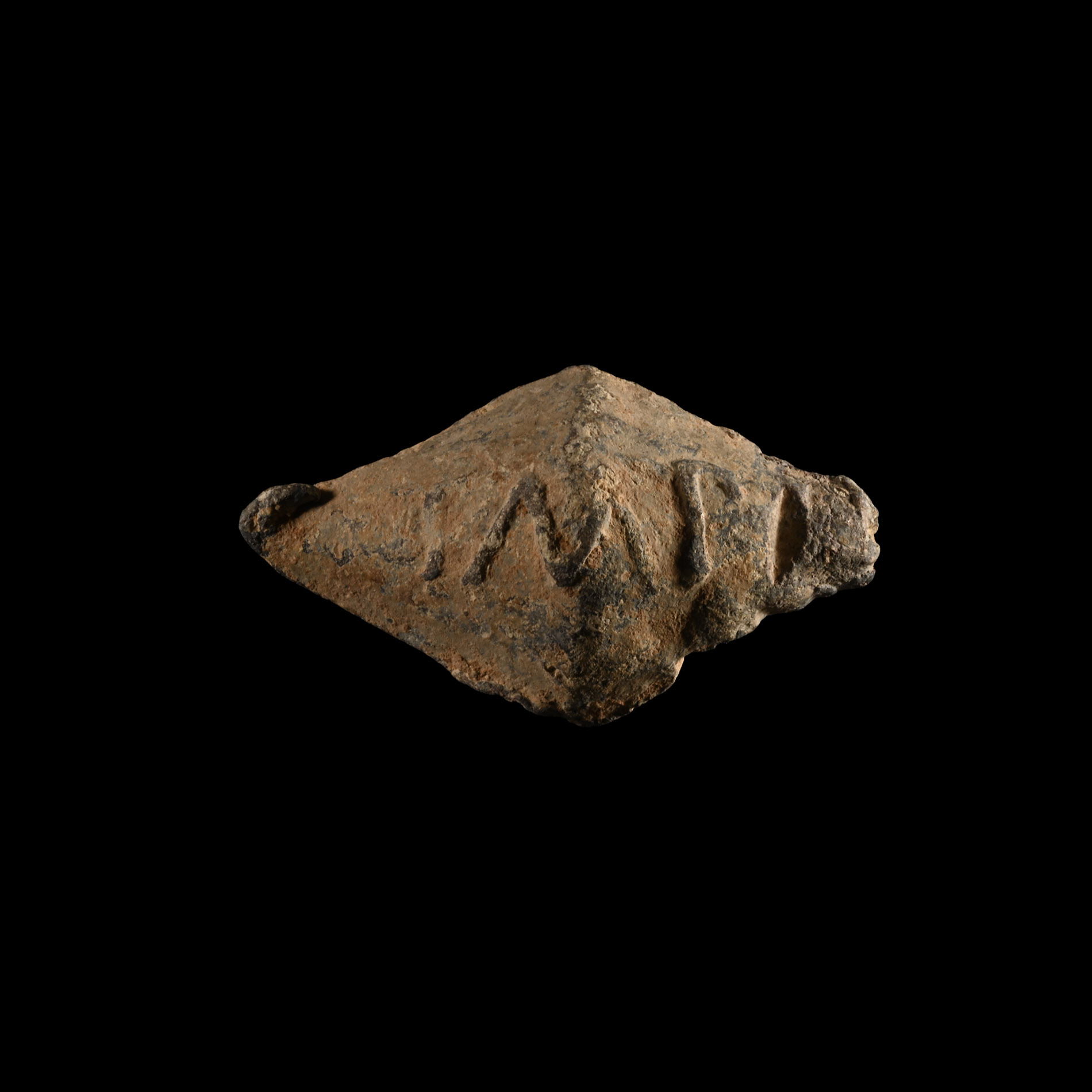
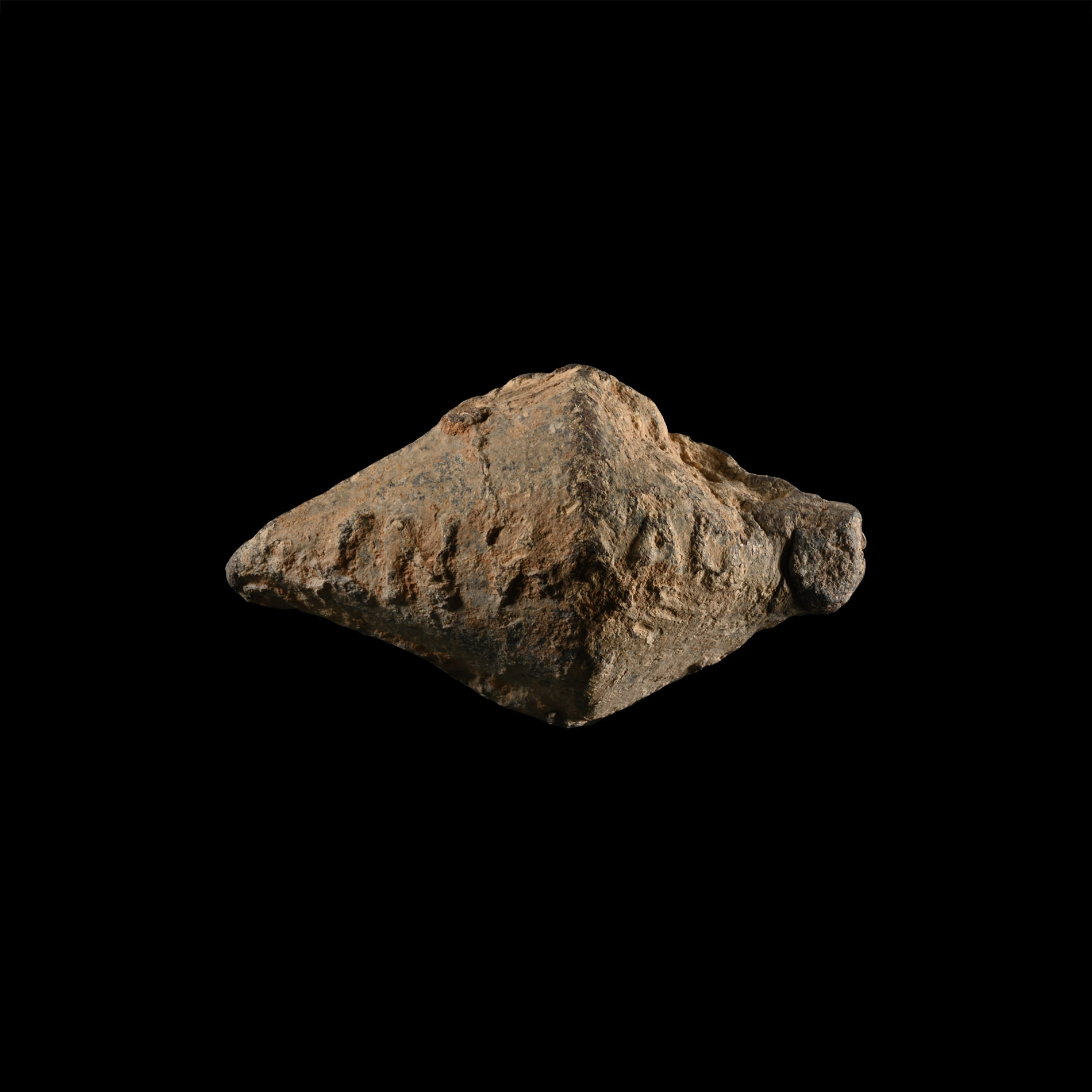
Roman 'Pompey the Great' Lead Slingshot
1ST CENTURY B.C.
1 5/8 in. (67.5 grams, 42 mm).
Biconical lead slingshot (glans) with inscription in Latin letters 'CN' (Cneius) 'MAG' (Magnus) on one side, and 'IMP' for 'IMPERATOR' (victorious general) to the other side, i.e Gnaeus Pompeius Magnus Imperator (Pompey the Great the victorious general). [No Reserve]
ProvenanceFrom a Spanish collection.
From the collection of an London antiquarian.
Accompanied by an academic paper by military specialist Dr Raffaele D'Amato, dated 4th May 2022 and titled 'Roman Res Publica - Lead Slingshots (glandes) of Caesarian Age - 45 B.C circa'.
Accompanied by a printed copy of the Spanish cultural export licence 2022/07273.
Cf. D'Amato, R. and Sumner, G., Arms and Armour of the Imperial Roman Soldier: From Marius to Commodus, 112 BC-AD 192, London, 2009, fig.32, p.45, for a similar glandes from Zaragoza Museum, the one with the name of Pompey inscribed coming from Munda battlefield.
FootnotesThe shot (Völling type 1C) is marked with the abbreviated name of Gnaeus Pompey; it was used in quantity at the Battle of Monda (or Munda) against Julius Caesar, 17th March 45 BC. The projectiles were made of different materials: lead (glandes) or in pottery or stone (lapides missiles). Sometimes they were signed with the name of the general, like our specimen.
CONDITIONTimeLine Auctions follows a vetting process to ensure the authenticity and legality of all items, reinforcing our commitment to integrity and responsible trading. Each antiquity, antique, and coin lot undergoes thorough examination by a vetting committee of at least ten external specialists, professional trade association members, scientists, and archaeologists: Our Vetting Process
AUCTIONS:
TimeLine is a leading auction house specialising in antiquities, ancient art, collectables, natural history, coins, medals, and books. Our auctions offer museums, collectors, historians, and enthusiasts the opportunity to acquire unique and historically significant pieces.
-
Luristan Bronze Horse Harness Cheekpiece
11th-8th century B.C.Estimate: £300 - 400 (+bp*)
Opening Bid: £160
In the form of a righthand side bar, surmounted by two loops for additional straps, ending in a lion's head at the front, the other extremity bending outwards and ending with a conical tip, remains of the iron bar visible on the sides; once belonging to an articulate bit. 130 grams, 13.5 cm wide
Fine condition.
Acquired mid 1980s to early 1990s. Private family collection formed in London, UK.
The association of Psalia in the shape of a bar and with an articulated bit is documented in Assyria, in Media and in central Iran starting from the 10th century B.C., but the zoomorphic elements of this specimen suggest that it was produced in Luristan. The use of articulated bits, which moved inside the horse's mouth, exerting a minimal pressure on the reins, allowed for better control of the mount. -
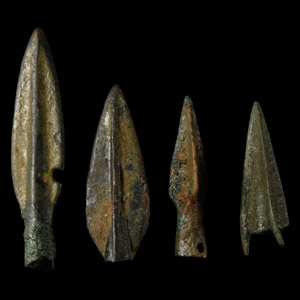
Greek Bronze Arrowhead Collection
Circa 5th-3rd century B.C.Sold for (Inc. bp): £111
Comprising: two leaf-shaped with raised midribs; one triangular with barbs; one triangular with short socket. 18 grams total, 34-52 mm
From an old UK collection, acquired on the UK art market. Property of a Shropshire private collector. -
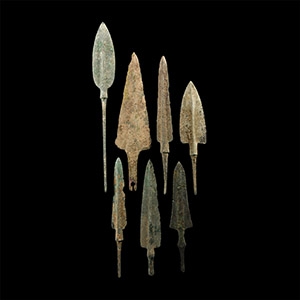
Luristan Bronze Arrowhead Group
13th-7th century B.C.Sold for (Inc. bp): £156
Comprising mainly tanged arrowheads including various types of leaf-shaped heads with midribs. 200 grams total, 12-15.3 cm
Acquired 1990s. From the collection of a late Japanese weaponry collector.
The barbed arrowhead seems to belong to the type V, subcategory type C, according to the classification of Khorasani and Negahban. In the four categories of triangular bronze arrowheads from Luristan, Marlik and Northern Iran individuated by Negahban, subtypes C and D of type V are larger arrow or javelin heads, C large triangular arrowheads with barbed shoulders and D with lanceolate shape and rounded midrib. The straight shoulders recalls a Marlik typology (see Khorasani, 2006, p.307, fig.379).
