
Loading, please wait...
_900x900.jpg "Roman Polychrome Mosaic Glass Set into a Marble Table Top")
_200x200.jpg "Roman Polychrome Mosaic Glass Set into a Marble Table Top")
_900x900.jpg "Roman Polychrome Mosaic Glass Set into a Marble Table Top")
_200x200.jpg "Roman Polychrome Mosaic Glass Set into a Marble Table Top")
.jpg "Roman Polychrome Mosaic Glass Set into a Marble Table Top")
.jpg "Roman Polychrome Mosaic Glass Set into a Marble Table Top")
LOT 0400
Roman Polychrome Mosaic Glass Set into a Marble Table Top
3RD CENTURY B.C.-2ND CENTURY A.D. AND LATER
11 5/8 in. (4.31 kg, 29.6 cm).
Discoid plaque with radiating panels of ancient inlaid mosaic and other glass; black outer border, centrepiece a disc with inlaid mosaic glass triangle, set into a marble table top; made in Rome circa 1825, attributed to Francesco Sibilio.
ProvenanceLady Walston, Newton Hall, Newton, Cambridgeshire.
The collection of Mr Edric Van Vredenburgh.
with Sotheby’s, London, The Eclectic World of Edric Van Vredenburgh, 6 June 2006, no.97.
British private collection.
This lot has been checked against the Interpol Database of stolen works of art and is accompanied by a search certificate number no.12743-235193.
This lot has been cleared against the Art Loss Register database, and is accompanied by an illustrated lot declaration signed by the Head of the Antiquities Department, Dr Raffaele D'Amato.
See Martine S. Newby, Francesco Sibilio and the Re-use of Ancient Roman Glass in the 19th century, Alvar Gonzalez-Palacios, Lavori di Sibilio, L'Armadio Delle Meraviglie, Milan, 1991, p.86.
CONDITIONTimeLine Auctions follows a vetting process to ensure the authenticity and legality of all items, reinforcing our commitment to integrity and responsible trading. Each antiquity, antique, and coin lot undergoes thorough examination by a vetting committee of at least ten external specialists, professional trade association members, scientists, and archaeologists: Our Vetting Process
AUCTIONS:
TimeLine is a leading auction house specialising in antiquities, ancient art, collectables, natural history, coins, medals, and books. Our auctions offer museums, collectors, historians, and enthusiasts the opportunity to acquire unique and historically significant pieces.
LOT 0400
Roman Polychrome Mosaic Glass Set into a Marble Table Top
Sold for (Inc. bp): £11,050
-
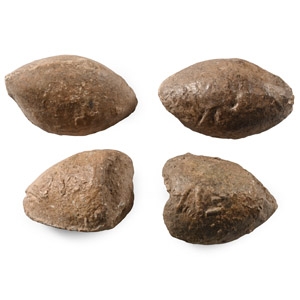
Roman Inscribed Lead Slingshot Group
1st century B.C.-1st century AD.Sold for (Inc. bp): £78
Comprising three fragmentary and one complete biconical slingshot, each with raised lettering. 151 grams total, 24-30 mm
Ex German art market, 2000s. Acquired from an EU collector living in London. From the collection of a Surrey, UK, gentleman. This lot is accompanied by an illustrated lot declaration signed by the Head of the Antiquities Department, Dr Raffaele D'Amato. -
.jpg)
Roman Constantine I Terracotta Forger's Coin Mould
Circa early 4th century A.D.Sold for (Inc. bp): £130
Terracotta disc with possibly Constantine I (307-337) coin impression to each face from which to cast counterfeit coins. 4.68 grams, 28 mm
From the collection of a gentleman, acquired on the London art market in the 1990s. This lot is accompanied by an illustrated lot declaration signed by the Head of the Antiquities Department, Dr Raffaele D'Amato. -
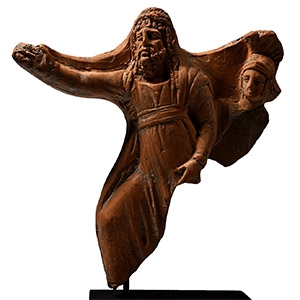
Roman Terracotta Figure of King Priam
1st century B.C.-1st century A.D.Sold for (Inc. bp): £936
A hollow-form figural group comprising an advancing old King Priam with his right arm raised, wearing a belted tunic and a diadem, hair arranged in orderly locks; behind him a smaller figure of a soldier wearing a plumed Pseudo-Attic helmet; the hand of the warrior is holding the old king; mounted on a custom-made display stand. 291 grams total, 18.5 cm high including stand
Private Swiss collection, 1971. with Galerie Rhéa, Zurich, Switzerland. This lot is accompanied by an illustrated lot declaration signed by the Head of the Antiquities Department, Dr Raffaele D'Amato.
The scene probably represents the old King Priam's plea to Achilles' son, Neoptolemus, to spare his son Polites, whom the Greek warrior is about to kill. It is made in a strong classical style with precise costume details, such as the royal diadem, the long sleeved Phrygian-type tunic and the king's belt.
