
Loading, please wait...
LOT 0306
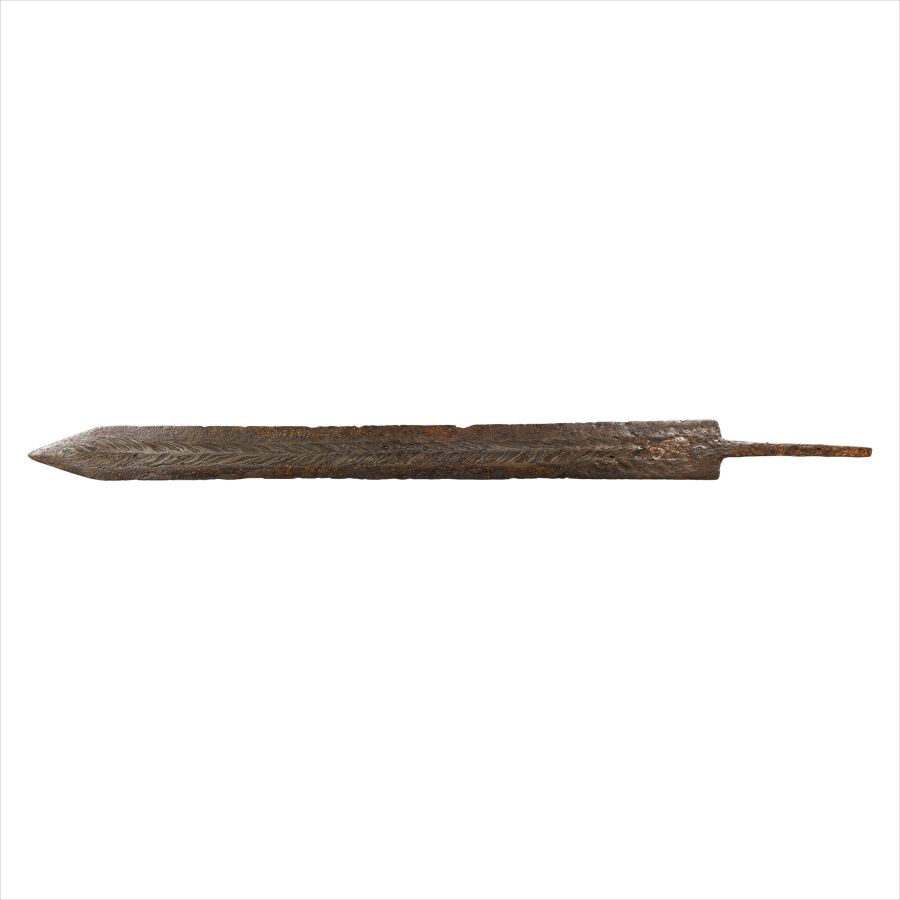
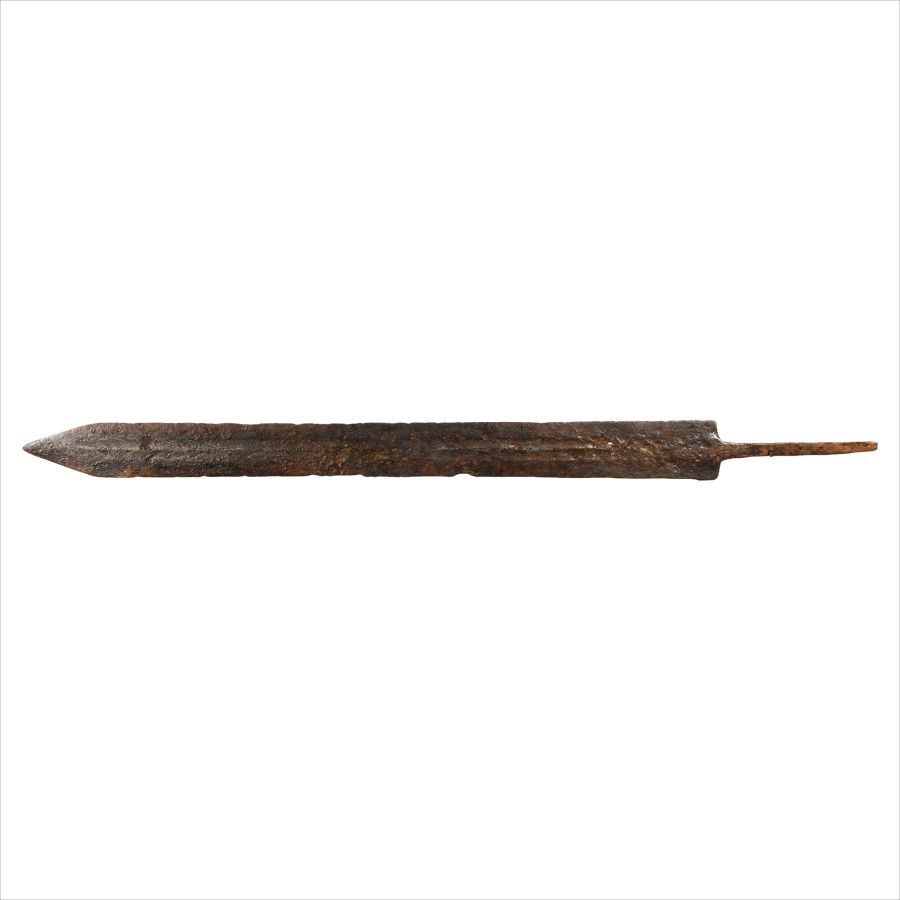
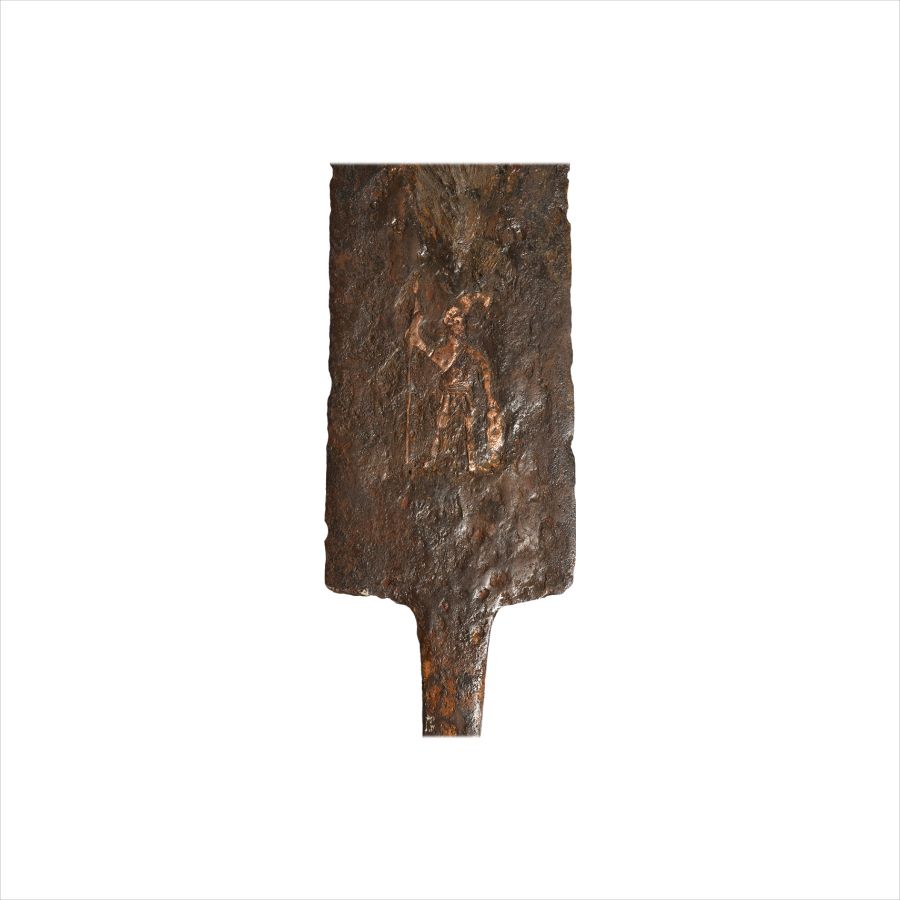
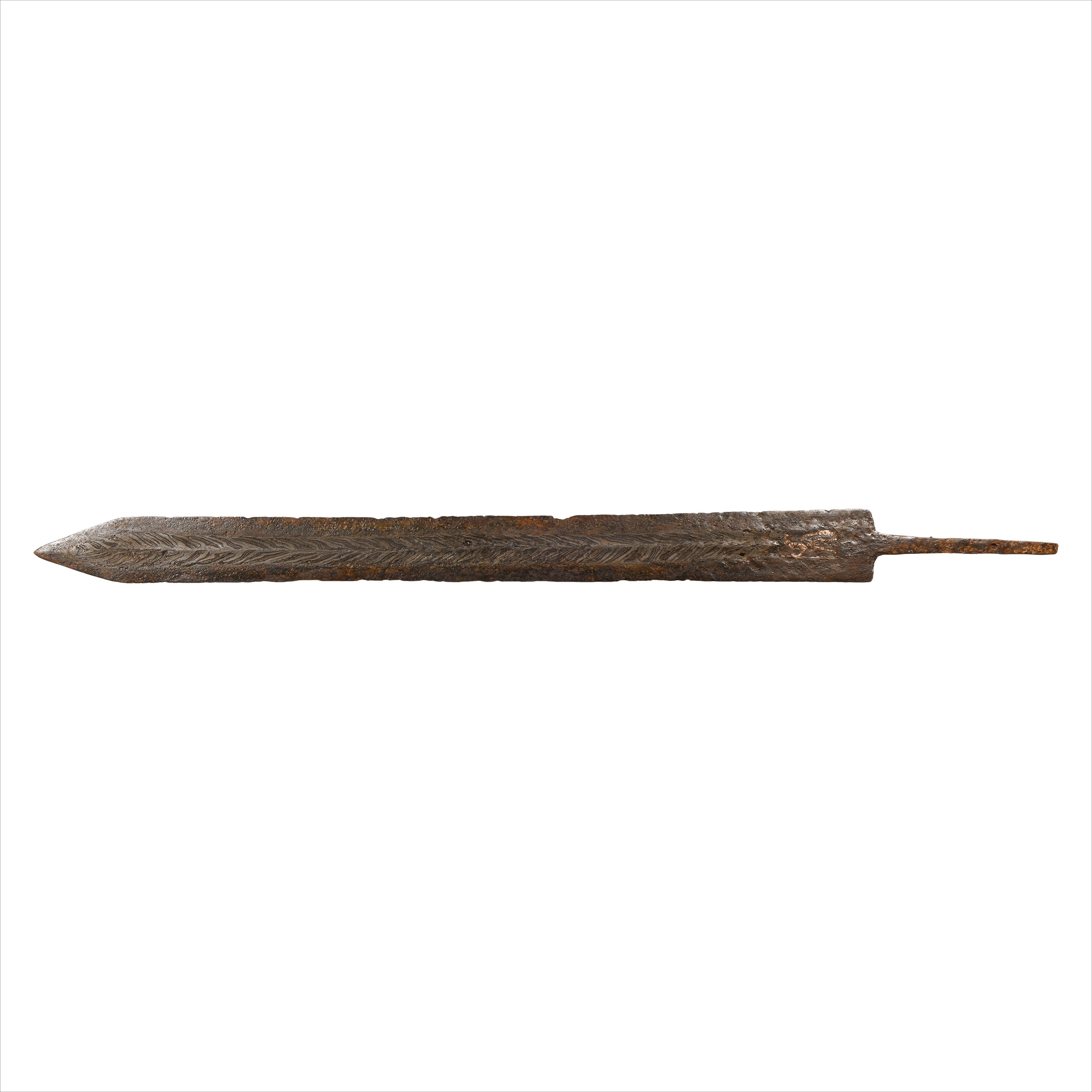
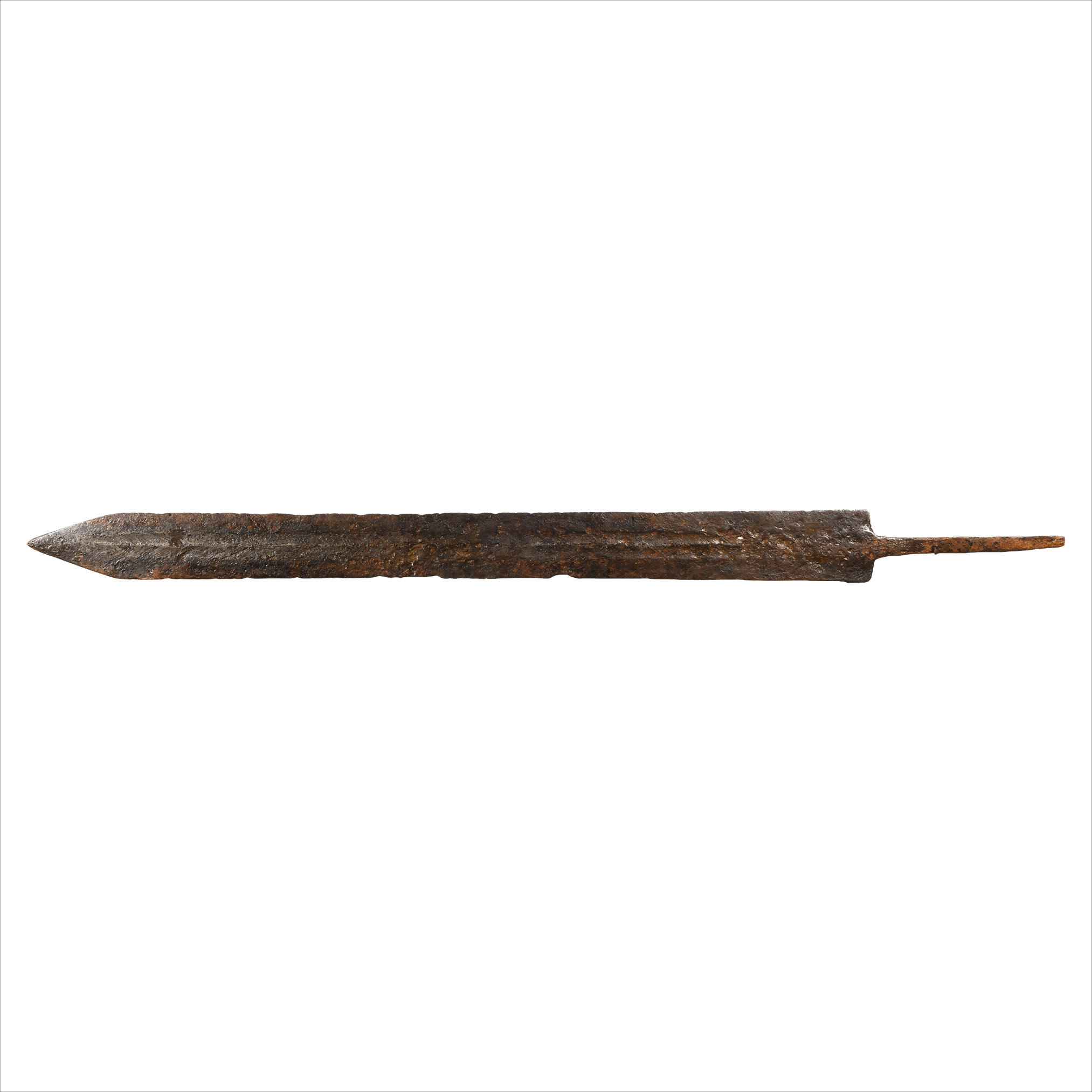
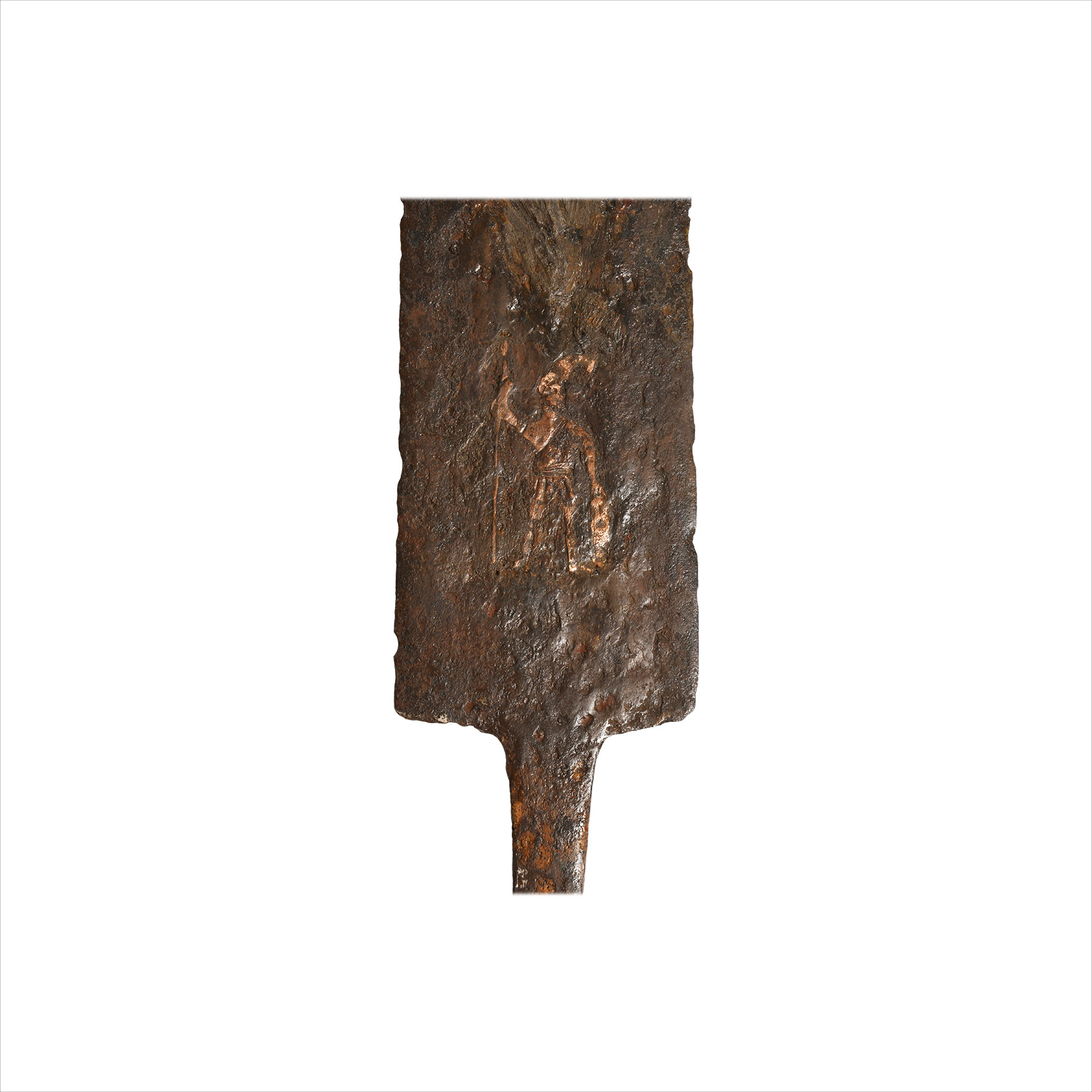
Roman Pattern-Welded Iron Spatha with Inlaid Military Figure
LATE 2ND-EARLY 3RD CENTURY A.D.
32 1/4 in. (467 grams, 82 cm).
With double-edged blade of Lauriacum Hromówka typology with blood channels running for the most of its length; inlaid figure of standing Mars Ultor wearing armour (statos) and plumed galea helmet, holding a shield (aspis) and a spear; the blade cleaned and conserved on one side.
ProvenanceFrom the private collection of a London gentleman, from his grandfather's collection formed before the early 1970s.
Accompanied by an academic report by Dr Raffaele D’Amato.
This lot has been checked against the Interpol Database of stolen works of art and is accompanied by search certificate number no.11922-209659.
Exhibited at Harwich Museum, Harwich, Essex, UK, 3rd February-9th March 2024; accompanied by a copy of a photograph of the artefact on display.
LiteratureCf. Biborski, M., ‘Miecze z okresu wpływów rzymskich na obszarze kultury przeworskiej’, in Materiały Archeologiczne XVIII, 1978, pp.53-165; Robinson, H.R., What the soldiers wore on Hadrian’s Wall, Newcastle on Tyne, 1976-1979; Czarnecka, K., ‘Two newly-found Roman swords from the Przeworsk culture cemetery in Oblin, Siedlce District, Poland’ in JRMES 3, 1992, pp.41-56; Bishop, M. C., & Coulston, J.C.N., Roman military equipment, from the Punic wars to the fall of Rome, London, 1993; Biborski, M., ‘Römische Schwerter im Gebiet des europäischen Barbaricum’, in JRMES 5, 1994, pp. 169-198; Radjush, O., ‘New armament finds of the Scythian wars' epoch in the northern Black Sea region’ in Busch, A. W. and Schalles, H.-J. (eds.), Waffen in Aktion. Akten des 16. Internationale Roman Military Equipment Conference (ROMEC), Xanten, 13.–16. June 2007, Xantener Berichte 16, Darmstad, 2009, pp.183–8; Guillaud I., Militaria à Lugdunum: étude de l’armement et de l’équipement militaire d’époque romaine à Lyon (1er s. av.-IVe s. apr. J.-C.), Archéologie et Préhistoire, Lyon, 2017; for very similar specimens see Miks, 2007, nos. A146,3; A146,10 (Ejsbol); A384 (Krasnik-Piasti); A595 (Pontoux); A830 (Sisak); A620 (Rezeczyca Dluga); A586 (Pododlow); A676 (Sobotka); A211 (Kielce) and especially A681,1 (South Shields).
CONDITIONTimeLine Auctions follows a vetting process to ensure the authenticity and legality of all items, reinforcing our commitment to integrity and responsible trading. Each antiquity, antique, and coin lot undergoes thorough examination by a vetting committee of at least ten external specialists, professional trade association members, scientists, and archaeologists: Our Vetting Process
AUCTIONS:
TimeLine is a leading auction house specialising in antiquities, ancient art, collectables, natural history, coins, medals, and books. Our auctions offer museums, collectors, historians, and enthusiasts the opportunity to acquire unique and historically significant pieces.
LOT 0306
Roman Pattern-Welded Iron Spatha with Inlaid Military Figure
Sold for (Inc. bp): £5,850
-
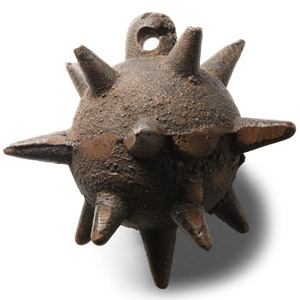
Iron Spiked Macehead
Circa 16th-17th century A.D.Sold for (Inc. bp): £221
Comprising a globular flail head with large suspension loop above and sixteen spiked projections to the sides. 829 grams, 89 mm
From a collection acquired on the UK art market from various auction houses and collections mostly before 2000. From an important Cambridgeshire estate; thence by descent.
The medieval flail was a weapon mainly used in Eastern Europe, probably created among the Steppe people and used by the Mongols, adopted by the Slavic people under the name of kisten. Such a weapon probably saw little use in Western Europe, where it is first represented in the 14th century in a fresco depicting the battle of Nineveh painted by Piero della Francesca, as a chain with three maceheads. In the poem Le Chevalier Délibéré written by Olivier de la Marche and published in 1486, there is an engraving representing a knight carrying a rather simple morning star with asymmetrically mounted quills and a single-ball flail of quills. It is thought that in the Middle Ages the nailed mace in general was used to break through and dismantle the armour of enemies who were then 'finished' with swords or daggers. -
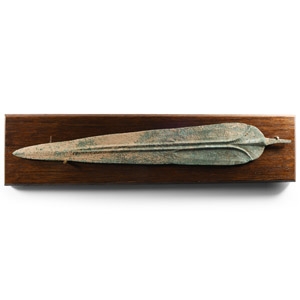
North West Persian Short Sword with Blood Channels
2nd-1st millennium B.C.Estimate: £250 - 350 (+bp*)
Opening Bid: £125
With short tang for an organic hilt, the blade showing multiple grooves forming a pronounced mid-rib spanning roughly more than three-quarters of the blade; accompanied by a custom-made display stand. 1.18 kg total, 45.5 cm (49 cm including stand)
Ex P.A., Hertfordshire, UK, specialist collection of Greek art, 1980-1990s.
Luristan was hardly an ethnic or political entity, but the people of Luri had relations through warfare and traded with Sumerians, Lullubi, Assyrians, Babylonians and Elamites over a long period of time, spanning from the 3rd to the 2nd millennium B.C. The ruling elites of warrior horsemen were buried with their weapons and horses. -
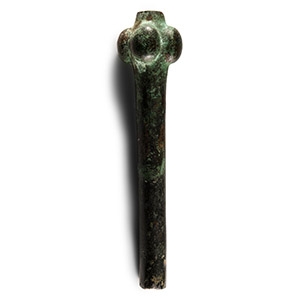
Luristan Sara-Gorz Bronze Macehead
Circa 2000-1300 B.C.Sold for (Inc. bp): £338
With long tubular shank and four hefty bulbs surrounding the shaft. 456 grams, 22.5 cm
Acquired 1980-2015. Ex Abelita family collection. Accompanied by an earlier catalogue identification card.
This rare and unusual mace finds parallels with similar pieces published by Slotta, Vatandust, and Moorey. The dating varies between 21st and 14th century B.C. Western Iranian maces, especially the Luristan ones, were notable for the variety of different forms. According to Dr D. Nicolle the gorz or mace was primarily used as an armour breaking weapon since ancient times, and was very common on the Iranian plateau.
