
Loading, please wait...
LOT 0846
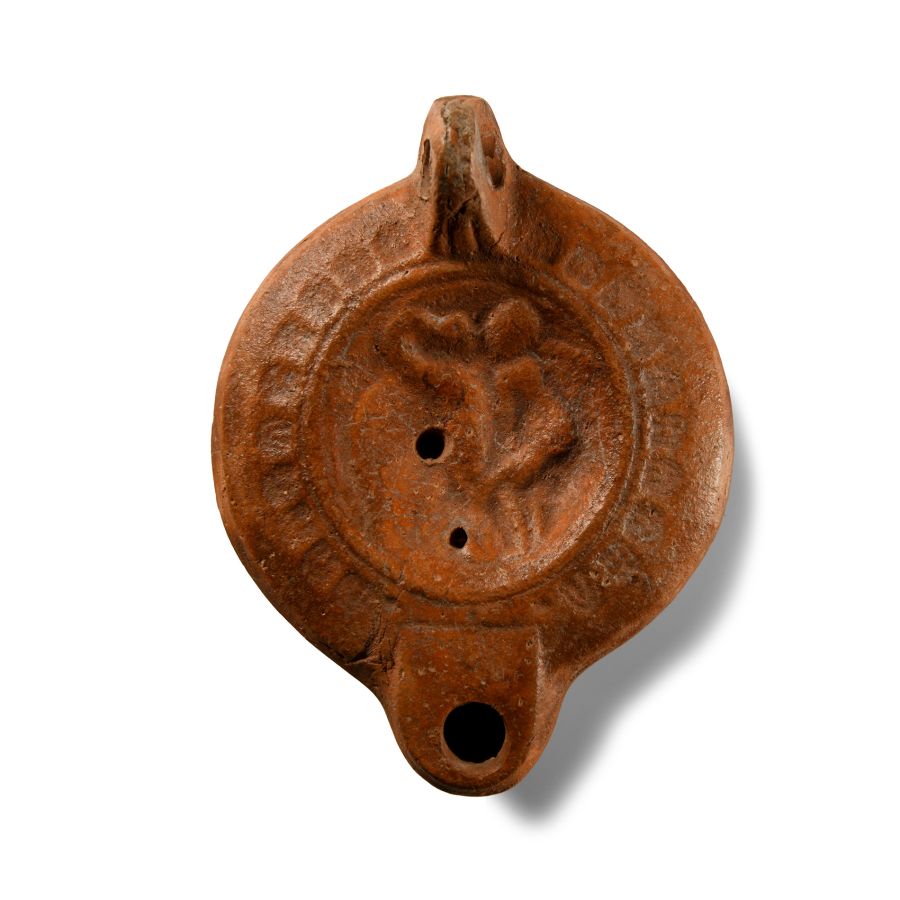
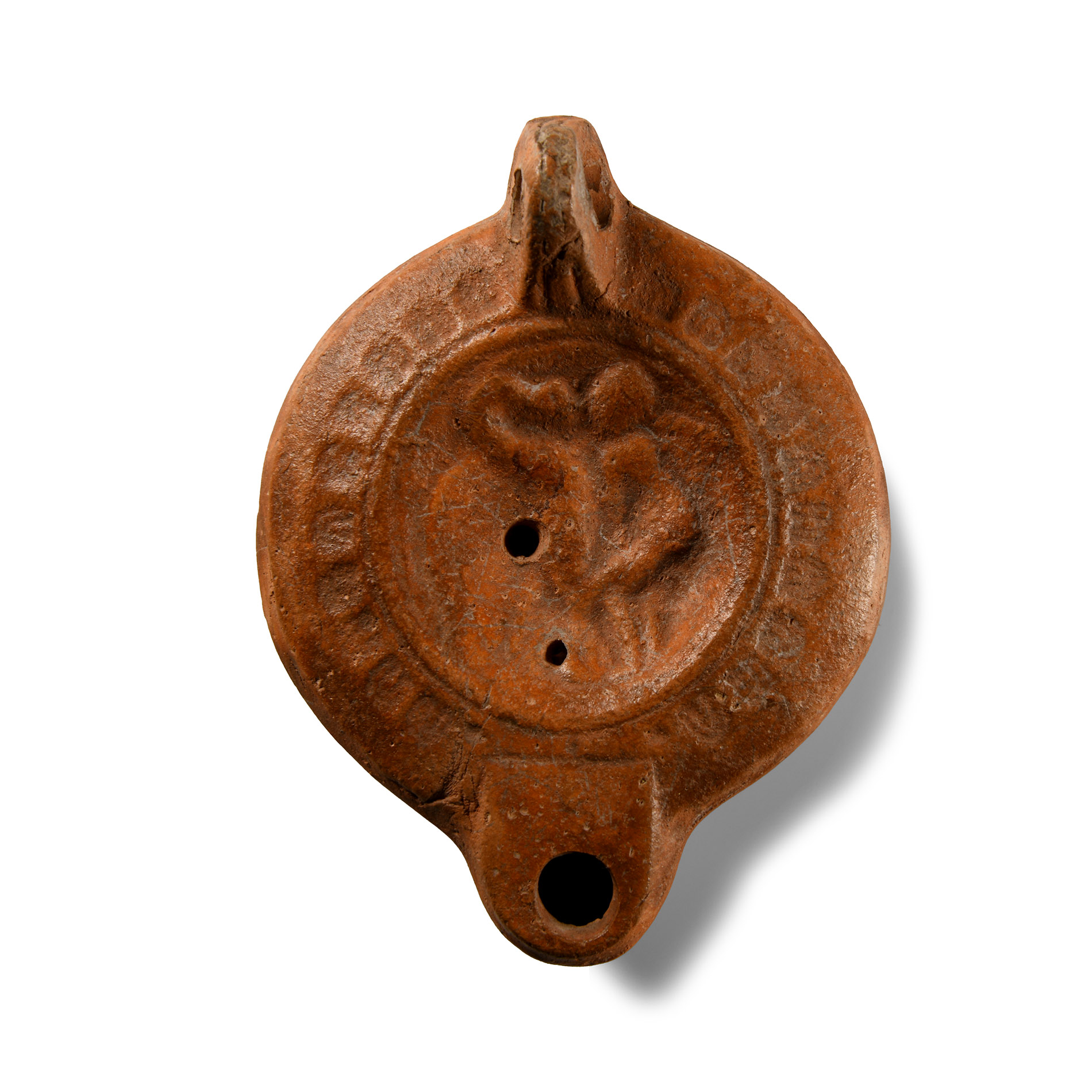
Roman Oil Lamp with Leda and The Swan
2ND CENTURY A.D.
4 in. (77 grams, 10.3 cm).
A Roman North African terracotta oil lamp with grooved ring handle; discus decorated with the mythological scene depicting Leda and the swan embracing.
ProvenanceDr Suzanne Gozlan, thence by descent.
Suzanne Gozlan (1921-2022), a doctor of History and Archaeology, served as a professor at the Ecole Normale d'Instituteurs de Chartres and lectured at the University of Paris 4 Sorbonne.
Property of a Bristol, UK, gentleman.
Cf. a similar lamp in Jean Bussiere and Birgitta Lindros Wohl, Ancient Lamps in the J. Paul Getty Museum, item 358.
FootnotesIn Greek mythology, Leda was the wife of King Tyndareus and queen of Sparta. According to the myth, Zeus, the king of the gods, was captivated by Leda's beauty and appeared before her in the form of a swan. He then either raped or seduced her and impregnated her. The same night, Leda slept with her husband who also impregnated her, as a result of these two unions she laid two eggs, each containing one set of twins. According to later Greek mythology Leda bore Helen (of Troy) and Polydeuces, children of Zeus, while at the same time bearing Castor and Clytemnestra, children of her husband.
CONDITIONTimeLine Auctions follows a vetting process to ensure the authenticity and legality of all items, reinforcing our commitment to integrity and responsible trading. Each antiquity, antique, and coin lot undergoes thorough examination by a vetting committee of at least ten external specialists, professional trade association members, scientists, and archaeologists: Our Vetting Process
AUCTIONS:
TimeLine is a leading auction house specialising in antiquities, ancient art, collectables, natural history, coins, medals, and books. Our auctions offer museums, collectors, historians, and enthusiasts the opportunity to acquire unique and historically significant pieces.
LOT 0846
Roman Oil Lamp with Leda and The Swan
Estimate £200 - 300€230 - 350 (for guidance only)$270 - 410 (for guidance only)
-
Roman Bronze Medical Implement with Inscription
1st-4th century A.D.Sold for (Inc. bp): £169
Comprising a pierced bulb finial and tapering shank with horizontal bands, ribbed median section and flat panel with perpendicular pierced disc finia; inscribed with Latin letters 'LV. HINT'. 25 grams, 84 mm
Acquired on the London, UK, art market in the 1990s. From a gentleman's private collection.
The fragment is possibly the upper part of a sharp pointed retractor, which was used for delicate operations on the tonsils and other internal parts of the body. The inscription probably refers to the name of the doctor, possibly LV[CIV]S HINT[IUS]. -
.jpg)
Roman Yellow Glass Flask
Circa 1st-2nd century A.D.Estimate: £1,800 - 2,400 (+bp*)
Opening Bid: £1,000
Mould-blown from translucent glass, the globular body on a circular flat base tapering at the shoulders to a cylindrical neck with an everted rim; a single applied handle; the body decorated with a horizontal band of a continuous Vitruvian wave framed by a double circumferential line, decorative ridges above and below; accompanied by a custom-made display stand. 16.7 grams, 66 mm (33.9 grams total, 79.4 mm high including stand)
From the property of the late Mr SM, London, UK, 1948-2000. Ex J.L. collection Surrey, UK. -
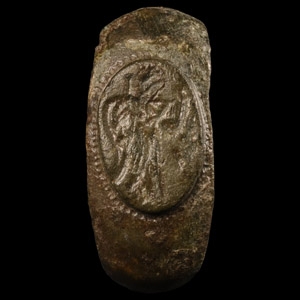
Roman Bronze Signet Ring with Victory
1st-3rd century A.D.Sold for (Inc. bp): £91
With raised plaque, incuse Victory standing robed. 4.78 grams, 23.84 mm overall, 19.84 mm internal diameter (approximate size British I 1/2, USA 4 1/2, Europe 8.07, Japan 7)
Ex German art market, 2000s. Acquired from an EU collector living in London. From the collection of Surrey, UK, gentleman.
