
Loading, please wait...
_900x900.jpg "Roman Mosaic with Pomegranate")
_200x200.jpg "Roman Mosaic with Pomegranate")
_900x900.jpg "Roman Mosaic with Pomegranate")
_200x200.jpg "Roman Mosaic with Pomegranate")
.jpg "Roman Mosaic with Pomegranate")
.jpg "Roman Mosaic with Pomegranate")
LOT 0147
Roman Mosaic with Pomegranate
4TH CENTURY A.D.
30 x 30 in. (26 kg, 76 x 76 cm).
Rectangular fragment with a central pomegranate motif on black background surrounded by a stylised dolphin or a fish; set in a modern matrix.
ProvenanceEmbedded in the floor of a reputable jewellery shop in Zurich, installed by the owner in the late 1970s to early 1980s.
with Galerie Rhéa, Zurich, Switzerland.
This lot has been checked against the Interpol Database of stolen works of art and is accompanied by a search certificate number no.12677-236415.
This lot has been cleared against the Art Loss Register database, and is accompanied by an illustrated lot declaration signed by the Head of the Antiquities Department, Dr Raffaele D'Amato.
TimeLine Auctions follows a vetting process to ensure the authenticity and legality of all items, reinforcing our commitment to integrity and responsible trading. Each antiquity, antique, and coin lot undergoes thorough examination by a vetting committee of at least ten external specialists, professional trade association members, scientists, and archaeologists: Our Vetting Process
AUCTIONS:
TimeLine is a leading auction house specialising in antiquities, ancient art, collectables, natural history, coins, medals, and books. Our auctions offer museums, collectors, historians, and enthusiasts the opportunity to acquire unique and historically significant pieces.
-
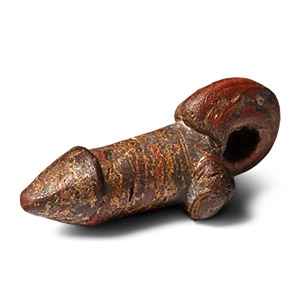
Roman Glass Phallic Pendant
1st-2nd century A.D.Sold for (Inc. bp): £1,235
In dark red glass with anatomical detailing, large suspension loop to the rear. 3.52 grams, 31 mm
with Sasu Boscher Encheres, 8 August 2022, no.228. with Galerie Rhéa, Zurich, Switzerland. This lot is accompanied by an illustrated lot declaration signed by the Head of the Antiquities Department, Dr Raffaele D'Amato. -
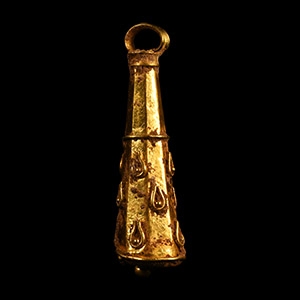
Roman Gold Herakles Club Pendant
Circa 2nd century A.D.Sold for (Inc. bp): £572
Comprising a conical sheet-gold body with applied collars to the lower end and centre, applied filigree and granule detailing. 1.65 grams, 26 mm
Acquired in the mid 1980s-1990s. Private collection, Switzerland, thence by descent. Private collection, since the late 1990s. This lot is accompanied by an illustrated lot declaration signed by the Head of the Antiquities Department, Dr Raffaele D'Amato. -
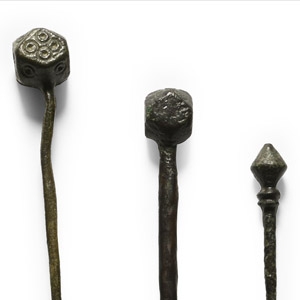
Roman Bronze Pin Group
1st-4th century A.D.Sold for (Inc. bp): £65
Including polyhedral types, one with punched-point detailing, and one biconical. 15.4 grams total, 74-92 mm
Ex German art market, 2000s. Acquired from an EU collector living in London. From the collection of a Surrey, UK, gentleman. This lot is accompanied by an illustrated lot declaration signed by the Head of the Antiquities Department, Dr Raffaele D’Amato. This lot is accompanied by an illustrated lot declaration signed by the Head of the Antiquities Department, Dr Raffaele D'Amato.
