
Loading, please wait...
_900x900.jpg "Roman Mosaic and Other Glass Necklace Bead Group")
_200x200.jpg "Roman Mosaic and Other Glass Necklace Bead Group")
.jpg "Roman Mosaic and Other Glass Necklace Bead Group")
LOT 0918
Roman Mosaic and Other Glass Necklace Bead Group
CIRCA 1ST-4TH CENTURY A.D.
1/4 - 1/2 in. (49 grams total, 7-13 mm).
Comprising thirty glass beads of various sizes, including mosaic beads and some with drawn decoration. [30]
ProvenanceUK gallery, early 2000s.
LiteratureCf. Eisen, G., ‘The Characteristics of eye beads from the Earliest Times to Present’ in American Journal of Archaeology, Second Series, Vol.XX (1916), pp.1-27, pl.1 and figs.58-62, for similar
FootnotesThe mass production of glass in Ancient Rome prompted the development of glass jewellery of unique qualities. The ancient Romans considered jewellery to be an essential accessory, being a public display of the wealth of high social classes. Recent excavations have provided better information on the use of glass beads for necklaces and bracelets, and in some case has been possible to understand the exact arrangement of a necklace or other jewellery made of glass. Many of the examples here presented belongs to the so-called category of ‘eye-beads’.
CONDITIONTimeLine Auctions follows a vetting process to ensure the authenticity and legality of all items, reinforcing our commitment to integrity and responsible trading. Each antiquity, antique, and coin lot undergoes thorough examination by a vetting committee of at least ten external specialists, professional trade association members, scientists, and archaeologists: Our Vetting Process
AUCTIONS:
TimeLine is a leading auction house specialising in antiquities, ancient art, collectables, natural history, coins, medals, and books. Our auctions offer museums, collectors, historians, and enthusiasts the opportunity to acquire unique and historically significant pieces.
-
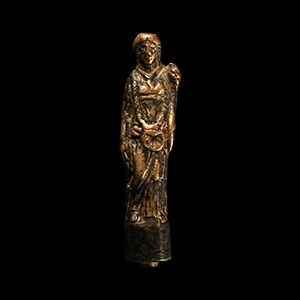
Romano-British Bronze Figural Knife Handle
2nd century A.D.Sold for (Inc. bp): £130
Standing female modelled in the round wearing a floor-length robe and a draped mantle; with scallop-shaped purse on a shoulder-strap, holding a cornucopia in the left hand; handle or finial with round block and peg beneath. 28.5 grams, 55 mm
Reportedly found in the Thames in the 1920s. Accompanied by a previous CNG catalogue information ticket. -
.jpg)
Roman Bronze Eagle Statuette
2nd-3rd century A.D.Sold for (Inc. bp): £468
Modelled in the round standing on a rectangular base, with head slightly turned, detailed plumage. 132 grams, 51 mm
From a collection acquired on the UK art market from various auction houses and collections mostly before 2000. From an important Cambridgeshire estate; thence by descent. -
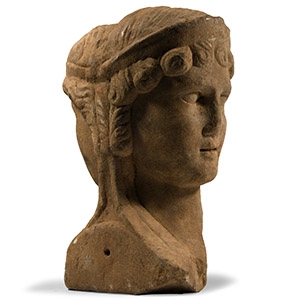
Roman Marble Janiform Herm Head of Ariadne and a Maenad
1st-2nd century A.D.Estimate: £20,000 - 30,000 (‡+bp*)
Opening Bid: £5,556
Carved architectural element depicting a double herm comprising: a diademed female bust with long wavy hair framing the face, slender features with small mouth and raised lids; the other side with a diademed female with hair arranged in neat curls on the forehead, large eyes and small mouth, taenia shown on each side of the neck; base reworked with drilled sockets for mounting. 12.6 kg, 29 cm high
Old collection, acquired in the 1970s. Acquired by inheritance from Mr N.S. Accompanied by an academic report by Dr Marina Mattei and Dr Laura Maria Vigna. This lot has been checked against the Interpol Database of stolen works of art and is accompanied by search certificate no.12084-211893.
The head with elaborately curled hair and diadem could represent Ariadne, as shown by comparisons with a fragment of a two-faced herm with bearded Dionysus and Ariadne preserved in the Antiquarium Ostiense, dated to the lmperial Roman age. The heads could be interpreted either as Ariadne and a Maenad, or as two Maenads being characterised by the diadem and long taeniae. The association of these figures with Dionysus is congruent with the typology of the herm, which refers to rural places and theatres. Numerous herms in fact attest that this type of sculpture was used in contexts linked to Dionysus and his sacred procession as well as, obviously, the representation of Ariadne, his female partner and double. The example fits into the class of domestic sculpture with a decorative function, mostly used to adorn peristyles and viridaria; the type placed at the crown of columns and pillars is quite documented, in particular in the version with the head of Dionysus contrasted with that of Ariadne or a Maenad.
