
Loading, please wait...
_900x900.jpg "Roman Maximian Terracotta Forger's Coin Mould")
_200x200.jpg "Roman Maximian Terracotta Forger's Coin Mould")
.jpg "Roman Maximian Terracotta Forger's Coin Mould")
LOT 0583
Roman Maximian Terracotta Forger's Coin Mould
CIRCA LATE 3RD CENTURY A.D.
1 in. (4.61 grams, 27 mm).
Terracotta disc with Maximian (280-305 A.D.) coin impression to each face from which to cast counterfeit coins. [No Reserve]
ProvenanceFrom the collection of a gentleman, acquired on the London art market in the 1990s.
This lot is accompanied by an illustrated lot declaration signed by the Head of the Antiquities Department, Dr Raffaele D'Amato.
TimeLine Auctions follows a vetting process to ensure the authenticity and legality of all items, reinforcing our commitment to integrity and responsible trading. Each antiquity, antique, and coin lot undergoes thorough examination by a vetting committee of at least ten external specialists, professional trade association members, scientists, and archaeologists: Our Vetting Process
AUCTIONS:
TimeLine is a leading auction house specialising in antiquities, ancient art, collectables, natural history, coins, medals, and books. Our auctions offer museums, collectors, historians, and enthusiasts the opportunity to acquire unique and historically significant pieces.
-
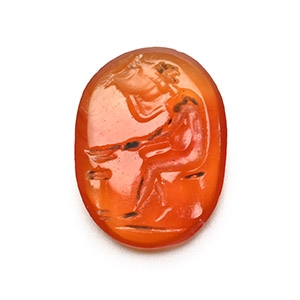
Roman Carnelian Intaglio with Vulcan
1st-century B.C.-1st century A.D.Estimate: £300 - 400 (‡+bp*)
Opening Bid: £150
Depicting a nude blacksmith seated on a stool before a forge, hammer in his right hand, holding an object he is hammering with the other hand. 0.25 grams, 10 mm
Private collection, North Germany. with Gorny & Mosch, 14 December 2005, no.238. Accompanied by a copy of an Art Loss Register certificate no.S00075379. This lot is accompanied by an illustrated lot declaration signed by the Head of the Antiquities Department, Dr Raffaele D’Amato. This lot is accompanied by an illustrated lot declaration signed by the Head of the Antiquities Department, Dr Raffaele D'Amato.
Probably a Roman copy of Hellenistic subject. Some Roman ring intaglios were dedicated to Vulcan (Greek Hephaestus), god of the blacksmiths, artisans, and carpenters. Usually the god is represented standing or working in his forge, wearing a wide brimmed hat and a one-shouldered tunic, identifying him as a craftsman. In his right hand he holds a hammer over an anvil, and in his left a pair of long metalworking tongs. Sometimes he is naked, seated and working. -
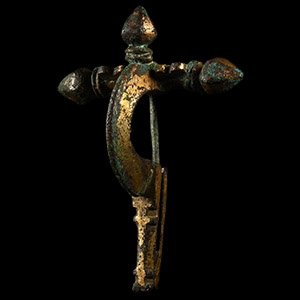
Large Roman Gilt Bronze Crossbow Brooch Type 2 with Pin
300-340 A.D.Sold for (Inc. bp): £286
With collared onion-knop finials, keeled deep bow and short chamfered foot; pin in situ. 56 grams, 86 mm
Acquired in Switzerland, 1997. Private collection, Europe. This lot is accompanied by an illustrated lot declaration signed by the Head of the Antiquities Department, Dr Raffaele D'Amato.
The typology of the so-called crossbow fibulae was used mainly among the military (militia armata), but was also employed by members of the ‘unarmed’ civil administration (militia non armata). They can be differentiated by their material of construction, which reflected the status of the wearer. The crossbow fibulae developed mainly between the end of the 3rd and the beginning of the 4th century A.D. Seven distinct types can be identified, based on size, decoration, material, etc. The more massive ones, usually in bronze, are usually pertinent to the 3rd and 4th centuries, and correspond to types 1 to 4 (here type 2). -
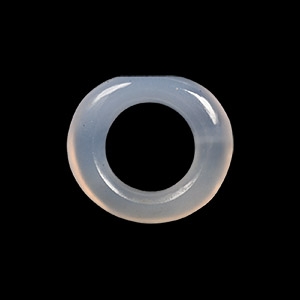
Roman Chalcedony Ring
1st century B.C.-1st century A.D. or laterSold for (Inc. bp): £124
Ellipsoid-shaped with carinated hoop on both inner and outer side. 3.95 grams, 25.55 mm overall, 13.70 mm internal diameter (approximate size British E 1/2, USA 2 1/2, Europe 3, Japan 3)
with H.A.C.A.G., Basel, prior 1999. This lot is accompanied by an illustrated lot declaration signed by the Head of the Antiquities Department, Dr Raffaele D’Amato. This lot is accompanied by an illustrated lot declaration signed by the Head of the Antiquities Department, Dr Raffaele D'Amato.
This ring, with a flat ellipsoid-shaped bezel, is related to type 2i of Roman rings from Gallia, which were usually considered as grave goods. Similar rings have often been found in Illyricum, Salonae, Zadar, Nin or Asseria.
