
Loading, please wait...
LOT 0154
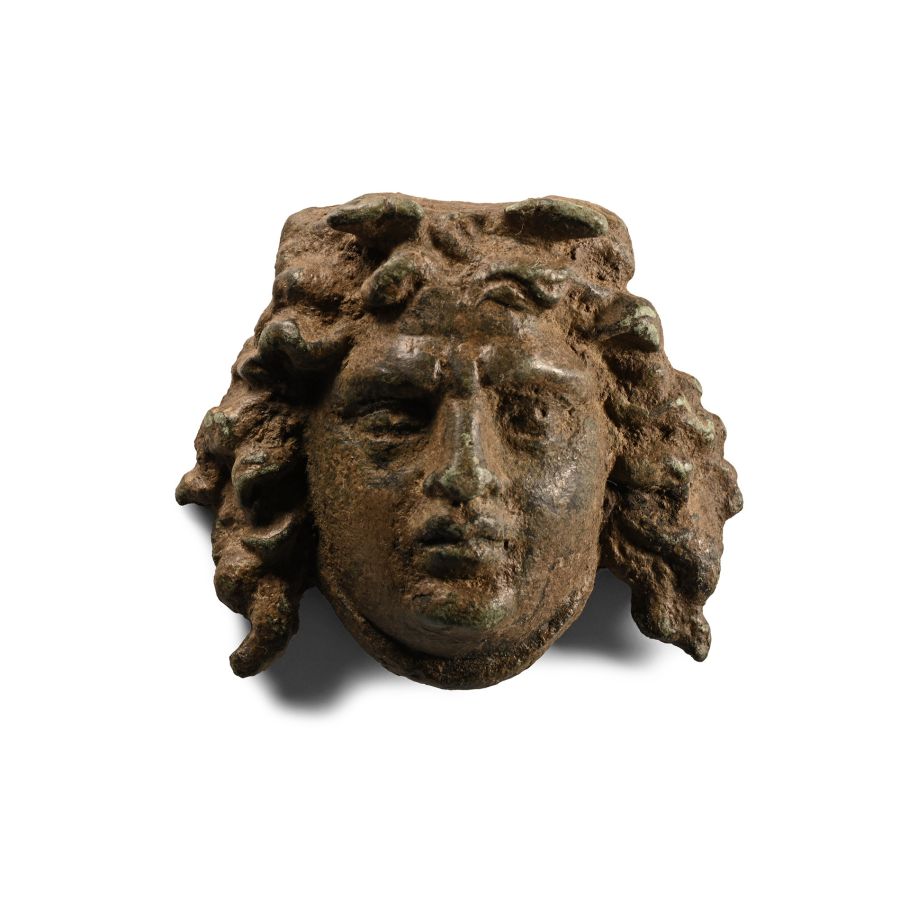
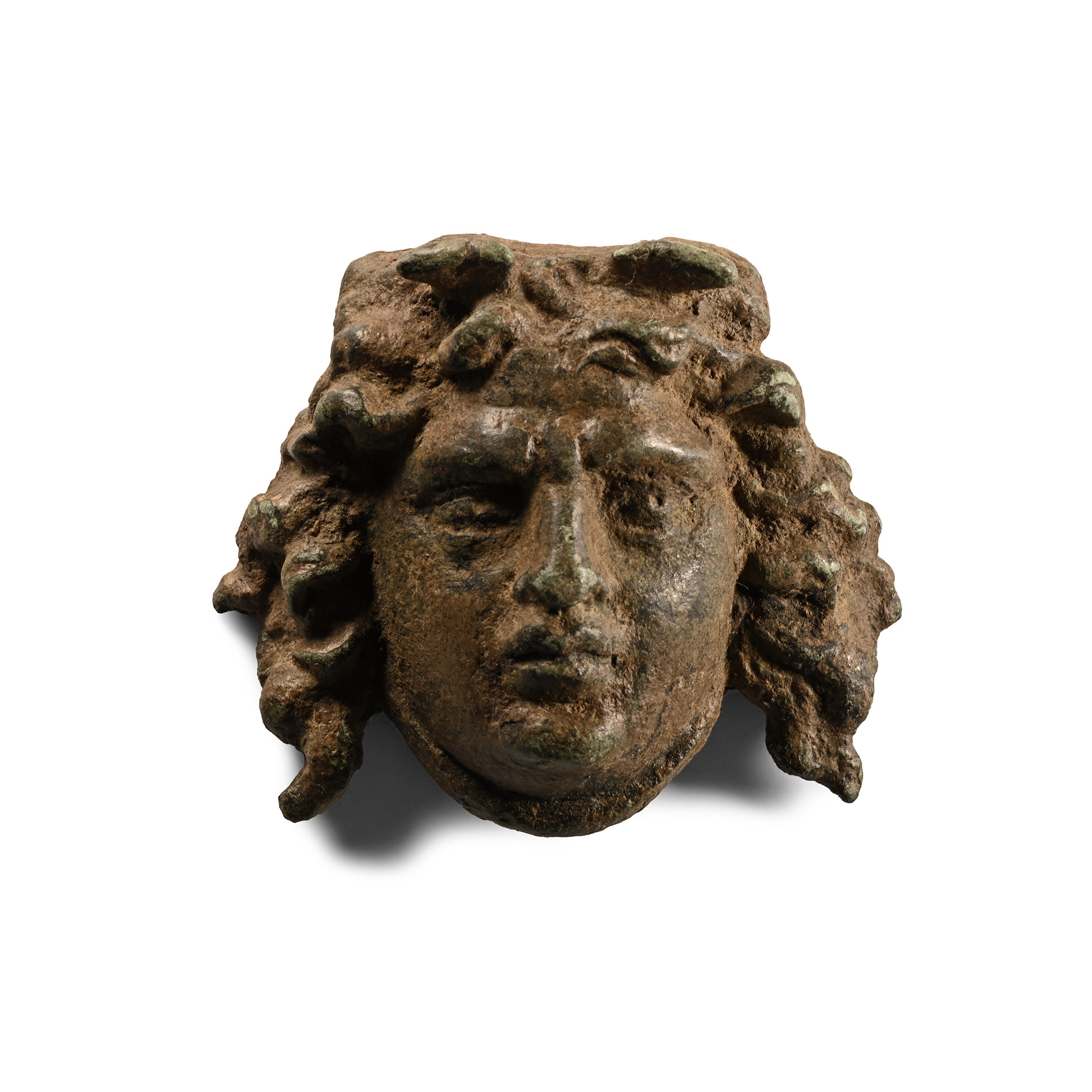
Roman Mask of Medusa
3RD CENTURY A.D.
2 3/8 in. (179 grams, 59 mm).
Modelled in the half-round, facing mask with lateral hanks of curly hair, two small wings above the brow, farme beneath the chin; slot to the reverse for attachment.
ProvenanceAcquired on the German art market, 2002.
European private collection.
Cf. similar item in the collection of the British Museum under accession no.1873,0520.1.
CONDITIONTimeLine Auctions follows a vetting process to ensure the authenticity and legality of all items, reinforcing our commitment to integrity and responsible trading. Each antiquity, antique, and coin lot undergoes thorough examination by a vetting committee of at least ten external specialists, professional trade association members, scientists, and archaeologists: Our Vetting Process
AUCTIONS:
TimeLine is a leading auction house specialising in antiquities, ancient art, collectables, natural history, coins, medals, and books. Our auctions offer museums, collectors, historians, and enthusiasts the opportunity to acquire unique and historically significant pieces.
LOT 0154
Roman Mask of Medusa
Estimate £1,000 - 1,400€1,160 - 1,620 (for guidance only)$1,350 - 1,890 (for guidance only)
-
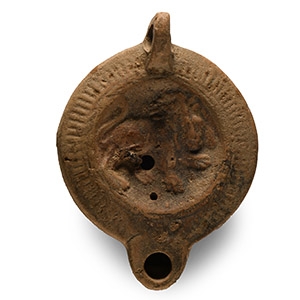
Roman Terracotta Oil Lamp with Lion
2nd-3rd century A.D.Sold for (Inc. bp): £208
Loop handle to the rear, low discus with an advancing lion with its head turned to the right, hatched decoration on the shoulder; concentric circles to the base. 108 grams, 11.2 cm
Acquired on the European art market, 1980s. English private collection.
This lamp belongs to the group of Provincial African lamps with a plain shoulder and a heart-shaped nozzle. Usually they are classified as D IX, but Italic and African variants of D X are very similar and have the shoulders with closely spaced outward-slanted rays, separated from discus by two circular grooves, here hardly visible. -
.jpg)
Roman Votive Hand to God Sabazios
2nd-3rd century A.D.Sold for (Inc. bp): £910
Hollow-formed right hand from a statuette, with fingers splayed and flat palm, good anatomical detailing. 362 grams, 12.1 cm
Private collection 1990s. Ex London, UK, gallery.
The votive character of the hand could link it to the God Sabazios, often associated with a number of archaeological finds depicting a bronze, right hand in the benedictio latina gesture. The hand appears to have had ritual significance and may have been affixed to a sceptre (as the one carried by Sabazios on a slab, one from Philippopolis, nowadays Plovdiv in Bulgaria). The association with Sabazios is sometimes suggested in similar hands, by the presence of a snake embossed around the circumference of the hand, because the iconic image of the god or hero on horseback battling the chthonic serpent, appears on Celtic-Roman votive columns, and with the coming of Christianity it was easily adapted to the representations of Saint George fighting the Dragon. -
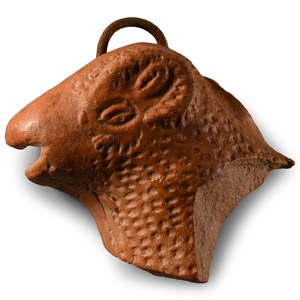
Roman Redware Ram Pottery Sherd
Circa 4th-5th century A.D.Sold for (Inc. bp): £39
Fragment of a terracotta votive statuette representing a ram, detail to the horns, ears and fleece; set with a suspension ring on the reverse. 50 grams, 77 mm wide
Acquired 1960s-1990s. From the late Alison Barker collection, a retired London barrister.
Many figurines of this type have been found in the Hellenised Roman provinces of the east and one identical in the Athenian Agora. They are all rendered with incisions that are characteristic of the technique of the late fourth century. Many similar examples were found in the Kerameikos and some are in the National Museum of Archaeology, Athens. A similar technique is observable in the plastic handles representing animal heads which occur on red pottery ornamented with white paint.
