
Loading, please wait...
LOT 0096
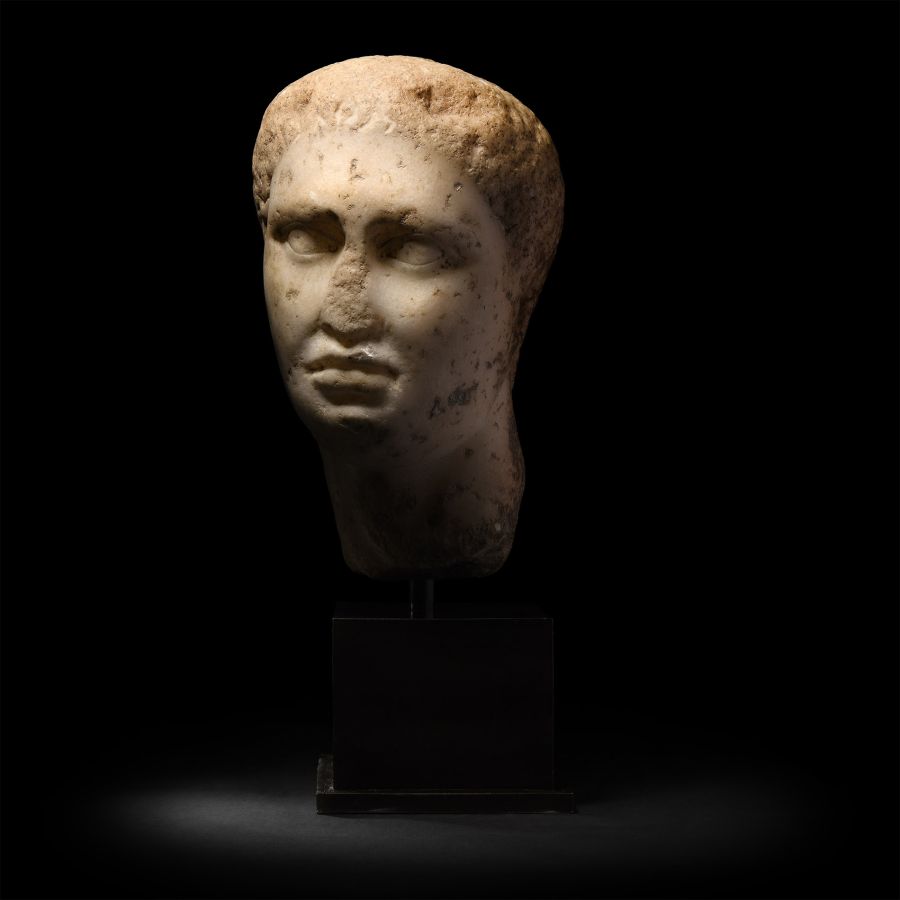
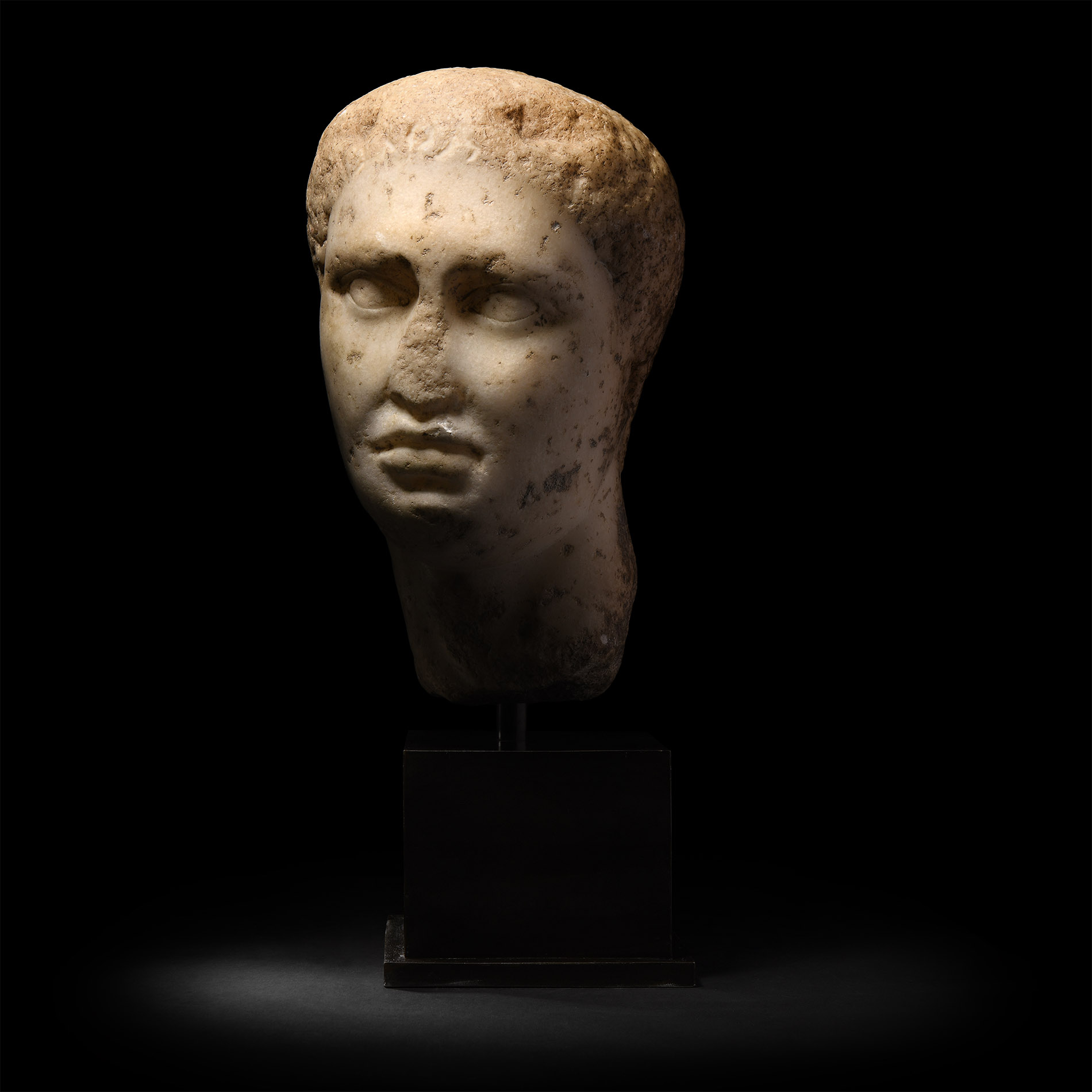
Roman Marble Statue Head
1ST CENTURY B.C.-1ST CENTURY A.D.
18 1/4 in. (17.8 kg total, 46 cm including stand).
A characteristic, rugged portrait with hairstyle typical of princes of the period, or of the god Hermes; the portrait representing a young man with a broad and flat face with a prominent forehead, naked brow, rounded eyelids and clearly defined lines around the eyes; detailed eyes and visible pupils, shallow eyebrows and pronounced lips; realistic hair arranged in locks on the forehead and ending with a precise line at the base of the neck; a recess to each side of the head for attachment of ears or possibly of headgear; mounted on a custom-made display stand.
ProvenanceFrench collection, 1990s-early 2000s.
Previously with Hampel Fine Art, Munich, Germany.
with Vermot & Associés, Paris, 7 October 2017, lot 90 (65,000-70,000 Euros).
From an important Paris gallery, France.
Ex private Parisian collection.
Accompanied by an academic report by Dr Raffaele D'Amato.
Accompanied by scholarly note TL05450 by Dr Ronald Bonewitz.
This lot has been checked against the Interpol Database of stolen works of art and is accompanied by search certificate no.114500-194057.
See Bianchi Bandinelli, R., L'arte Romana nel centro del potere, dalle origini alla fine del II secolo d.C., Roma, 1969; Scrinari, V. S. M., Sculture Romane di Aquileia, Roma, 1972; Agnoli, N., Museo Archeologico Nazionale di Palestrina, Le sculture, Roma, 2002; Goddio, F., Fabre, D., Egitto, Tesori Sommersi, Moncalieri, 2009; Gagarin, M., Fantham, E., The Oxford Encyclopedia of Ancient Greece and Rome volume I, Oxford, 2010.
FootnotesThe face is that of a young subject, portrayed in a naturalistic way, with the intention to represent a king or a young Ptolemaic prince. The absent nose and the worn surface make it difficult to completely understand the physiognomy, although the prolonged lines of the eyes, extending to the corners, reveals a characteristic Egyptian trait. The representation of hair is not Egyptian, however, but appears in many Ptolemaic and Roman statues with Greek features. A parallel can be found in the colossal head recovered from the sea in the harbour of Alexandria (Goddio, Fabre, 2009, fig.20).
CONDITIONTimeLine Auctions follows a vetting process to ensure the authenticity and legality of all items, reinforcing our commitment to integrity and responsible trading. Each antiquity, antique, and coin lot undergoes thorough examination by a vetting committee of at least ten external specialists, professional trade association members, scientists, and archaeologists: Our Vetting Process
AUCTIONS:
TimeLine is a leading auction house specialising in antiquities, ancient art, collectables, natural history, coins, medals, and books. Our auctions offer museums, collectors, historians, and enthusiasts the opportunity to acquire unique and historically significant pieces.

2nd-4th century A.D.
Lot No. 0669
Sold for (Inc. premium): £208

Early 1st-2nd millennium A.D.
Lot No. 0705
Sold for (Inc. premium): £98
1st century B.C.-1st century A.D.
Lot No. 0097
Sold for (Inc. premium): £3,380
