
Auction Highlights
-
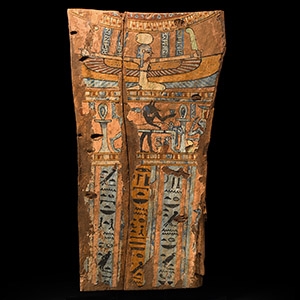
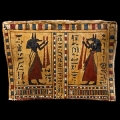
Egyptian Wooden Coffin Panel with Anubis
Sold for (Inc. bp): £5,200
A substantial polychrome painted wooden coffin panel in two parts, from the chest down to the lower legs: the upper portion gesso-painted preserving the outer edge of a decorative collar; a kneeling winged goddess below, most likely Nut, grasping a feather of truth in each hand and wearing a solar disc upon her head, four short vertical columns containing meaningless hieroglyphic inscriptions on a blue background above; the register below showing the deceased in diamond-pattern wrappings, lying on an elaborately detailed leonine bed, attended by the standing figure of Anubis anointing his wrappings; two hawk-headed canopic jars beneath the bed, two more were probably shown on the left; the bed flanked by two composite ankh/djed symbols flanked by short columns of meaningless hieroglyphic inscription on a blue background; behind each of these groups a kneeling goddess in a gesture of mourning: Nephthys largely preserved on the right and traces of the other (possibly Isis) to the left; three vertical columns of hieroglyphs below, the outer two on blue background and the central one in yellow, a rearing cobra facing the right column; mounted on a custom-made display stand. -
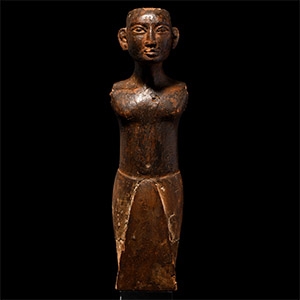
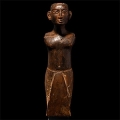
Large Egyptian Wooden Dignitary Figure
Sold for (Inc. bp): £6,240
A finely modelled wooden figure of a high official carved in the round, standing facing, with a bald head, naturalistic albeit idealised facial features, wearing a skin-tight civil kilt with large front panel; remains of sockets for the figure's arms (now absent); remains of polychrome pigment; accompanied by a custom-made display base. -
.jpg)
Egyptian Scarab with Cartouche of Tutankhamun
Sold for (Inc. bp): £5,460
A carnelian scarab with naturalistic detailing to the carapace, head and legs; the underside bearing a cartouche containing the throne name of Tutankhamun, Nebkheperure (which translates as ‘Lord of manifestations is Re’); drilled for suspension. -
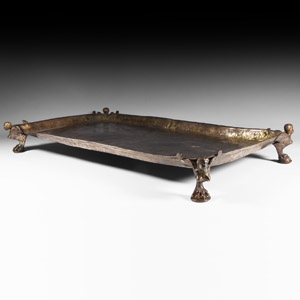
Hellenistic Silver Salver with Sphinxes
Sold for (Inc. bp): £19,500
A rare and important shallow rectangular tray with incised palmettes to the corners, arcaded band to the inner face of the flanged border, narrow parcel-gilt band to the outer face of the upstand; separately cast sphinxes with lion-paw foot to each corner, wings outspread supporting each corner of the tray. -
.jpg)
Substantial Roman Statue of a Nude Boy
Sold for (Inc. bp): £45,500
A very fine figure of a nude putto; naturalistic head and body with soft, childlike features; the left leg slightly forward; the right arm resting, left arm raised with the hand open; the face is worked with great care, with large pupils showing the cavities in which the original stone or glass eyes were inserted; the hair with blocks of curls in a short but dense hairstyle composed of thick short locks, with some in tight curls and others in S-shaped waves, suggesting a natural hairstyle similar to those frequently found in portraits of Roman children. -
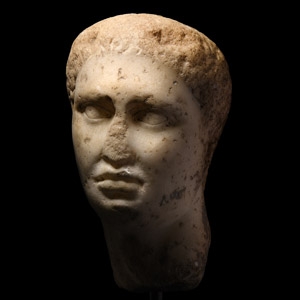
Roman Marble Statue Head
Sold for (Inc. bp): £4,940
A characteristic, rugged portrait with hairstyle typical of princes of the period, or of the god Hermes; the portrait representing a young man with a broad and flat face with a prominent forehead, naked brow, rounded eyelids and clearly defined lines around the eyes; detailed eyes and visible pupils, shallow eyebrows and pronounced lips; realistic hair arranged in locks on the forehead and ending with a precise line at the base of the neck; a recess to each side of the head for attachment of ears or possibly of headgear; mounted on a custom-made display stand. -
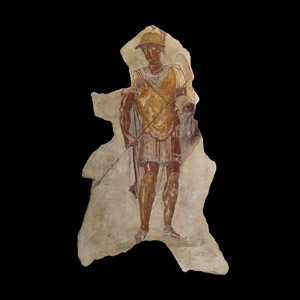
Roman Fresco of a Military Commander
Sold for (Inc. bp): £16,250
An imposing fresco fragment representing a young military commander dressed in high rank Roman uniform, standing with his face slightly turned to the right and leaning on his left leg, the right leg brought slightly forward; the right hand holding a long spear of which the butt is visible, a round flat shield of cavalry type (parma) on his left arm; gladius hanging from a baldric on the left side of the body; the warrior wearing a short sleeveless tunic of Greek type, off-white in colour with light red reflexes, decorated by two white segments in the lower skirt, and a military cloak of cerulean colour, arranged over a muscled bronze torso armour; the legs protected by bronze greaves and head by a bronze helmet restored as an Italic type Buggenum surmounted by a white cylinder from which a horsehair crest emerges, some restoration; mounted. -
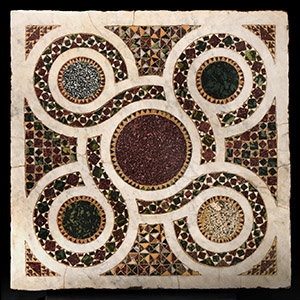
Byzantine Cosmatesque Mosaic Panel
Sold for (Inc. bp): £16,900
A rectangular marble floor panel recalling similar workmanship to the floor of the Sistine Chapel, comprising a large central circular panel in porphyry, within a border composed of small triangles, the larger motif ornamented with rhomboid and triangular elements in green and porphyry; each spiral centre enclosed by a circular panel in different coloured stone; the composition framed by pelta-shaped panels set with triangular and rhomboid stones, a small triangle to each corner; accompanied by a custom-made display stand. -
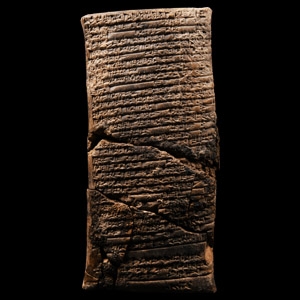
Old Babylonian Cuneiform Tablet, a Letter from Iluni King of Ešnunna to Warassa King of Dêr
Sold for (Inc. bp): £7,150
A large pillow-shaped ceramic tablet of biconvex cross-section, columns of cuneiform text to both broad faces and two edges, a letter from Iluni king of Ešnunna to Warassa king of Dêr who reigned at the end of the 18th century B.C., the document is a duplicate preserved in Ešnunna as indicated by the mention of the name of the messengers in charge of transporting the document to Dêr and the date at the end, the message itself has 64 lines, Iluni begins with the usual greetings invoking Tišpak, the god of the city of Ešnunna: 'May the Sun god and Tišpak keep you in good health forever!', the continuation is less usual: 'I kissed the (consecrated) flour of Ištaran that you made me carry and as I prayed for my life, I prayed for your life, etc.', the relationship between Dêr and Ešnunna was thus excellent, Iluni addresses three different topics; initially, he justifies the delay which he took to send to Dêr a troop that Warassa requires of him: an Elamite embassy occurred in Ešnunna, Iluni underlines how much the interests of Dêr depend on those of his city; the second subject concerns a group of inhabitants of Dêr who were arrested at the border of Ešnunna, Iluni blames them for not going to greet him; lastly, Iluni tackles a question of international diplomacy which touches the relationship between Ešnunna, Dêr, Elam and 'the troop of the Sea' a reference to a new political force which was constituted in the south of Mesopotamia, it is in this context that Iluni announces that he wrote to the Elamite Kukannašur, better known as Kuknašur (II?), which makes it possible to establish a new synchronism between Mesopotamian history and that of Elam. -
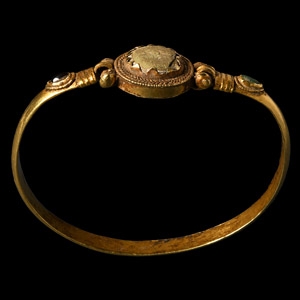
Sarmatian Gold Bracelet with Gemstones
Sold for (Inc. bp): £7,800
A gold bracelet composed of a D-section hoop terminating in corrugated sleeves, the oval setting hinged to the looped ends; one hinge permanently secured, while the other can be opened by removing a pin, allowing the bracelet to be sprung and slipped over the wrist; one side adorned with a teardrop-shaped garnet, the other set with a teardrop-shaped green glass stone in a raised cell; the box setting holding a composition stone held in place by a serrated flange, bordered by strip-twist and herringbone wiring. -
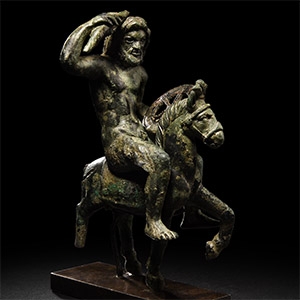
Gallo-Roman Statuette of God Taranis on Horseback
Sold for (Inc. bp): £32,500
A bronze figure of the god Taranis, naked on horseback; the god shown youthful and muscular with centre-parted hair and neat beard, his right arm bent and hand clutching a thunderbolt, left hand extended holding the reins(?) of the horse, legs spread to sit comfortably on the back of his steed; the horse in an advancing pose with one foreleg raised, mouth pierced to accept separate reins; bridle with plume between the pricked ears, swept mane; saddlecloth with raised border on its back, rectangular slot above the horse's rump; bronze model wheel with six short spokes, ribbed detailing to both faces; the figure and horse modelled separately but found as one complex; mounted on a custom-made stand. -
.jpg)
'Museum Displayed' Anglo-Scandinavian Viking 'The Brinton' Gold Bracteate
Sold for (Inc. bp): £8,450
A sheet-gold bracteate of hybrid type A / C with repoussé design depicting a large profile male head with elaborate hairstyle terminating in a bird's head placed above a quadruped with legs extended and a partial row of pellets, all enclosed within a border of stamped 'horseshoe' motifs; applied beaded wire rim; loop lost in antiquity. -
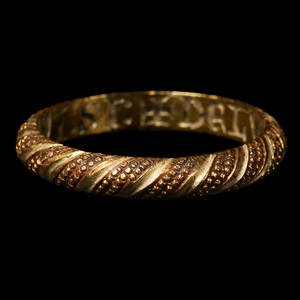
'The Breamore House' Medieval Bi-Gold 'Think Of Him By Whom I Am Here' Posy Ring
Sold for (Inc. bp): £5,460
A gold posy ring composed of a D-section band, the external face decorated with spiralling double-beaded rose gold bands alternating with recessed pale gold bands; the interior bearing an Anglo-French inscription in Lombardic script: '+DE LVI:PENSEZ.PAR.KI SVI:SI:' for 'Think of Him by whom I am here', with traces of black niello inlay. -
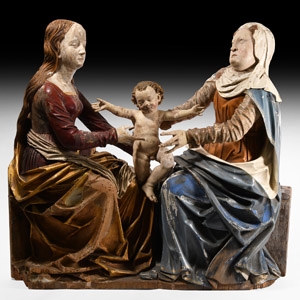
Large Medieval Virgin and Child with Saint Anne from the Workshop of Niklaus Weckmann
Sold for (Inc. bp): £4,940
A carved limewood scene of the Virgin Mary, infant Jesus and Saint Anne from the workshop of Niklaus Weckmann; to the left, Virgin Mary seated wearing a long crimson robe with a gold mantle around her shoulders and hips, and a white band disappearing beneath her copious auburn hair; Saint Anne seated to the right, wearing a white veil and wimple with yellow linear detailing, russet-tan robe over a cream-white undershift visible at the sleeves, sky-blue mantle wrapped around her lower body; infant Jesus naked standing between the two females in lively pose with arms spread wide. -
.jpg)
Medieval Limewood Figure of St John from the Workshop of Tilman Riemenschneider
Sold for (Inc. bp): £7,800
A carved limewood figure of St John from the workshop of Tilman Riemenschneider in Würzburg, Germany; the saint standing with his head slightly tilted, a mop of curled hair surrounding his doleful face; a long mantle draped over his sleeved tunic, his bare feet placed on a knoll with textured grass and stones; holding a Gospel in his left hand. -
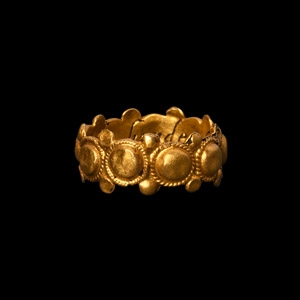
'The Brookland' Late Tudor 'Love is the Bond of Peace' Gold Posy Ring
Sold for (Inc. bp): £5,460
A late Tudor or Stuart solid gold finger ring formed as a band of bosses each with a beaded collar and smaller interstitial bosses flanking the junction with each neighbour; to the inner face, the legend engraved in a florid italic hand 'Love is the bonde of peace' with flourish on the final 'e'.
Ptolemaic Period, 332-31 B.C.
Lot No. 0001
Sold for (Inc. premium): £2,860

Ptolemaic Period, 332-31 B.C.
Lot No. 0002
Sold for (Inc. premium): £1,430

Roman Period, c.30 B.C.-3rd century A.D.
Lot No. 0003
Sold for (Inc. premium): £5,200
Middle Kingdom, 2023-1862 B.C.
Lot No. 0004
Sold for (Inc. premium): £4,680

Late Period-Roman Period, 664 B.C.-323 A.D.
Lot No. 0005
Sold for (Inc. premium): £1,170
New Kingdom, 1550-1070 B.C.
Lot No. 0006
Sold for (Inc. premium): £6,240
.jpg&width=120)
Late Period-Ptolemaic Period, 664-30 B.C.
Lot No. 0007
Sold for (Inc. premium): £4,160

Late Period, 664-525 B.C.
Lot No. 0009
Sold for (Inc. premium): £845

Late Period-Ptolemaic Period, 664-30 B.C.
Lot No. 0010
Sold for (Inc. premium): £91

New Kingdom-early Third Intermediate Period, circa 1550-1069 B.C.
Lot No. 0012
Sold for (Inc. premium): £7,930
.jpg&width=120)
18th Dynasty, 1335-1325 B.C.
Lot No. 0013
Sold for (Inc. premium): £5,460
.jpg&width=120)
Late Middle Kingdom, 2055-1650 B.C.
Lot No. 0017
Sold for (Inc. premium): £491
