
Loading, please wait...
_900x900.jpg "Roman Marble Portrait of a Boy as Worshipper of Isis")
_200x200.jpg "Roman Marble Portrait of a Boy as Worshipper of Isis")


.jpg "Roman Marble Portrait of a Boy as Worshipper of Isis")
LOT 0117
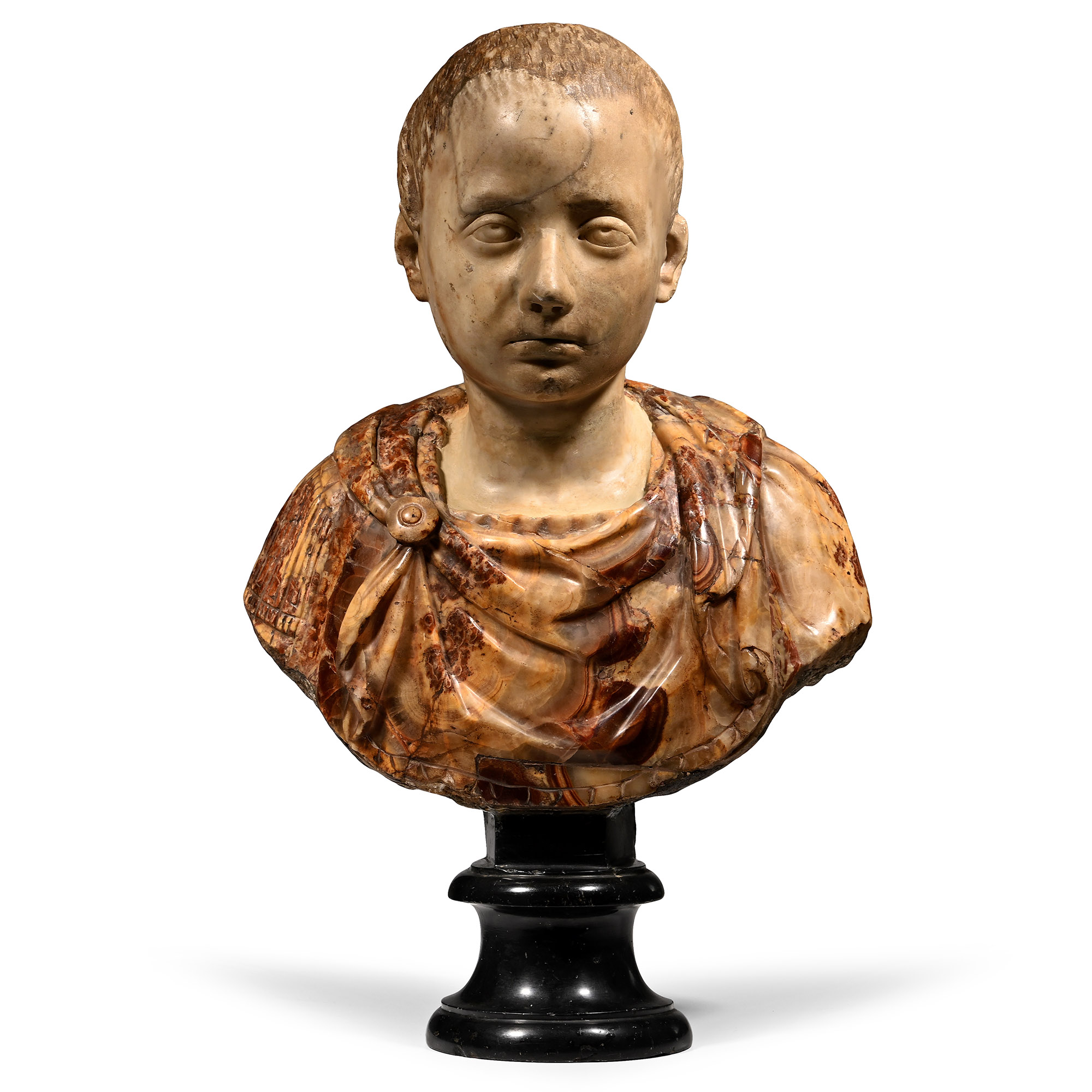
Roman Marble Portrait of a Boy as Worshipper of Isis
EARLY 3RD CENTURY A.D.
20 1/4 in. (19.6 kg total, 51.5 cm including stand).
Carved head of a prepubescent worshipper of Isis, with soft facial features, long nose, small downturned mouth, heavy-lidded eyes, the whole giving the face a sombre or mournful appearance; the hair textured to indicate a short cut and combed forward across the scalp, sidelock above the right ear; mounted on a 16th century carved breccia upper body with leather cuirass and pteruges to right shoulder, cloak draped across the shoulders and fastened at the clavicle on the right side with a disc-brooch; socle base; some restoration.
ProvenanceNorth German private collection, 1970s, and thence by descent.
Antiquities, Bonhams, London, 5 October 2011, no.136.
Accompanied by an academic report by Dr Raffaele D’Amato.
This lot has been checked against the Interpol Database of stolen works of art and is accompanied by search certificate number no.12185-222445.
Exhibited at the Museum für Kunst und Gewerbe, Hamburg, 21 January-6 March 1977; published in Hornbostel, W., Kunst der Antike, Schätze aus norddeutschem Privatbesitz, Hamburg, 1977, pp. 55-56, no. 35.
LiteratureSee Bianchi Bandinelli, R., Roma, la fine dell’arte antica, Milano, 1970, fig.55, for Roman sculpture of the period; for another portrait head of a boy with short hair and sidelock, also dating to the 3rd century A.D. in Petworth House, Sig.Wyndham, Petworth, and for a discussion of the Horus lock in imperial iconography, see Gonzenbach, V., ‘Untersuchungen zu den Knabenweihen im Isiskult der römischen Kaiserzeit‘, in Antiquitas 1. 4, Bonn, 1957, pp.105-128, and 139ff., K.8 pl.9; Raeder, J., Die antiken Skulpturen in Petworth House, MAR 28 (2000), 216 ff. Kat. Nr. 83 [Arachne Sculpture Database no.1084685]; for related example of hairstyle in the British Museum see Walker, S. & Bierbrier, M., Ancient Faces. Mummy Portraits from Roman Egypt, London, 1997, pp.192-193, no.261; for ancient sculptures reproduced or inserted in Renaissance marble see Fittschen, K., ‘Sul ruolo del ritratto antico nell’arte italiana’ in Setis, S., Memoria dell’antico nell’arte italiana, ed., vol.II, Turin, 1985; Favaretto, I., ‘La fortuna del ritratto antico nelle collezione venete di antichità: originali, copie e invenzione,’ in Bolletino d’Arte LXXVIII, no.79, May-June, 1993, pp.68-72; Bava, A.M., Le Meraviglie del mondo, le collezioni di Carlo Emanuele I di Savoia, Genova, 2016, p.233, fig.86.
FootnotesThe child is depicted as a worshipper of Isis with the right side of the head signalling that the boy was a devotee of the goddess’s cult. The head of the boy is probably a funerary portrait, and it is clearly in the first half of 3rd century style. Its resemblance to the portrait of Gordian III on the so-called sarcophagus of Acilia is impressive, so much so that this was probably the reason for which the head was incorporated within a military bust in the 16th century.
CONDITIONTimeLine Auctions follows a vetting process to ensure the authenticity and legality of all items, reinforcing our commitment to integrity and responsible trading. Each antiquity, antique, and coin lot undergoes thorough examination by a vetting committee of at least ten external specialists, professional trade association members, scientists, and archaeologists: Our Vetting Process
AUCTIONS:
TimeLine is a leading auction house specialising in antiquities, ancient art, collectables, natural history, coins, medals, and books. Our auctions offer museums, collectors, historians, and enthusiasts the opportunity to acquire unique and historically significant pieces.
LOT 0117
Roman Marble Portrait of a Boy as Worshipper of Isis
Sold for (Inc. bp): £17,550
-
Roman Bronze Eros Statuette
2nd-3rd century A.D.Estimate: £400 - 600 (+bp*)
Opening Bid: £200
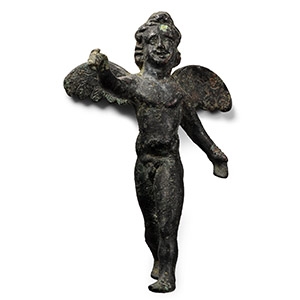
Modelled in the round, nude, striding forwards with his wings spread, his right hand reaching out to grasp a bow (absent), and left hand extending to the rear; feather detailing to the wings, piled hairstyle. 76 grams, 76 mm
Ex German art market, 2000s. Acquired from an EU collector living in London. From the collection of Surrey, UK, gentleman. -
Roman Gilt Bronze Phalera with Theseus and the Minotaur
2nd century B.C.- 2nd century A.D.Sold for (Inc. bp): £182
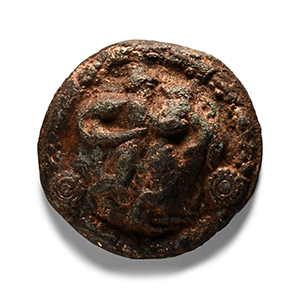
Domed roundel with high-relief design of combat between a bearded hero and a monster, wreath and rosettes to the rim. 32 grams, 49 mm
Found near Sedgeford, Norfolk, UK, in the 1980s. Acquired in the late 1990s. Property of a Norfolk, UK, collector.
According to the legend, Theseus, prince of Athens, went to the island of Crete to kill a monster who was the son of queen Pasiphae and a wild bull, although officially he was the son of Minos and Pasiphae. Theseus chased him into the labyrinth, killed him and found his way out with the help of the comb of Ariadne, daughter of King Minos. The myth has its representation in the Archaic, Classical and Hellenistic period, and was widely depicted in the Graeco-Roman world. The present repoussé appliqué was probably used as a furniture or horse harness ornament. -
.jpg)
Roman Bronze Dolphin Brooch
Circa 2nd century A.D.Sold for (Inc. bp): £26
With deep curved bow, dorsal fin to the apex and fantail footplate, hinged pin. 7.89 grams, 36 mm
Property of the vendor's grandfather, thence by family descent, circa 1985. From the private collection of a New York, USA gentleman.
