
Loading, please wait...
_900x900.jpg "Roman Marble Panther Protome Fragment")
_200x200.jpg "Roman Marble Panther Protome Fragment")
_900x900.jpg "Roman Marble Panther Protome Fragment")
_200x200.jpg "Roman Marble Panther Protome Fragment")
_900x900.jpg "Roman Marble Panther Protome Fragment")
_200x200.jpg "Roman Marble Panther Protome Fragment")
.jpg "Roman Marble Panther Protome Fragment")
.jpg "Roman Marble Panther Protome Fragment")
.jpg "Roman Marble Panther Protome Fragment")
LOT 0134
Roman Marble Panther Protome Fragment
1ST CENTURY A.D.
5 7/8 in. (758 grams total, 15 cm high including stand).
Sculpted as a panther with head turned on its long muscular neck, mouth open and teeth bared; highly polished finish; mounted on a custom-made stand.
ProvenancePreviously acquired from a USA collection, 1980s.
Ex private German collection.
This lot has been checked against the Interpol Database of stolen works of art and is accompanied by search certificate no.12082-213586.
TimeLine Auctions follows a vetting process to ensure the authenticity and legality of all items, reinforcing our commitment to integrity and responsible trading. Each antiquity, antique, and coin lot undergoes thorough examination by a vetting committee of at least ten external specialists, professional trade association members, scientists, and archaeologists: Our Vetting Process
AUCTIONS:
TimeLine is a leading auction house specialising in antiquities, ancient art, collectables, natural history, coins, medals, and books. Our auctions offer museums, collectors, historians, and enthusiasts the opportunity to acquire unique and historically significant pieces.
-
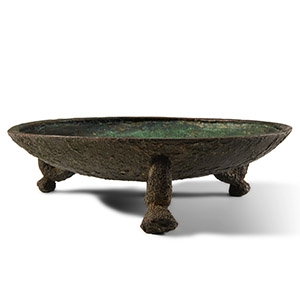
Roman Bronze Tripod Offering Dish
Circa 1st-3rd century A.D.Sold for (Inc. bp): £338
Broad dish with carinated rim, three legs to the underside, each a C-shaped shank with a bun foot. 681 grams, 17.5 cm
From a collection acquired on the UK art market from various auction houses and collections mostly before 2000. From an important Cambridgeshire estate; thence by descent. -
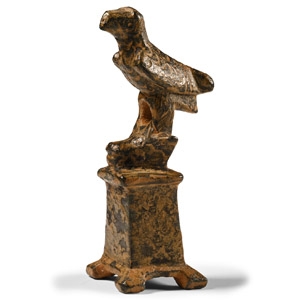
Roman Bronze Eagle on Bull's Head Statuette
2nd-3rd century A.D.Sold for (Inc. bp): £169
Comprising an altar with a severed head of a bull on the top and an eagle perching on it; hollow to the underside, four stub feet to the angles. 46.4 grams, 58 mm
From a collection acquired on the UK art market from various auction houses and collections mostly before 2000. From an important Cambridgeshire estate; thence by descent.
The image of an eagle on the severed head of a bull was probably connected with the cult of Jupiter Dolichenus. -
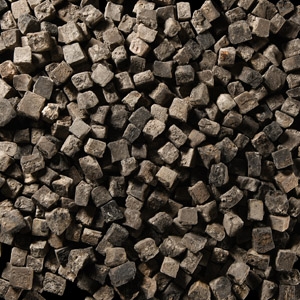
Roman Stone Tesserae Group
1st-4th century A.D.Sold for (Inc. bp): £130
A mixed group of four hundred and thirty single stone tesserae of various colours and sizes. 830 grams total, 10-17 mm
From a collection acquired on the UK art market from various auction houses and collections mostly before 2000. From an important Cambridgeshire estate; thence by descent.
