Loading, please wait...

Roman Marble Mortar with Pestle Roman Marble Mortar with Pestle Roman Marble Mortar with Pestle
Use mousewheel to zoom in and out, click to enlarge
Details

LOT 0105

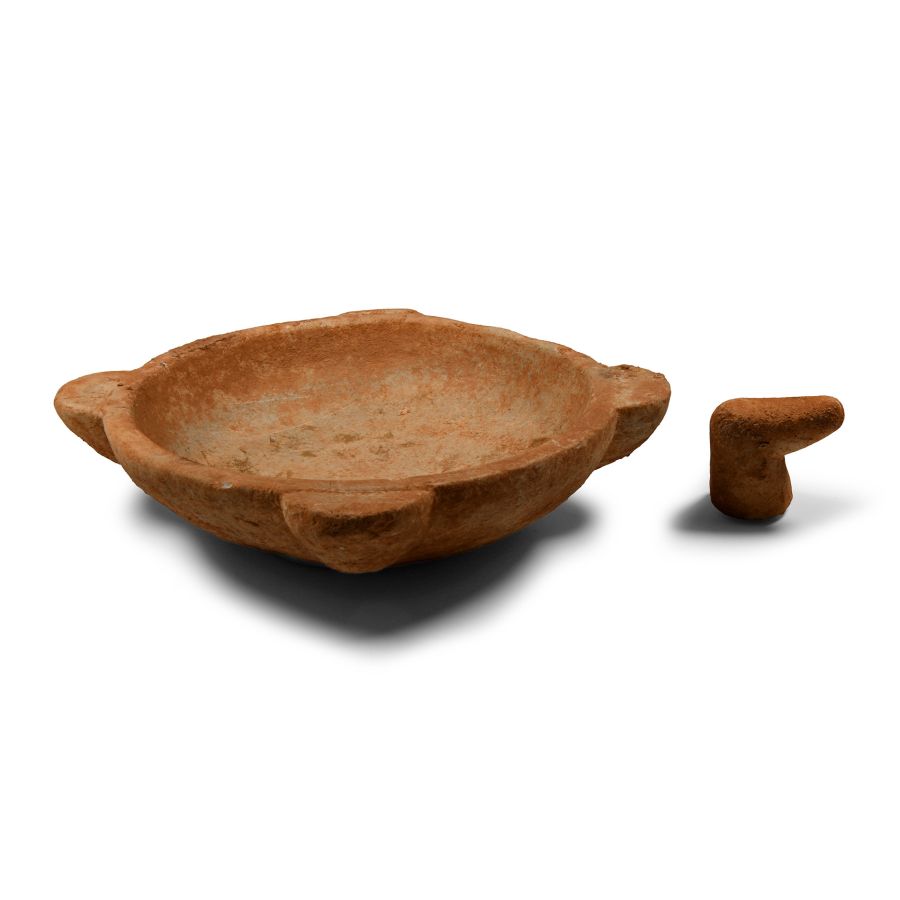
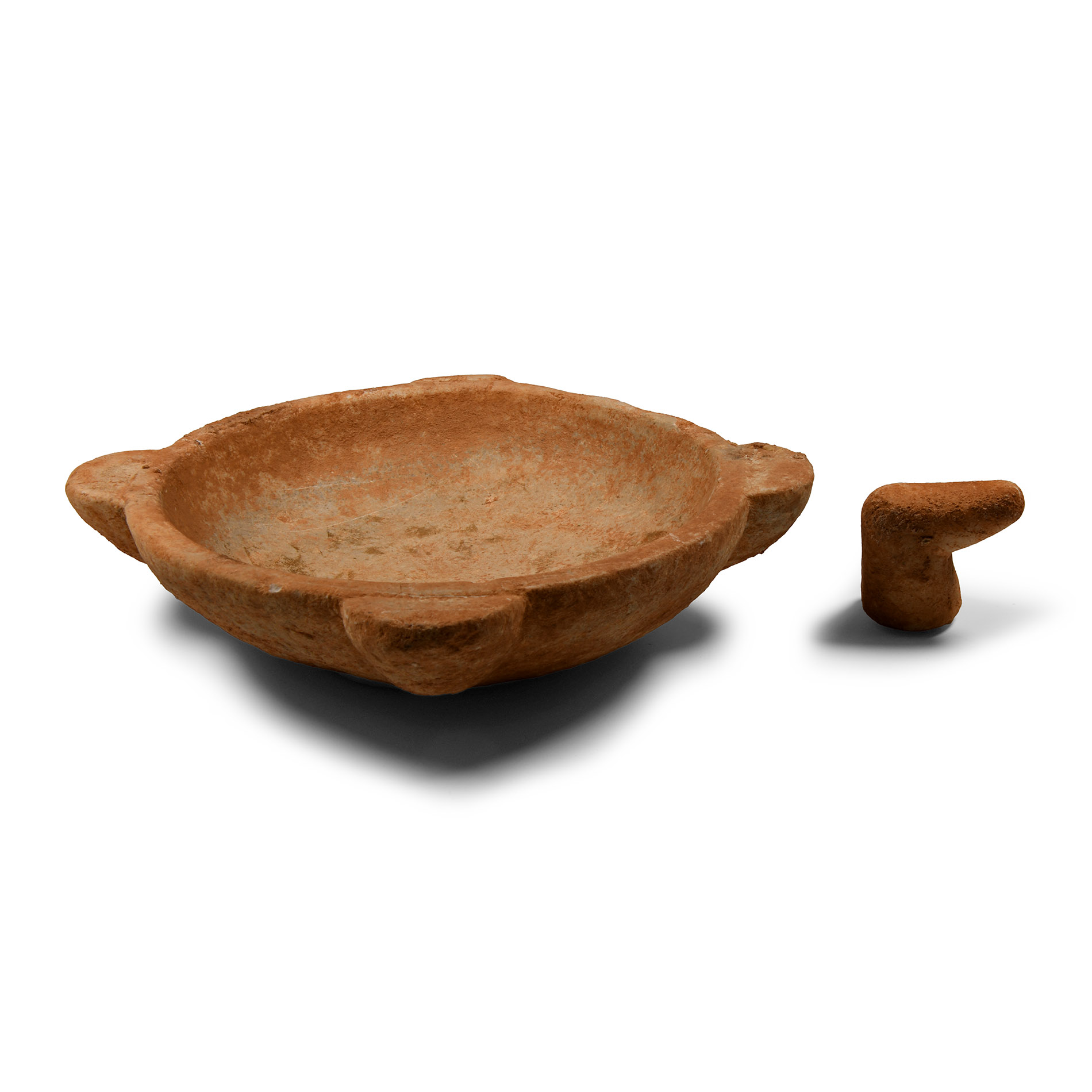
Roman Marble Mortar with Pestle

2ND-4TH CENTURY A.D.

2 1/4 - 9 3/4 in. (1.96 kg total, 5.6-24.8 cm).

Broad squat carved mortarium with basal pad and four D-section ribs to the outer face; separate pestle shaped like a thumb. [2]

Provenance

Ex private collection, Mrs L.S., 1990s.
Acquired from the above, 2000.
Private European collection.

This lot has been checked against the Interpol Database of stolen works of art and is accompanied by a search certificate number no.12095-218195.

CONDITION
VETTING:

TimeLine Auctions follows a vetting process to ensure the authenticity and legality of all items, reinforcing our commitment to integrity and responsible trading. Each antiquity, antique, and coin lot undergoes thorough examination by a vetting committee of at least ten external specialists, professional trade association members, scientists, and archaeologists: Our Vetting Process


AUCTIONS:

TimeLine is a leading auction house specialising in antiquities, ancient art, collectables, natural history, coins, medals, and books. Our auctions offer museums, collectors, historians, and enthusiasts the opportunity to acquire unique and historically significant pieces.

LOT 0105

Roman Marble Mortar with Pestle

Estimate £1,800 - 2,400€2,090 - 2,780 (for guidance only)$2,430 - 3,240 (for guidance only)

Print page

RELATED LOTS
  • Roman Veined Marble Torso of an Athlete
    Roman Veined Marble Torso of an Athlete
    1st-2nd century A.D.

    Sold for (Inc. bp): £48,100

    Standing contrapposto with his weight on his right leg and the left leg brought slightly forward; the musculature of the torso displaying well-defined pectoral muscles, prominent abdominal muscles and wide shoulders, the back with equally toned musculature and well-formed rounded buttocks; the veining of the marble accentuating the idealised anatomy; the now-absent head was most probably turned towards the supporting leg and the left arm would have been raised; mounted on a custom-made display stand. 42.95 kg total, 64 cm high including stand


    Formerly in a French private collection in Compiègne, since the 1960s. Acquired from Galerie Chenel, 2015. Accompanied by a copy of a French cultural passport no.166817. Accompanied by an academic report by Dr Laura Maria Vigna.

    The model of the sculpture recalls the Polykleitian tradition. In particular, the tension of the muscles of the athletic body recalls the Doryphoros of Polykleitos, a famous bronze sculpture erected in Argos in around 450-440 B.C., as evidenced by a stele found there. The statue represented a hero, perhaps Achilles, or a winning athlete. Many Hellenistic and Roman copies of this sculpture are preserved, most notably in marble. These include the Tiberian-era Doryphoros in the National Museum of Naples, from Pompeii, the nude male statue, a copy of the Doryphoros of Polykleitos, in the Doria Pamphilj Collection, dated to the end of the 1st century A.D. The raised left shoulder is reminiscent of the Diadumenos, a work by the same artist made in Argos in around 430-420 B.C., depicting an athlete girding his head with ribbons or fillets, a symbol of victory, known from many copies. The Polykleitos original and the subsequent copies were enormously popular and became canonical representations of physical perfection and refinement.

    Lot Details

  • Roman Terracotta Jar
    Roman Terracotta Jar
    1st-4th century A.D.

    Sold for (Inc. bp): £78

    Fusiform in profile with broad carinated mouth, slightly flared base. 1 kg, 19.5 cm


    Acquired 1980-2015. Ex Abelita family collection.

    Lot Details

  • Roman Childrens Leather Shoe Collection
    Roman Children's Leather Shoe Collection
    Circa 1st-2nd century A.D.

    Sold for (Inc. bp): £7,800

    Comprising: the sole of a carbatina type shoe, formed as two thick layers of leather with a third, thinner layer beneath, slits to the upper face to accept securing straps and punched ornamentation (lines of concentric-ring motifs), underside with a line of domed iron studs to the outer edge and others at he middle of the sole and heel; a soft shoe made from a single piece of leather with pierced triangular tags to the open upper face, the toe and heel sewn so that the seam does not contact the ground; a similar soft shoe with openwork sides resembling arcading, no covering at the toes, heel sewn. 150 grams total, 13-17.5 cm


    Found City of London, UK. Acquired from mudlark Steve Brooker in the early 2000s. Ian Wilkinson collection, Nottinghamshire, UK, formed since 1985. Accompanied by several original handwritten letters regarding the conservation of the shoes. This lot has been checked against the Interpol Database of stolen works of art and is accompanied by a search certificate number no.12093-214631.

    In Great Britain, examples of carbatinai dated to the last quarter of the 1st century A.D. have been found in Castleford. Others dated to the 2nd century have been found in London and Bar Hill. Carbatinae were often worn by children: two well-preserved specimens were discovered at the Vindolanda fort, which housed a mixed population of soldiers and their families.

    Lot Details

Stay up-to-date with the latest from TimeLine Auctions by joining our mailing list