
Loading, please wait...
_900x900.jpg "Roman Marble Head of Hercules Wearing the Nemean Lion Skin")
_200x200.jpg "Roman Marble Head of Hercules Wearing the Nemean Lion Skin")
_900x900.jpg "Roman Marble Head of Hercules Wearing the Nemean Lion Skin")
_200x200.jpg "Roman Marble Head of Hercules Wearing the Nemean Lion Skin")
_900x900.jpg "Roman Marble Head of Hercules Wearing the Nemean Lion Skin")
_200x200.jpg "Roman Marble Head of Hercules Wearing the Nemean Lion Skin")
.jpg "Roman Marble Head of Hercules Wearing the Nemean Lion Skin")
.jpg "Roman Marble Head of Hercules Wearing the Nemean Lion Skin")
.jpg "Roman Marble Head of Hercules Wearing the Nemean Lion Skin")
LOT 0126
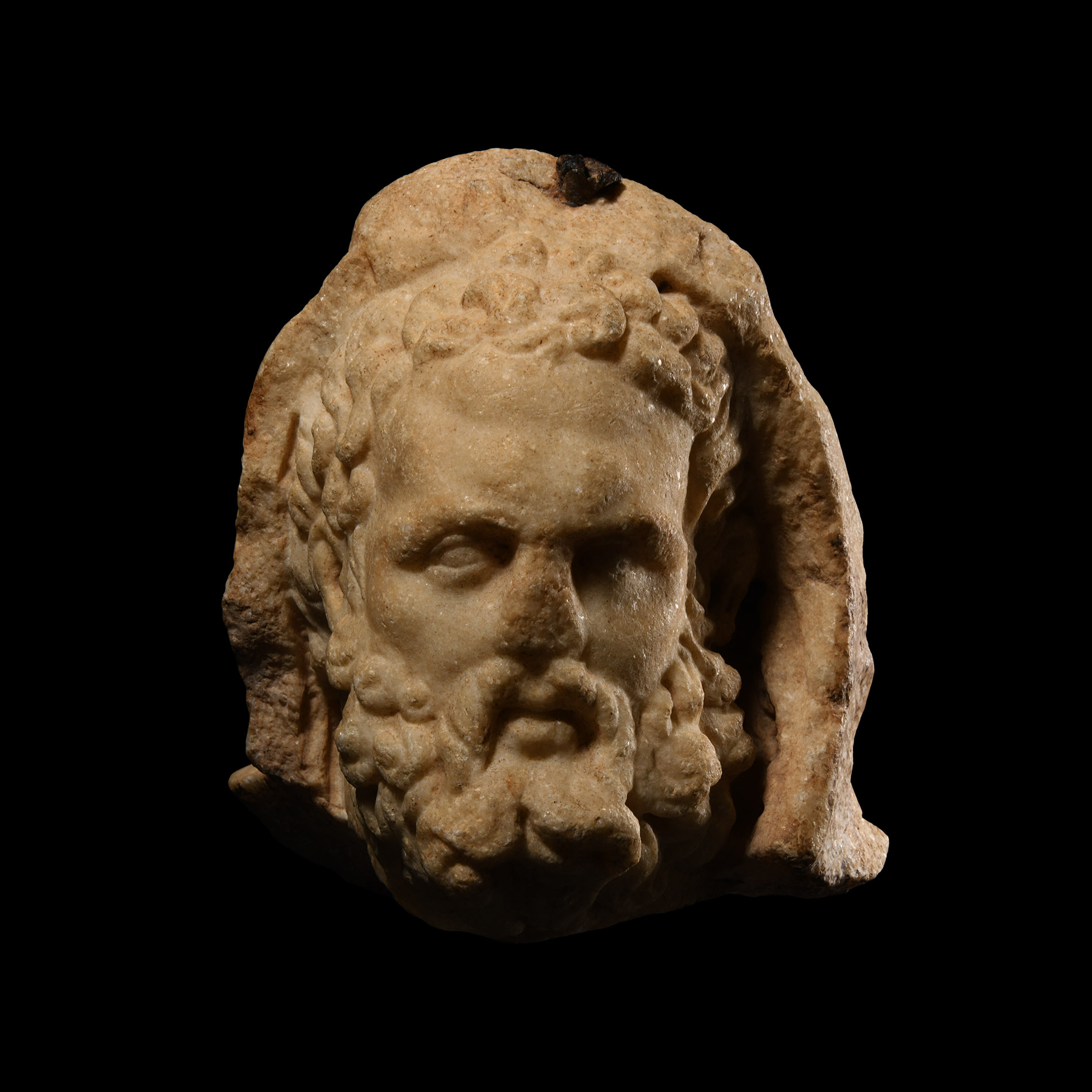
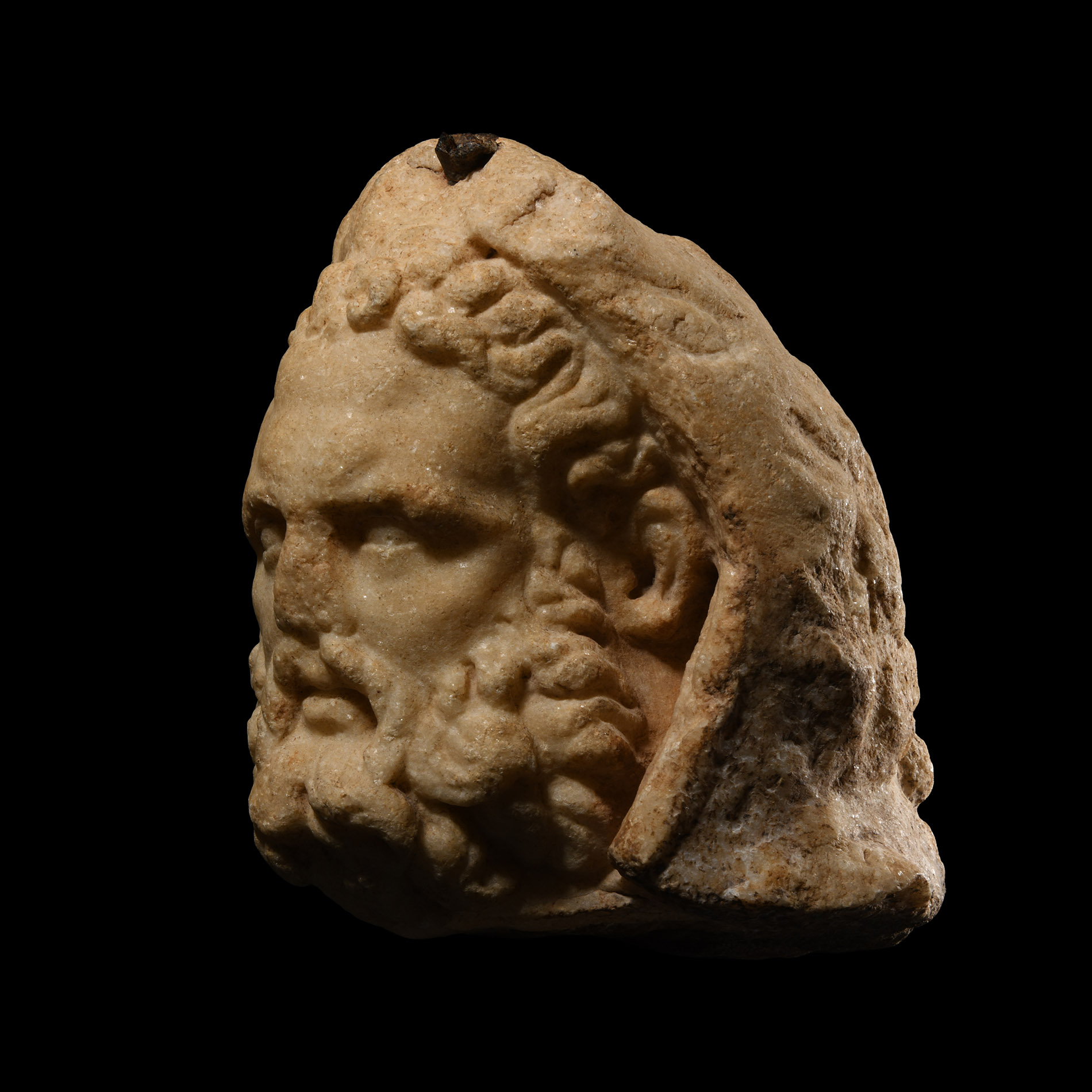
Roman Marble Head of Hercules Wearing the Nemean Lion Skin
IMPERIAL, CIRCA 1ST CENTURY A.D.
11 1/4 in. (8 kg total, 28.5 cm including stand).
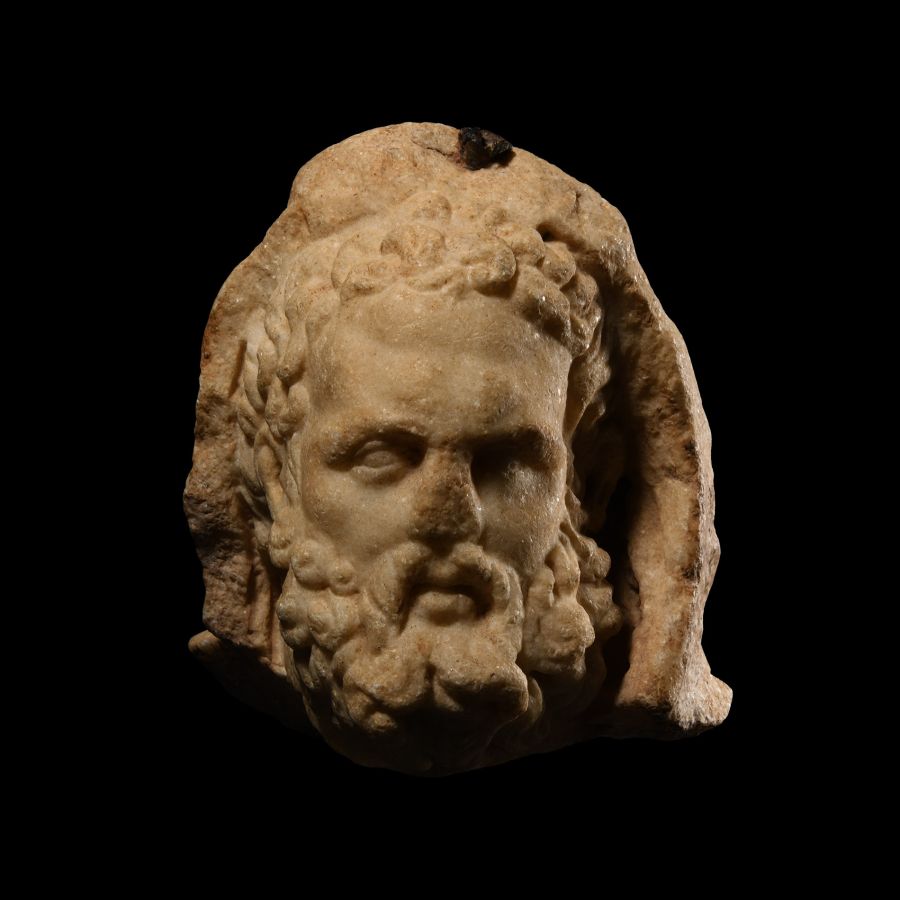
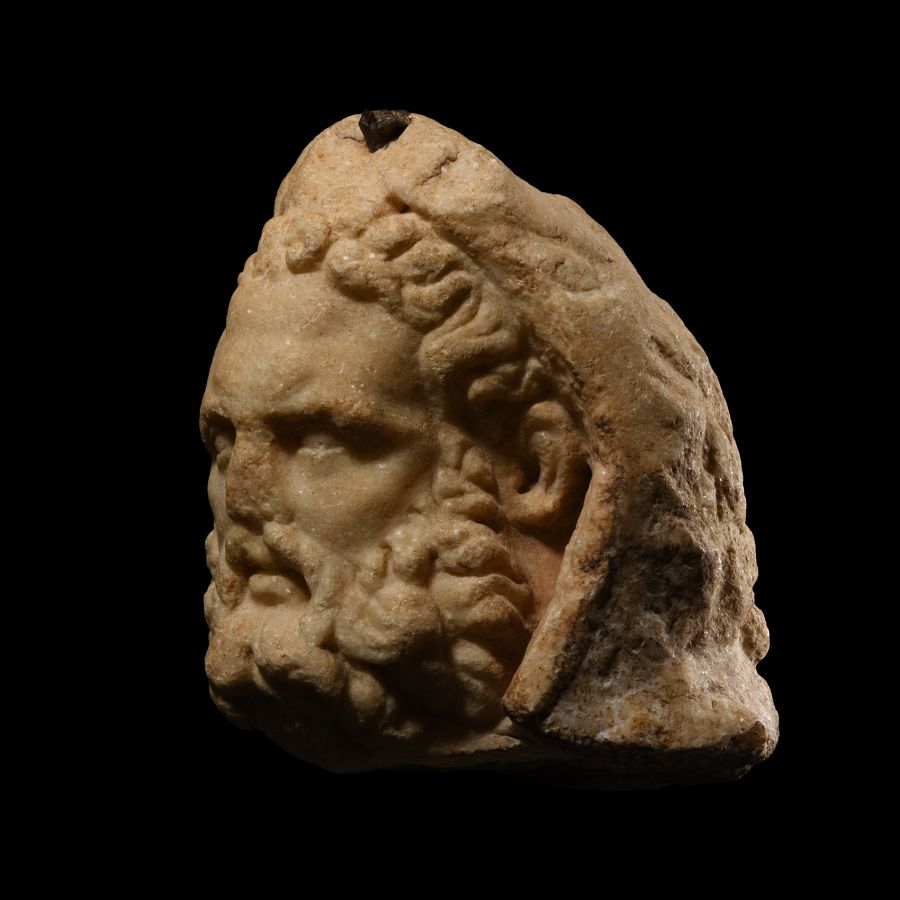
Modelled with naturalistic features, gazing left, sculpted pupils and strong lids; luxuriant beard and moustache framing the face; strong forehead with tightly formed curls emerging from beneath the lion's skin hood; the hood with clear eye detailing and the mane with regularly arranged tufts; original iron pin to the front of the muzzle; mounted on a custom-made display stand.
ProvenancePrivate Germany collection, 1981.
with Gorny and Mosch, 19 June 2013, no.3.
Ex A.S.collection, Florida, USA.
Accompanied by an academic report by Dr Raffaele D’Amato.
This lot has been checked against the Interpol Database of stolen works of art and is accompanied by search certificate number no.12085-214457.
See Reinach, S., Répertoire de la statuaire Grecque et Romaine, Paris, 1897, p.211, item 3; Kansteiner, S., Herakles, Die Darstellungen in der Grossplastik der Antike, Köln, 2000, pp.32ff., figs.45-48, for the type; Kansteiner, S., ‘Lysipps Statuen des Herakles’ in Archaeologischer Anzeiger, 2020 (1), pp.120-136ff., fig.14.
FootnotesThe head is a Roman copy of a Hellenistic original, of ‘Palazzo Pitti/Wilton House’ type depicting Hercules wearing the skin of the Nemean lion with the paws of the lion crossed upon the breast, his left arm holding the club and the right hand holding the golden apples of Hesperides. The representation of a slight movement of the head also shows elements of the Lysippean Antalya-Borghese type (example from the Archaeological Museum of Naples with the head covered by the Nemean lion skin).
CONDITIONTimeLine Auctions follows a vetting process to ensure the authenticity and legality of all items, reinforcing our commitment to integrity and responsible trading. Each antiquity, antique, and coin lot undergoes thorough examination by a vetting committee of at least ten external specialists, professional trade association members, scientists, and archaeologists: Our Vetting Process
AUCTIONS:
TimeLine is a leading auction house specialising in antiquities, ancient art, collectables, natural history, coins, medals, and books. Our auctions offer museums, collectors, historians, and enthusiasts the opportunity to acquire unique and historically significant pieces.
LOT 0126
Roman Marble Head of Hercules Wearing the Nemean Lion Skin
Sold for (Inc. bp): £7,800
-
Roman Lead Sling Shot Projectile Collection
1st century B.C.-2nd century A.D.Sold for (Inc. bp): £585
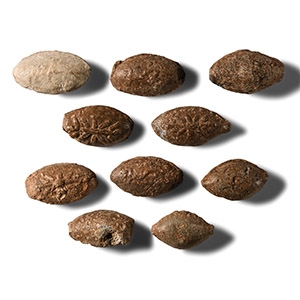
Comprising ten lentoid-section glandes, five with impressed stylised 'fulmen' (thunderbolt) of Jupiter. 384 grams total, 18-36 mm
Acquired in Europe in 1990. European private collection.
The missiles of ovoid shape belong to type Ia of the Völling classification. The sling (funda) with its lead missiles (plumbea pondera or glandae) and stone (lapides) was used by special funditores, illustrated on Trajan’s Column where they are simply dressed in broad tunics with no armour, but carry a shield. A fold in their cloak, or sagulum, acted as an ammunition bag. The effectiveness of the slingers was unquestionable and much appreciated, especially against elephants. Celsus, writing towards the end of the 2nd century A.D., described how a slingshot wound was more dangerous and harder to treat than one inflicted by an arrow. -
Roman Bronze-Handled Iron Key
3rd-4th century A.D.Sold for (Inc. bp): £173
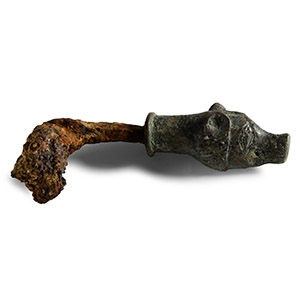
With angled shank, wolf-head handle. 70 grams, 92 mm
Ex German art market, 2000s. Acquired from an EU collector living in London. From the collection of Surrey, UK, gentleman. -
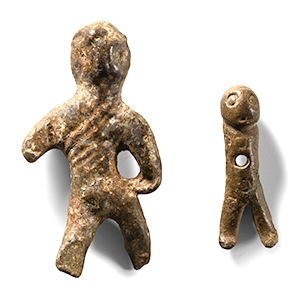
Roman Bronze Statuette Group
2nd century B.C-1st century A.D.Sold for (Inc. bp): £78
Comprising: small figure pierced at the middle wit pellet detailing to face and body, legs spread; figure in active pose with slanting stripes across the body, possibly intended for Hercules; probably votives for deposition at a temple. 42 grams total, 30-47 mm
From a collection acquired on the UK art market from various auction houses and collections mostly before 2000. From an important Cambridgeshire estate; thence by descent.
