
Loading, please wait...
_900x900.jpg "Roman Marble Head of Euripides")
_200x200.jpg "Roman Marble Head of Euripides")
.jpg "Roman Marble Head of Euripides")
LOT 0143
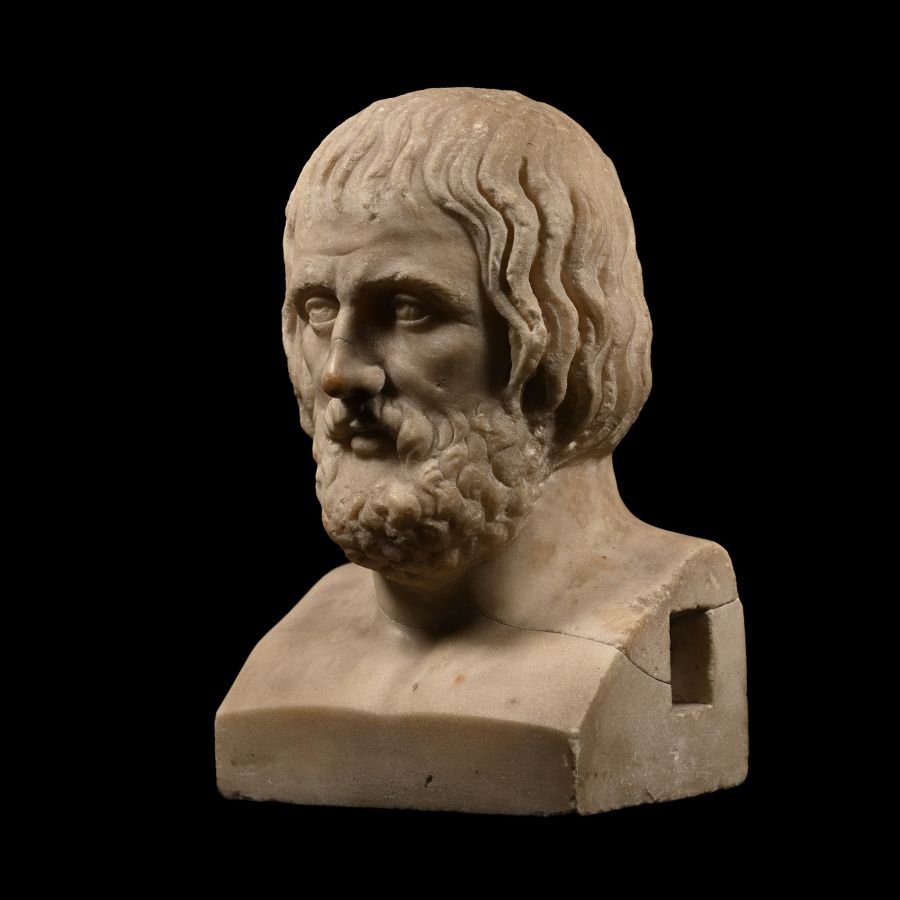
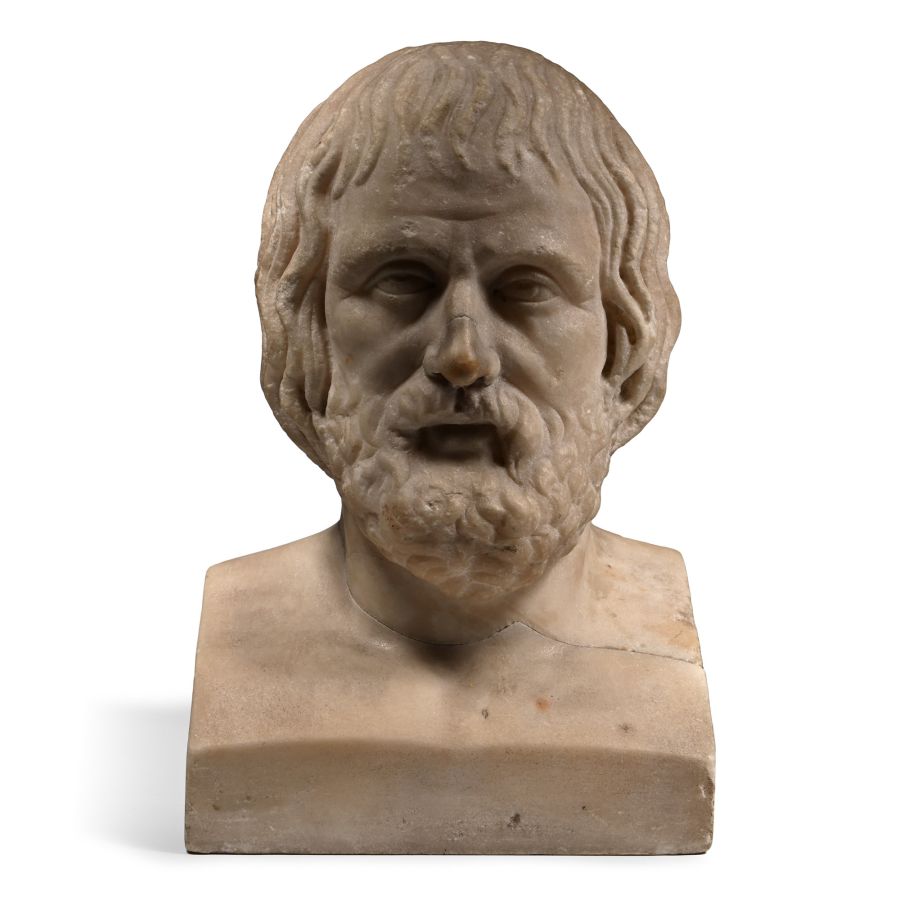
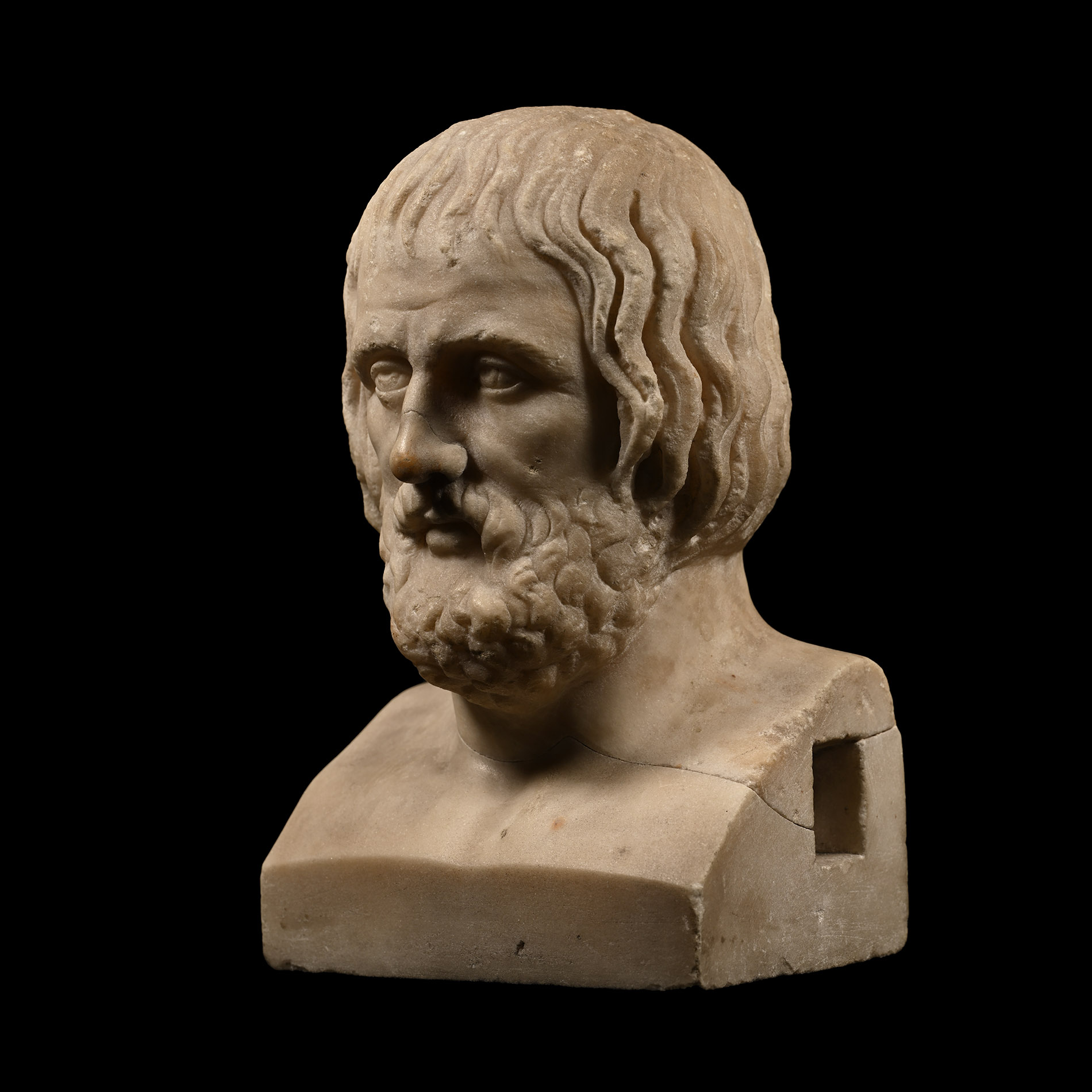
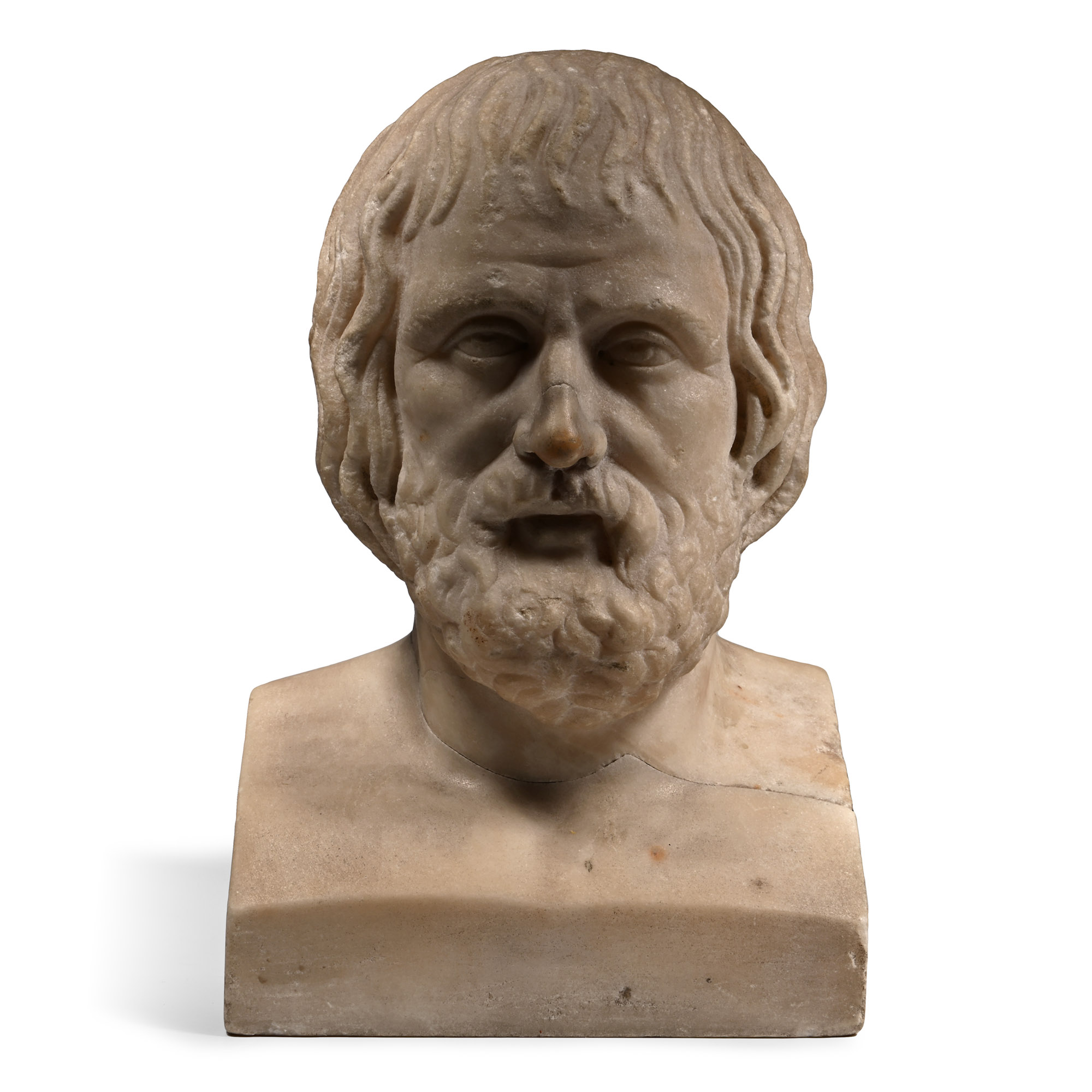
Roman Marble Head of Euripides
2ND CENTURY A.D.
9 7/8 in. (7.46 kg, 25 cm).
An impressive carved herm of the tragic author of the tragic author Euripides, portrayed as an elderly man with full beard and long hair forming compact, slightly wavy strands, radiating from a single point at the back of the head and combed forwards over the forehead; heavy brow and small mouth; cracked and repaired.
ProvenanceEnglish private collection, acquired in the late 1970s/early 1980s.
David Cambridge, Cheltenham.
with Galerie Chenel, Paris, acquired from the above in 1998.
French private collection, acquired from the above in 1999/2000.
Ancient Marbles, Classical Sculpture and works of art; Sotheby's, London, 13 June 2016, no.49.
Accompanied by an academic report by Dr Raffaele D’Amato.
This lot has been checked against the Interpol Database of stolen works of art and is accompanied by search certificate number no.12191-222443.
Cf. for the famous copy in Museo Archeologico Nazionale di Napoli see Gasparri, C., (ed.), Le sculture Farnese, vol.2, 2009, pp.32ff., no.14, pl.14; cf. Richter, G.M.A., The Portraits of the Greeks, Vol. I, London, 1965, pp.133-140, illus.717-767, for an overview of the known ancient copies of the portrait of Euripides; among them we remember the one of the Getty Museum (inv. no.79.AA.133), a Roman copy from Lesbos dated at 2nd century A.D., in Antonaccio, C. M. ‘Style, Reuse, and Context in a Roman Portrait at Princeton,’ in Archaeologischer Anzeiger 3, (1992), pp.414-452, p.449, no.30.
FootnotesEuripides was a classical Athenian playwright and one of the three great tragedians of ancient Greece, alongside Aeschylus and Sophocles. Born in 480 B.C., his work is renowned for its complex characters and psychological depth, often exploring the darker aspects of human nature and societal norms. Euripides' plays, such as Medea, The Bacchae, and Hippolytus, are marked by their innovative use of mythological themes to comment on contemporary issues.
CONDITIONTimeLine Auctions follows a vetting process to ensure the authenticity and legality of all items, reinforcing our commitment to integrity and responsible trading. Each antiquity, antique, and coin lot undergoes thorough examination by a vetting committee of at least ten external specialists, professional trade association members, scientists, and archaeologists: Our Vetting Process
AUCTIONS:
TimeLine is a leading auction house specialising in antiquities, ancient art, collectables, natural history, coins, medals, and books. Our auctions offer museums, collectors, historians, and enthusiasts the opportunity to acquire unique and historically significant pieces.
LOT 0143
Roman Marble Head of Euripides
Estimate £18,000 - 24,000€20,880 - 27,840 (for guidance only)$24,300 - 32,400 (for guidance only)
-
.jpg)
Roman Deep Blue Glass and Other Bead Necklace String
1st century A.D. and laterSold for (Inc. bp): £156
Restrung to a Y-shape with mainly blue glass beads. 13.8 grams, 56 cm long
UK gallery, early 2000s. -
Roman Bronze Tankard Handle with Drunken Putto on Donkey
2nd century A.D.Sold for (Inc. bp): £221
Comprising a crescent plaque above with facing mask a a thumb-pad, lateral scrolls; perpendicular D-section bar with ribbing to the outer face; rectangular lower attachment panel with scrolled upper corners, high-relief putto (?) holding a patera in one hand and tankard in the other, riding an ass side-saddle; mounted on a custom-made stand. 318 grams total, 17 cm including stand
From a collection acquired on the UK art market from various auction houses and collections mostly before 2000. From an important Cambridgeshire estate; thence by descent.
This type of bronze handles are usually depicting mythological scenes. The scene of the putto riding a donkey is often linked to Bacchic processions. The face of the character riding the donkey could also correspond to that of Silenus, who in the same processions is often represented riding such an animal. -
Roman Silver Decorated Dish
Circa 4th-5th century A.D.Sold for (Inc. bp): £416
Comprising a shallow bowl fitted with handles and raised foot, the rim engraved with petals. 39 grams, 95 mm wide
From a North Yorkshire, UK, private collection. Acquired from Adam Partridge Auctioneers, Macclesfield, UK. Property of Mr A.B., an American collector.
In regards of the shape, Roman silver vessels usually fall into three classes: (1) vessels for eating; (2) vessels for drinking; (3) jugs and saucepans (trullae). The first class includes flat, circular dishes (lances), often of considerable size; the situlae or buckets, and the bowls with projecting rims (our specimen) of various dimensions. The form of the present bowl (probably used for spices, like pepper [piperatoria]) occurs all over the Mediterranean basin, and is Alexandrian in origin.
