
Loading, please wait...
_900x900.jpg "Roman Marble Head of a Woman")
_200x200.jpg "Roman Marble Head of a Woman")
.jpg "Roman Marble Head of a Woman")
LOT 0067
Roman Marble Head of a Woman
1ST-EARLY 3RD CENTURY A.D.
9 5/8 in. (2.95 kg total, 24.5 cm high including base).
Carved in the round with youthful features; large eyes with thickened eyelids, especially the lower lid, well-defined eyebrows forming two long arcs; small mouth with fleshy lips and deep corners; the hair parted at the centre and forming two symmetrical bands of wavy locks leaving the ears uncovered, secured with a ribbon and gathered at the nape of the neck to a small braid with a low hanging knot; mounted on a custom-made display stand.
Provenance19th-20th century collection, based on the stand.
Ex German collection, 1980s.
with HVMC Auctions, Monaco, 12 May 2021, lot 99.
Accompanied by an academic report by Dr Marina Mattei and Dr Laura Maria Vigna.
This lot has been checked against the Interpol Database of stolen works of art and is accompanied by search certificate number no.11761-202174.
Cf. Scarpati, G., Ritratto Femminile, in Palazzo Massimo alle Terme, Le Collezioni, a cura di Carlo Gasparro e Rita, Paris/Milan, 2013, n.131, p.193; Fileri, E., Ritratto Femminile, in Palazzo Massimo alle Terme, Le Collezioni, a cura di Carlo Gasparri e Rita, Paris/Milan, 2013, n.266, p.366.
FootnotesThe arrangement of the hair is characteristic of female portraits of the late Antoninian to early Severan age. The head finds comparisons with a female portrait in the National Roman Museum, depicting an elderly woman of the Antoninian age, and with another female portrait in the National Roman Museum, dated to the third decade of the 3rd century A.D., reworked in the Tetrarchic Period, with the hairstyle falling within the so-called 'Nest Frisur' of the Severan age.
CONDITIONTimeLine Auctions follows a vetting process to ensure the authenticity and legality of all items, reinforcing our commitment to integrity and responsible trading. Each antiquity, antique, and coin lot undergoes thorough examination by a vetting committee of at least ten external specialists, professional trade association members, scientists, and archaeologists: Our Vetting Process
AUCTIONS:
TimeLine is a leading auction house specialising in antiquities, ancient art, collectables, natural history, coins, medals, and books. Our auctions offer museums, collectors, historians, and enthusiasts the opportunity to acquire unique and historically significant pieces.
-
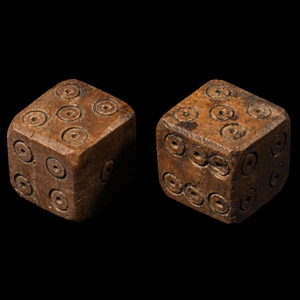
Roman Bone Dice Pair
2nd-4th century A.D. or laterSold for (Inc. bp): £208
With ring-and dot markings disposed 1:6, 2:5, 3:4 7.7 grams total, 12-13 mm
Ex collection of a UK gentleman formed in the 1990s. From the collection of Surrey, UK, gentleman. -
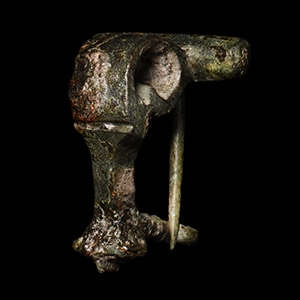
Roman Silvered Bronze Bow Brooch
Circa 1st-2nd century A.D.Sold for (Inc. bp): £33
Composed of a comma-shaped piercing to bow; complete with pin and catchplate. 15.2 grams, 30 mm
Acquired before 2000. Ex property of a Hampshire, UK, gentleman. -
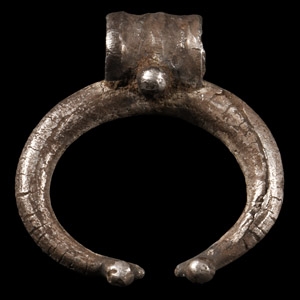
Roman Silver Lunar Pendant
1st century A.D.Sold for (Inc. bp): £91
With ribbed suspension loop, applied granules to the junction and finials. 2.04 grams, 17 mm
From the collection of an EU gentleman formed in the 1990s. Acquired on the UK art market.
