
Loading, please wait...
LOT 0677
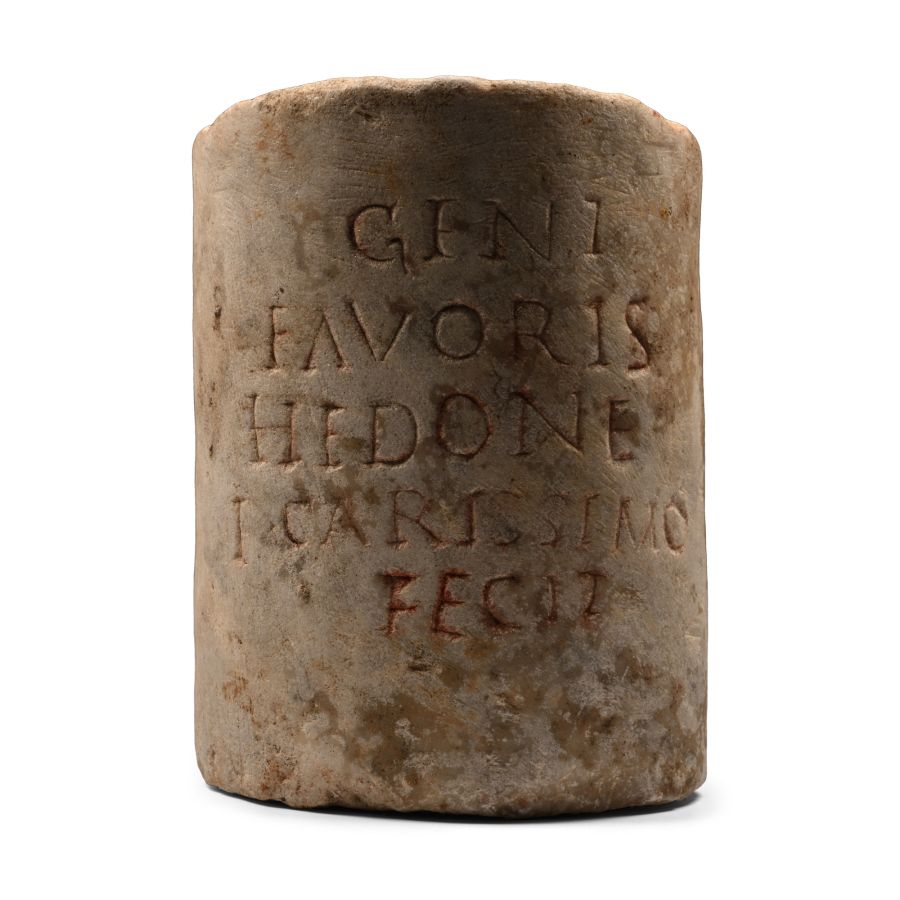
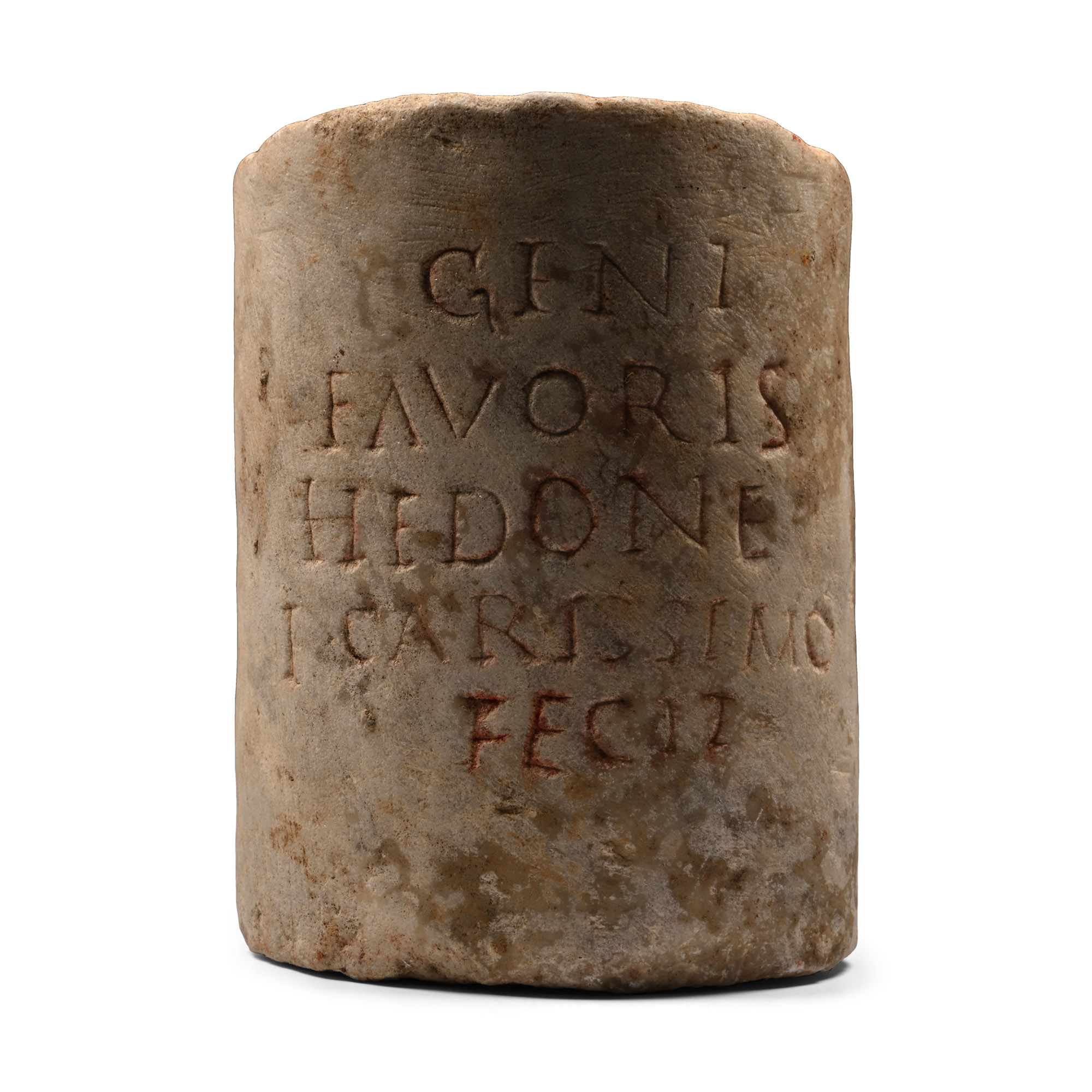
Roman Marble Column Fragment with Latin Inscription
3RD CENTURY A.D.
4 3/4 in. (1.81 kg, 12 cm).
Provincial columnar fragment with inscription in rustic capitals: 'GENI / FAVORIS /IHEDONE / I CARISSIMO / FECIT' [With the favour of the Genius Hedone made it for the dearest]; traces of red pigment.
ProvenancePrivate collection, 2005.
This lot is accompanied by an illustrated lot declaration signed by the Head of the Antiquities Department, Dr Raffaele D'Amato.
Cf. Antonius Franciscus Gori, Inscriptionum Antiquarum quae in Etruriae Urbibus Extant Appendix postrema, pars tertia, Florentiae, 1643, p.248, for an inscription dedicated to a certain Pacuvia Hedone.
FootnotesThe dedicatory inscription seems to refer to a funerary monument erected by a certain Hedone for a loved one (probably her husband). It is a late inscription which justifies the use of the genitive and not the ablative for GENI FAVORIS (instead of GENII FAVORE). Hedone is a Greek name which, however, occurs in Italic sepulchral inscriptions.
CONDITIONTimeLine Auctions follows a vetting process to ensure the authenticity and legality of all items, reinforcing our commitment to integrity and responsible trading. Each antiquity, antique, and coin lot undergoes thorough examination by a vetting committee of at least ten external specialists, professional trade association members, scientists, and archaeologists: Our Vetting Process
AUCTIONS:
TimeLine is a leading auction house specialising in antiquities, ancient art, collectables, natural history, coins, medals, and books. Our auctions offer museums, collectors, historians, and enthusiasts the opportunity to acquire unique and historically significant pieces.
-
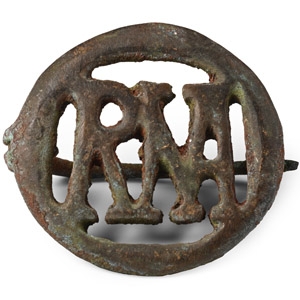
Roman Bronze ROMA Openwork Brooch
2nd-3rd century A.D.Sold for (Inc. bp): £169
The discoid body formed as an openwork monogram ROMA in Latin letters, the M and A ligated, the O formed by the brooch frame itself; ROMA also a palindrome for AMOR. 12.5 grams, 34 mm
Ex German art market, 2000s. Acquired from an EU collector living in London. From the collection of a Surrey, UK, gentleman. This lot is accompanied by an illustrated lot declaration signed by the Head of the Antiquities Department, Dr Raffaele D'Amato.
When viewed from the default side, RMA + the circle of the brooch form a monogram for ‘Roma’. Roma refers to both the city and its divine personification, the Dea Roma. When RMA is read from right to left (or the brooch is viewed from the opposite side), the letters form a monogram for ‘AMOR’, the Latin name for Cupid, the god of love. The phrase pertains to Roma-Amor, a widely recognised palindrome espousing Roman wordplay in the ancient times. -
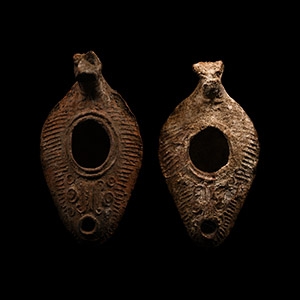
Late Roman Holy Land Terracotta Oil Lamp Group
Circa 5th-6th century A.D.Sold for (Inc. bp): £65
Each comprising a slipper-shaped hollow-formed piriform body with low-relief hatching to the discus, handle formed as a canine head with pricked ears. 157 grams total, 10.2 cm each
From a private, UK, collection in the 1980s. Property of a London, UK, antiquarian. This lot is accompanied by an illustrated lot declaration signed by the Head of the Antiquities Department, Dr Raffaele D'Amato. -
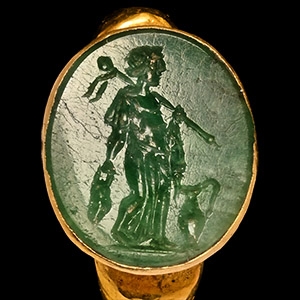
Roman Gold Ring with Maenad Gemstone
1st-2nd century A.D.Estimate: £4,000 - 6,000 (+bp*)
Opening Bid: £2,000
With scooped shoulders and trumpet bezel, inset jadeite cloison with intaglio advancing Maenad with ewer, thyrsus and vessel; supplied with a museum-quality impression. 3.79 grams, 21.03 mm overall, 14.82 mm internal diameter (approximate size British H, USA 3 3/4, Europe 6.18, Japan 6)
Ex Mayfair, London, UK, collection, 1990-2000s. This lot has been checked against the Interpol Database of stolen works of art and is accompanied by a search certificate number no.12682-234914. This lot has been cleared against the Art Loss Register database, and is accompanied by an illustrated lot declaration signed by the Head of the Antiquities Department, Dr Raffaele D'Amato.
