
Loading, please wait...
LOT 1053
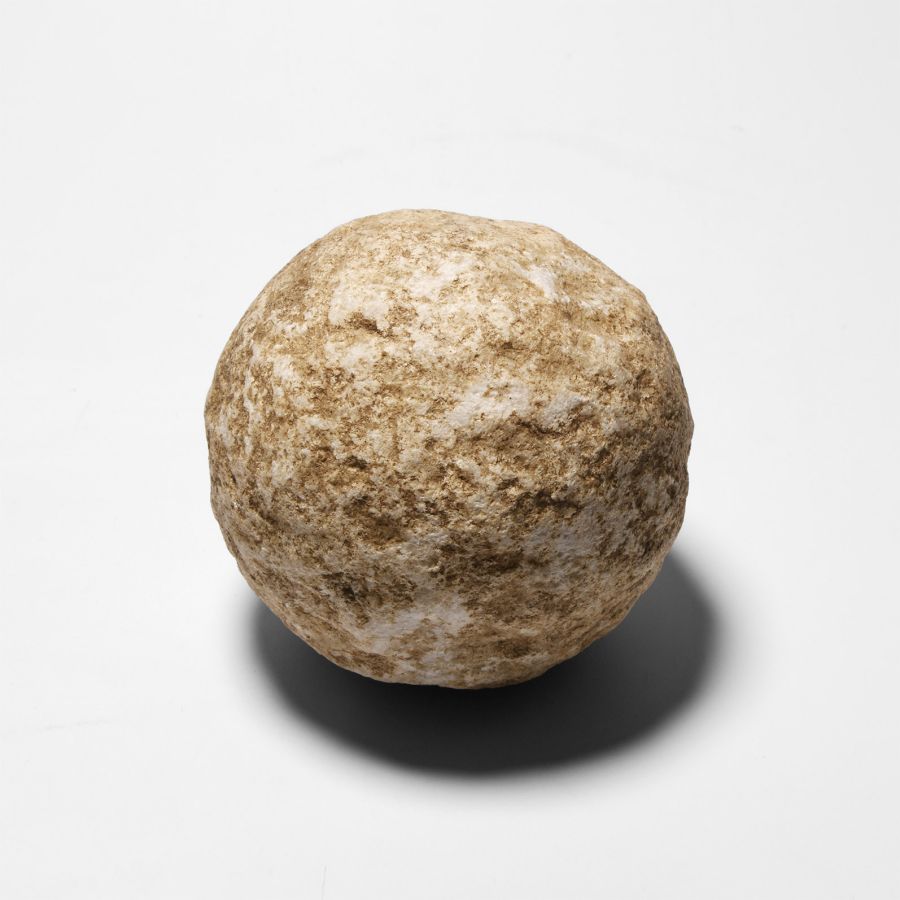
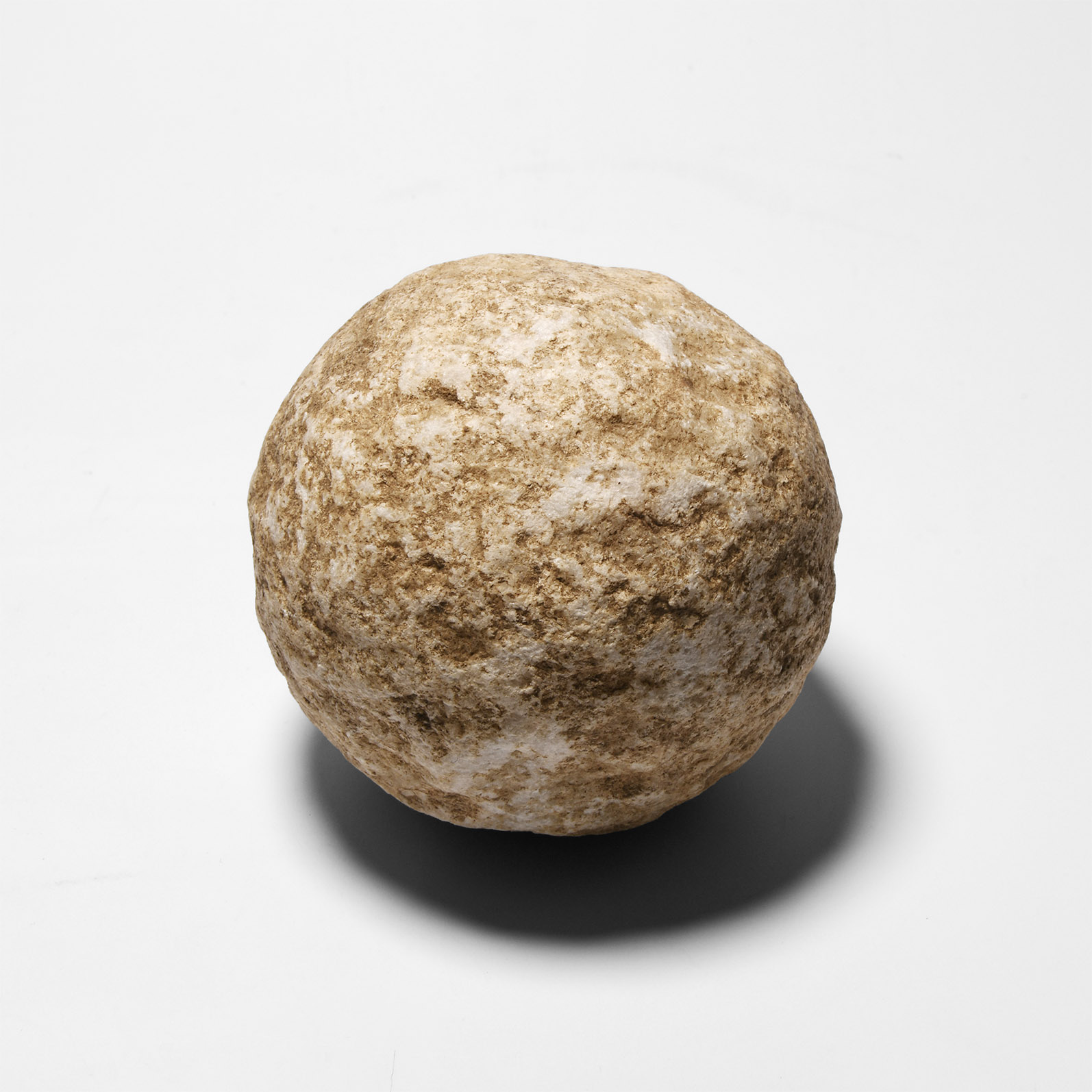
Roman Marble Ballista Catapult Shot
1ST-3RD CENTURY A.D.
3 1/8 in. (682 grams, 79 mm).
Suitable for use with an onager or other small catapult-type siege weapon; with roughened, abrasive surface. [No Reserve]
ProvenanceAcquired 1971-1972.
From the collection of the vendor's father.
Property of a London, UK, collector.
See Wilkins, A., Roman Imperial Artillery, Solway Print, 2017.
FootnotesThe operation of the onager (Latin for 'wild ass') is first mentioned in 353 A.D. by Ammianus Marcellinus in his Res Gestae and more fully in Vegetius's Epitoma Rei Militaris probably written in the reign of Emperor Theodosius I (378-395 A.D.).
CONDITIONTimeLine Auctions follows a vetting process to ensure the authenticity and legality of all items, reinforcing our commitment to integrity and responsible trading. Each antiquity, antique, and coin lot undergoes thorough examination by a vetting committee of at least ten external specialists, professional trade association members, scientists, and archaeologists: Our Vetting Process
AUCTIONS:
TimeLine is a leading auction house specialising in antiquities, ancient art, collectables, natural history, coins, medals, and books. Our auctions offer museums, collectors, historians, and enthusiasts the opportunity to acquire unique and historically significant pieces.
-
Luristan Bronze Sword with 'Ear' Pommel
10th-9th century B.C.Sold for (Inc. bp): £585
Comprising a long tapering blade, rectangular-section hilt with raised circular bosses, horned crescent-shaped guard curved to accept the blade and a large bifurcated pommel formed as two ear-lobes with ribbed joining shank. 1.17 kg, 66 cm
Acquired in the early-1990s. Ex Guernsey collection. The Kusmirek Collection, UK.
This kind of sword was entirely made of cast bronze. They were characterised by an 'ear' pommel and raised mid-rib on the blade, square shoulders and rectangular, open guard. The handle was cast on the blade. The square and solid sectioned handle has bossed with reinforcements which allow a better grip. -
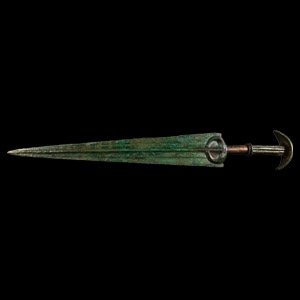
Marlik Bronze Short Sword with Crescentic Pommel
14th-10th century B.C.Sold for (Inc. bp): £1,300
Formed with a slender triangular blade, raised midrib with flat upper face, penannular guard and scooped shoulders, columnar grip with two gusseted hoops, the upper half of the grip is decorated with vertical lines, the lower part with horizontal grooves, crescent pommel; short sword or dagger. 430 grams, 44 cm
Ex Alexander Cotton collection, Hampshire, UK 1980s.
This short sword or dagger belongs to the category of blades with pennanular guard, with hilt and guard cast in one piece with the grip. This solid weapon has separate sets of encircling ribs on the grip. Negahban excavated similar weapons from the Marlik cemeteries, although sometimes the type combines grip and penannular guard with flanged hilts open to accept inlays. -
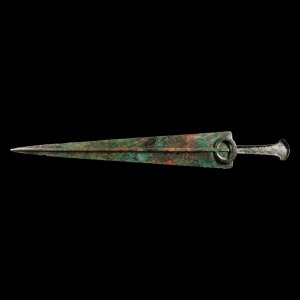
Luristan Bronze Hilted Dirk
Circa 1000 B.C.Sold for (Inc. bp): £715
The blade with a tapering profile, triangular in overall form, with square shoulders, penannular guard with strong midrib, flanged hilt with straight grip, widening slightly into a fan-shaped pommel. 363 grams, 47.5 cm
Acquired from Alan Cherry, Bournemouth, UK. Ex Alexander Cotton collection, Hampshire, UK 1980s.
These types of short sword or dirks were usually cast in one piece, and the penannular rib in relief was cast on at the same time with the handle of the blade. In some cases, however, the penannular rib was later cast on the dagger, possibly to strengthen a weak point at the junction of hilt and blade. The flanged hilt was originally filled with organic material like bone.
