
Loading, please wait...
LOT 1393
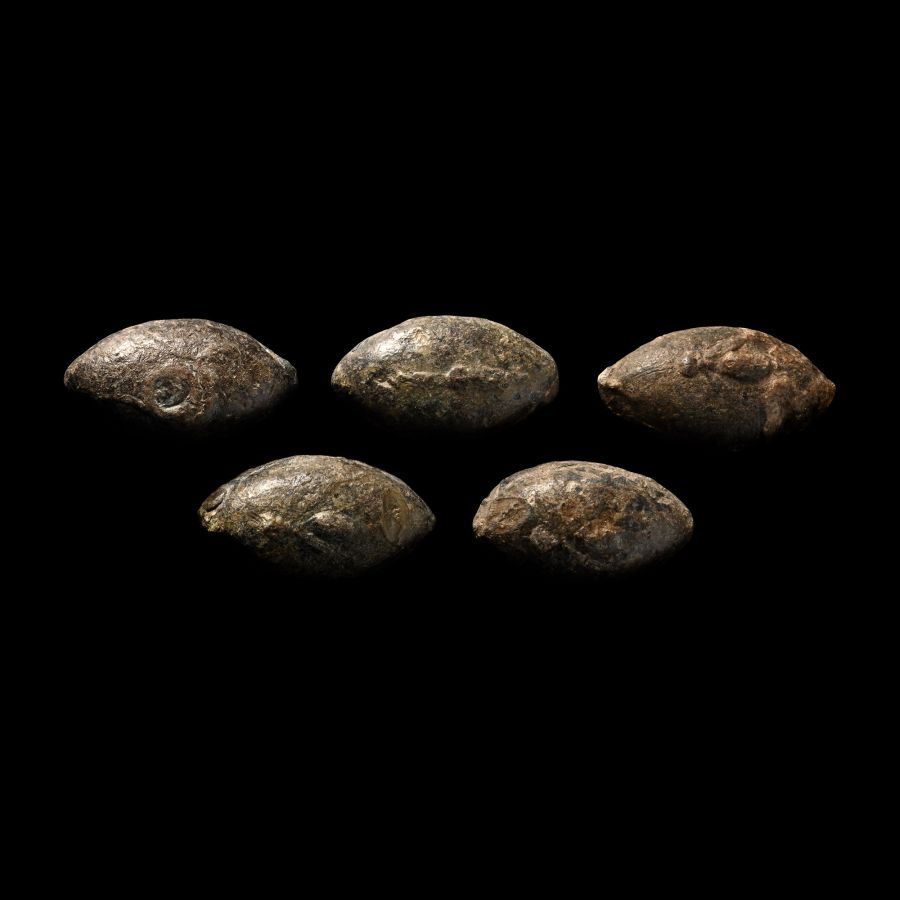
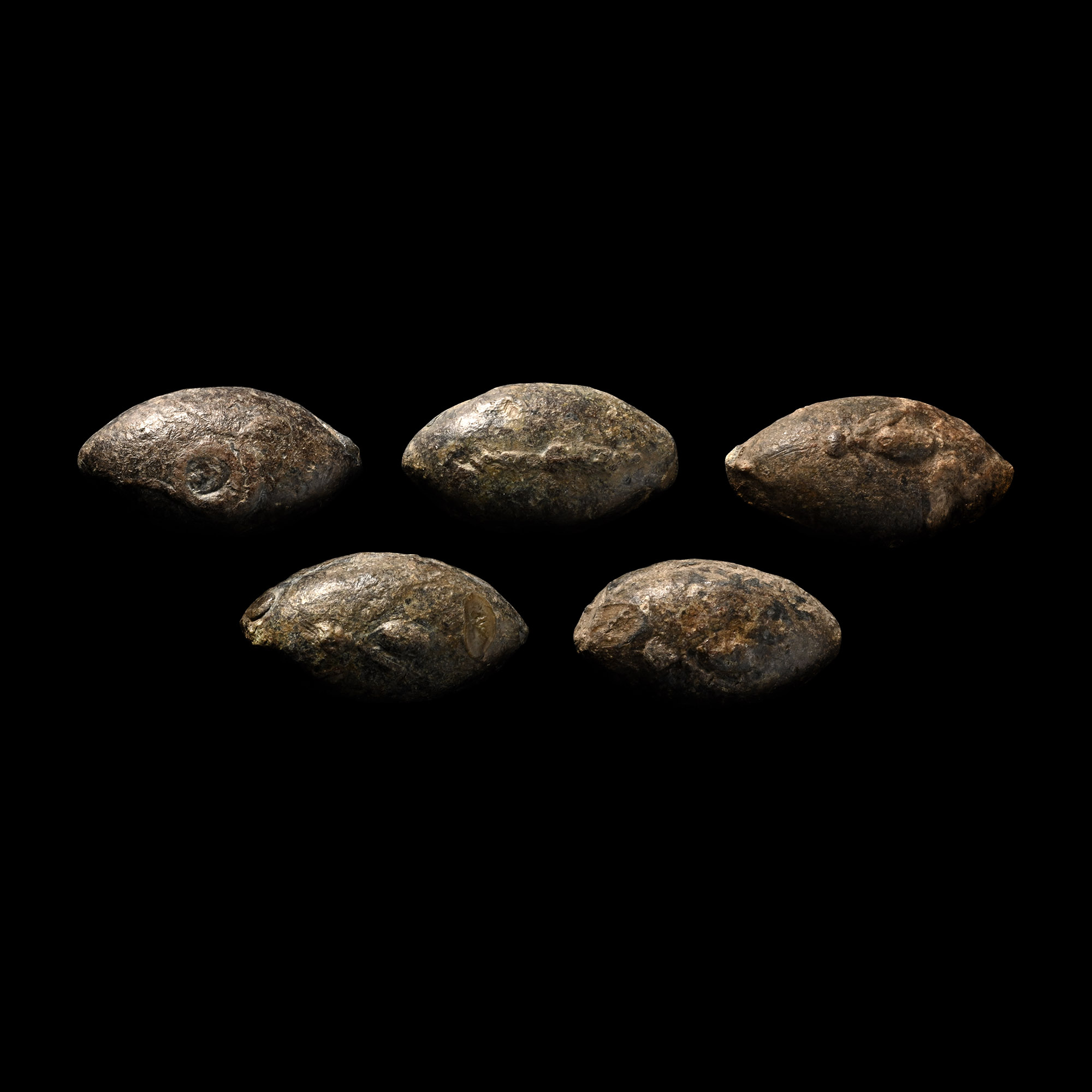
Roman Lead Slingshot Group
1ST CENTURY B.C.
1 1/8 in. (155 grams total, 28-30 mm).
A mixed group of four lentoid-section biconical lead slingshot, three fitted with iconic winged thunderbolts on one side, and one with the Tanit goddess symbol, possibly alluding to a Balearic-Punic origin. [5, No Reserve]
ProvenanceFrom the collection of a Surrey, UK, gentleman; acquired in the 1990s.
LiteratureSee D'Amato, R. and Sumner, G., Arms and Armour of the Imperial Roman Soldier: From Marius to Commodus, 112 BC-AD 192, London, 2009, fig.32, p.45, for similar glandes from Zaragoza Museum; Schinco, G., Small, A.M., 'A previously unknown siege of Brotomagno/Silvium: the evidence of slingshots from Gravina in Puglia (provincia di Bari, Puglia),' in Papers of the British School at Rome, 2019, pp.1-52, figs.2,3.
FootnotesThe slingshots are belonging to the type IIb of the Völling classification. The practice of inscribing slingshots developed early, in 4th century BC Greece. Most inscriptions are names (in full or abbreviated) of generals or commanders of units of slingers. Some are slogans of the contesting sides. Individual letters occasionally appear, sometimes in conjunction with a name or motif or numbers.
CONDITIONTimeLine Auctions follows a vetting process to ensure the authenticity and legality of all items, reinforcing our commitment to integrity and responsible trading. Each antiquity, antique, and coin lot undergoes thorough examination by a vetting committee of at least ten external specialists, professional trade association members, scientists, and archaeologists: Our Vetting Process
AUCTIONS:
TimeLine is a leading auction house specialising in antiquities, ancient art, collectables, natural history, coins, medals, and books. Our auctions offer museums, collectors, historians, and enthusiasts the opportunity to acquire unique and historically significant pieces.
-
Germanic Iron Socketted Javelin Head
Circa 5th-6th century A.D.Sold for (Inc. bp): £247
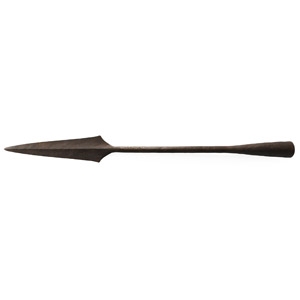
Long shaft tapering towards a triangular blade with strong mid-rib and squared shoulders; professionally cleaned, conserved, and restored. 210 grams, 40.7 cm
Cleaned, conserved and restored.
From the family collection of a South East London collector; formerly acquired in the late 1950s.
The total length of these javelins, including iron heads, shanks and wooden shafts, was probably about 210cm. The design was, obviously, intended to kill or cripple efficiently. The length of the shaft suggest that these javelins, including the infamous angon, were used also in hand to hand combat, where there was a danger of the head being lopped off. -
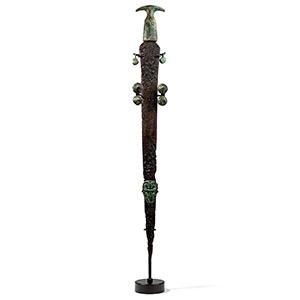
Caucasian Bronze Hilted Iron Sword
Iron Age, 8th-6th century B.C.Estimate: £4,000 - 6,000 (+bp*)
Opening Bid: £1,600
A broad sword with tapering blade and rounded shoulders, bronze hilt with crescentic pommel and apotropaic eye motifs to both sides; accompanied by bronze scabbard or baldric elements including a pair of eyelets with suspension loops, four circular appliqués with conical tips and ropework borders, and a scabbard chape with two opposing ibexes; mounted on a custom-made display stand. 2.2 kg total, 78 cm including stand
From the private collection of a London gentleman, from his grandfather's collection formed before the early 1970s. Accompanied by an academic report by Dr Raffaele D'Amato. This lot has been checked against the Interpol Database of stolen works of art and is accompanied by search certificate number no.12914-245170.
The sword belongs to the Caucasian culture of the Colchis, and represents a very rare typology. A similar blade was found together with early Scythian arrows during excavations at Karmir-Blur. A similar combination found at Kulanurkhva’s excavations suggests that the appearance of such blades in Abkhazia is linked to the Scythian campaigns in Near Eastern Asia. -
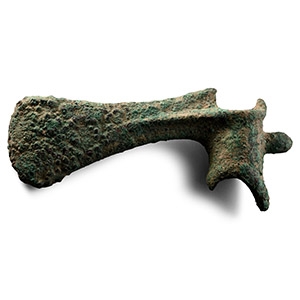
Luristan Bronze Socketted Axehead
2nd-1st millennium B.C.Sold for (Inc. bp): £72
Trapezoidal blade and a cylindrical socket with a collared base, lateral horizontal rib to each face, lobe to the rear; the blade long and with a slightly convex blunt edge. 232 grams, 13.1 cm
Ex Norri collection, Milton Keynes, UK, 1980s-1990s.
