
Loading, please wait...
LOT 0724
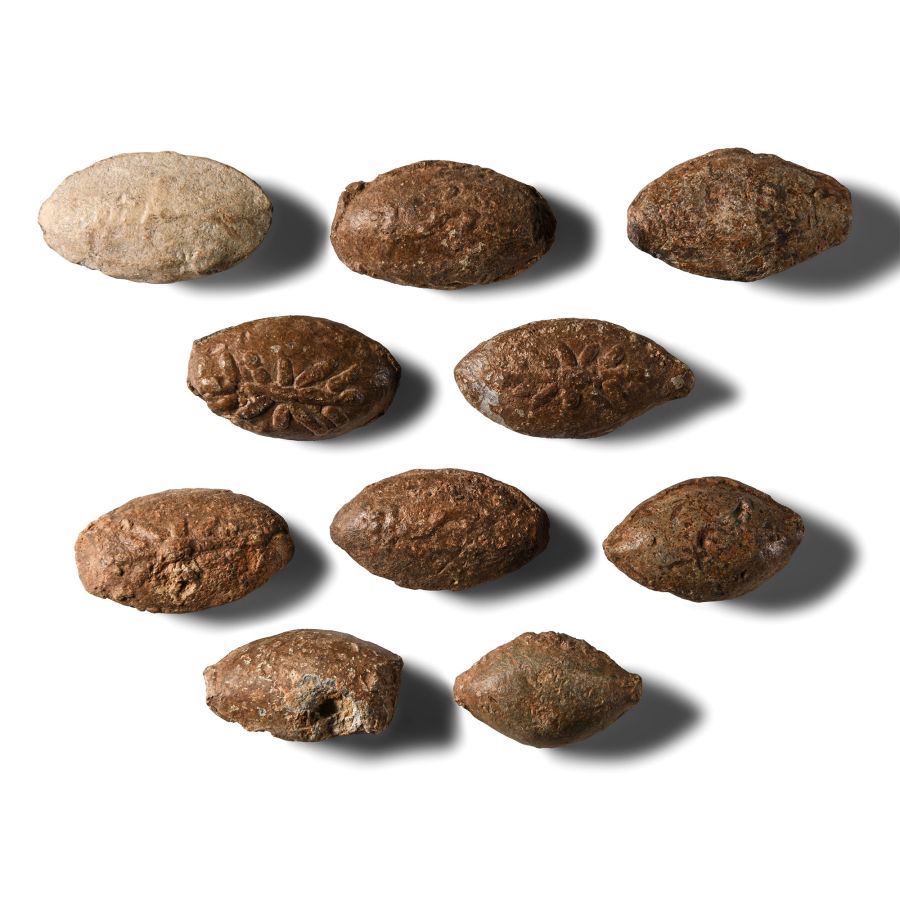
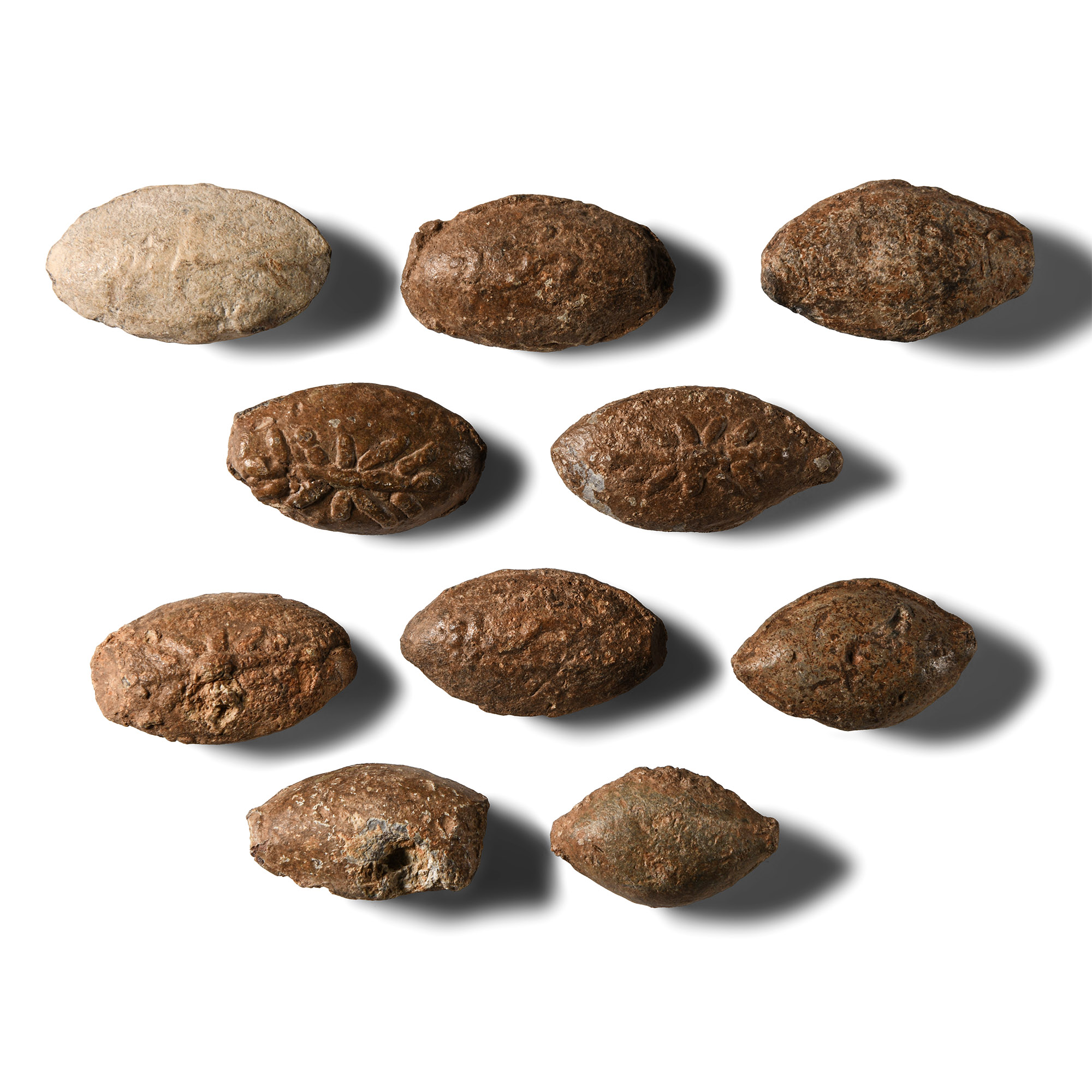
Roman Lead Sling Shot Projectile Collection
1ST CENTURY B.C.-2ND CENTURY A.D.
3/4 - 1 3/8 in. (384 grams total, 18-36 mm).
Comprising ten lentoid-section glandes, five with impressed stylised 'fulmen' (thunderbolt) of Jupiter. [13]
ProvenanceAcquired in Europe in 1990.
European private collection.
Cf. Marchant, D.J., Roman weaponry in the province of Britain from the second century to the fifth century AD, Durham, 1991, fig.26, for similar; Schinco, G., Small, A.M., 'A previously unknown siege of Botromagno/Silvium: the evidence of slingshots from Gravina in Puglia (Provincia di Bari, Puglia)' in Papers of the British School at Rome, 2019, pp.1-52, figs.36, 37.
FootnotesThe missiles of ovoid shape belong to type Ia of the Völling classification. The sling (funda) with its lead missiles (plumbea pondera or glandae) and stone (lapides) was used by special funditores, illustrated on Trajan’s Column where they are simply dressed in broad tunics with no armour, but carry a shield. A fold in their cloak, or sagulum, acted as an ammunition bag. The effectiveness of the slingers was unquestionable and much appreciated, especially against elephants. Celsus, writing towards the end of the 2nd century A.D., described how a slingshot wound was more dangerous and harder to treat than one inflicted by an arrow.
CONDITIONTimeLine Auctions follows a vetting process to ensure the authenticity and legality of all items, reinforcing our commitment to integrity and responsible trading. Each antiquity, antique, and coin lot undergoes thorough examination by a vetting committee of at least ten external specialists, professional trade association members, scientists, and archaeologists: Our Vetting Process
AUCTIONS:
TimeLine is a leading auction house specialising in antiquities, ancient art, collectables, natural history, coins, medals, and books. Our auctions offer museums, collectors, historians, and enthusiasts the opportunity to acquire unique and historically significant pieces.
-
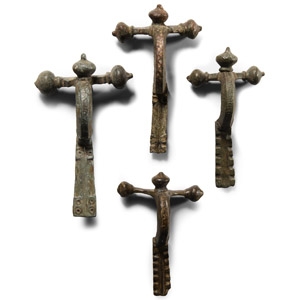
Roman Bronze Crossbow Brooch Group
3rd-4th century A.D.Sold for (Inc. bp): £169
Each with onion-shaped knops to the head, deep bow and footplate with decorative detailing. 147 grams total, 65-82 mm
UK art market, acquired prior to 1980. Property of a Scottish collector, acquired in 2013. -
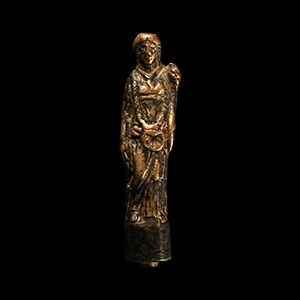
Romano-British Bronze Figural Knife Handle
2nd century A.D.Sold for (Inc. bp): £130
Standing female modelled in the round wearing a floor-length robe and a draped mantle; with scallop-shaped purse on a shoulder-strap, holding a cornucopia in the left hand; handle or finial with round block and peg beneath. 28.5 grams, 55 mm
Reportedly found in the Thames in the 1920s. Accompanied by a previous CNG catalogue information ticket. -
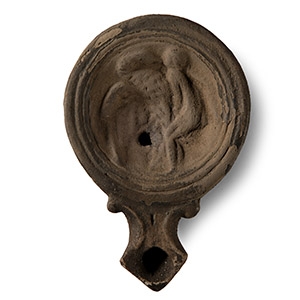
Roman Erotic Leda and the Swan Terracotta Oil Lamp
Circa 1st-2nd century A.D.Sold for (Inc. bp): £572
With a long canal nozzle with volutes, discus with one filling hole and three concentric lines enclosing a central scene of Leda and the swan, softly rendered anatomical details and carefully modelled plumage; two old stickers to base. 74 grams, 11.7 cm
From the collection of Arno Jumpertz, Leverkusen, Germany, 1924-1984; much of the collection was exhibited at the Neus Museum, 1985. Accompanied by a previous catalogue information slip.
The lamp's style refers to the Loeschcke type I, a style popular during the Augustan and Imperial times.
