
Loading, please wait...
_900x900.jpg "Roman Lead Curse Tablet Targeting a Legionary Commander and His Military Unit")
_200x200.jpg "Roman Lead Curse Tablet Targeting a Legionary Commander and His Military Unit")
.jpg "Roman Lead Curse Tablet Targeting a Legionary Commander and His Military Unit")
LOT 0119
Roman Lead Curse Tablet Targeting a Legionary Commander and His Military Unit
LATE 1ST CENTURY A.D.
3 3/8 in. (151 grams total, 87 mm each).
The names of high-ranking officers of a Roman legion engraved in two columns in retrograde script, inter alia the Senatorial Commander of a Roman Legion (legatus legionis), two Tribunes and several Centurions being cursed; with holes to fix it to an object with nails, both being magical practices of antiquity aiming for the malediction of enemies; a unique and important document; it has been proposed to identify the legate with Q. Pomponius Rufus, consul in the year A.D. 95.
ProvenancePrivate collection of the gentleman, J.L. Fernández, Switzerland, before 2000.
From the private academic collection of Professor P.M.A.R.
Accompanied by a copy of the academic paper Rothenhoefer, P., Römische Offiziere auf einer tabella defixionum. Ein außergewöhnliches Dokument magischen Schadenzaubers gegen eine Legionskommandeur und weitere Mitglieder des Offizierskorps, Epigraphica 78, 2016, pp.235-251, where this unique curse tablet is published.
This lot is accompanied by an illustrated lot declaration signed by the Head of the Antiquities Department, Dr Raffaele D'Amato.
Rothenhoefer, P., Römische Offiziere auf einer tabella defixionum. Ein außergewöhnliches Dokument magischen Schadenzaubers gegen eine Legionskommandeur und weitere Mitglieder des Offizierskorps, Epigraphica 78, 2016, pp.235-251; Sánchez Natalías, C., Sylloge of Defixiones from the Roman West. A Comprehensive Collection of Curse Tablets from the Fourth Century BCE to the Fifth Century CE, Oxford, 2022, no.149.
CONDITIONTimeLine Auctions follows a vetting process to ensure the authenticity and legality of all items, reinforcing our commitment to integrity and responsible trading. Each antiquity, antique, and coin lot undergoes thorough examination by a vetting committee of at least ten external specialists, professional trade association members, scientists, and archaeologists: Our Vetting Process
AUCTIONS:
TimeLine is a leading auction house specialising in antiquities, ancient art, collectables, natural history, coins, medals, and books. Our auctions offer museums, collectors, historians, and enthusiasts the opportunity to acquire unique and historically significant pieces.
LOT 0119
Roman Lead Curse Tablet Targeting a Legionary Commander and His Military Unit
Sold for (Inc. bp): £1,690
-
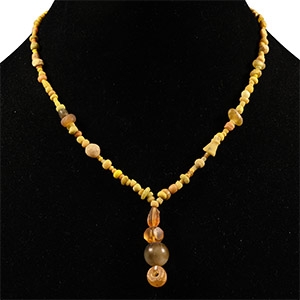
Roman Yellow Glass Bead Necklace String
1st-4th century A.D. and laterSold for (Inc. bp): £98
Restrung group of spherical, cylindrical and other beads. 10.6 grams, 34 cm
Ex London, UK, collection, 1990s. This lot is accompanied by an illustrated lot declaration signed by the Head of the Antiquities Department, Dr Raffaele D'Amato. -
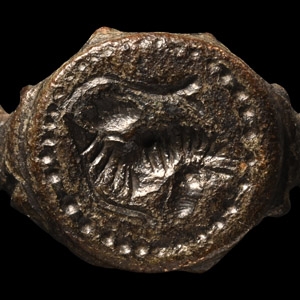
Late Roman Bronze Ring with Animal
4th-5th century A.D.Sold for (Inc. bp): £52
Comprising a slender hoop and balustered shoulders, raised discoid bezel with a hippocampus within a pelletted border. 5.41 grams, 24.65 mm overall, 19.90 mm internal diameter (approximate size British S, USA 9, Europe 20, Japan 19)
Ex German art market, 2000s. Acquired from an EU collector living in London. From the collection of a Surrey, UK, gentleman. This lot is accompanied by an illustrated lot declaration signed by the Head of the Antiquities Department, Dr Raffaele D'Amato. -
.jpg)
Roman and Byzantine Ceramic Oil Lamp Collection
2nd-8th century A.D.Estimate: £300 - 400 (‡+bp*)
Opening Bid: £150
Comprising: a slipper-shaped lamp with low-relief linear decoration; a rounded lamp with large nozzle, a band of omega motifs around the central filler hole; a drum-shaped lamp with low discus with raised double border, short nozzle with ring-and-dot motifs. 159 grams total, 88-94 mm
with Galerie Rhéa, Zurich, Switzerland. This lot is accompanied by an illustrated lot declaration signed by the Head of the Antiquities Department, Dr Raffaele D'Amato.
