
Loading, please wait...
_900x900.jpg "Roman Lead Commercial Weight of 1 Mna")
_200x200.jpg "Roman Lead Commercial Weight of 1 Mna")
.jpg "Roman Lead Commercial Weight of 1 Mna")
LOT 0100
Roman Lead Commercial Weight of 1 Mna
DATED SE 230 (83/2 B.C.)
3 3/4 in. (704 grams, 96 mm).
Square in plan with ribbed edge and hatched reverse; ETOYΣ ΛΣ (date) ΔHMOΣIA MNA (denomination) with border to initial lamda, two crossed cornucopiae, to left a monogram; latticework design to the reverse.
ProvenanceAcquired in the mid 1980s-1990s.
Private collection, Switzerland, thence by descent.
Private collection, since the late 1990s.
This lot has been checked against the Interpol Database of stolen works of art and is accompanied by search certificate number no.12225-222343.
See Gale Brown, H., A study of lead ingot cargoes from ancient Mediterranean Shipwrecks, Vermont, 2011; cf. De Rochesnard; Pondera Online 3558.
FootnotesSuch commercial weights were produced in cities currently or formerly under Seleukid control. The inscription ΔHMOΣIA ('public'), indicates that this was used as an official market weight.
CONDITIONTimeLine Auctions follows a vetting process to ensure the authenticity and legality of all items, reinforcing our commitment to integrity and responsible trading. Each antiquity, antique, and coin lot undergoes thorough examination by a vetting committee of at least ten external specialists, professional trade association members, scientists, and archaeologists: Our Vetting Process
AUCTIONS:
TimeLine is a leading auction house specialising in antiquities, ancient art, collectables, natural history, coins, medals, and books. Our auctions offer museums, collectors, historians, and enthusiasts the opportunity to acquire unique and historically significant pieces.
LOT 0100
Roman Lead Commercial Weight of 1 Mna
Estimate £3,000 - 4,000€3,480 - 4,640 (for guidance only)$4,050 - 5,400 (for guidance only)
-
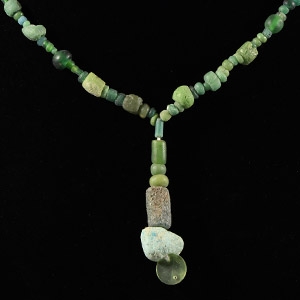
Roman Green Glass Bead Necklace String
1st-4th century A.D. and laterSold for (Inc. bp): £59
Restrung group of mainly annular and seed beads with tabular dangle centrepiece. 13.75 grams, 32.5 cm
Acquired 1980-2015. Ex Abelita family collection. -
.jpg)
Roman and Later Artefact Group
1st-20th century A.D.Sold for (Inc. bp): £85
Comprising complete and fragmentary artefacts: a glass cameo; seal; implements; strap ends; mounting studs; brooches; weights; buckles; pendants; together with other miscellaneous artefacts. 498 grams total, 0.8-13.3 cm
Acquired on the UK art market. Property of a Ruislip, UK, gentleman, by inheritance. -
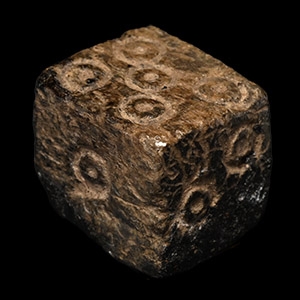
Roman 'Lancashire' Jet Dice Gaming Piece
1st-4th century A.D.Sold for (Inc. bp): £286
Cuboid with incised ring-and-dot markings disposed 1:6, 2:4, 3:5; old collector's label '12' to one face and record card; abraded through usage. 3.24 grams, 13 mm
Found Lancashire, UK. From the important private collection of dice and gaming pieces of Colin Narbeth, London, UK, collection no.12. Accompanied by a Colin Narbeth catalogue identification card.
