
Loading, please wait...


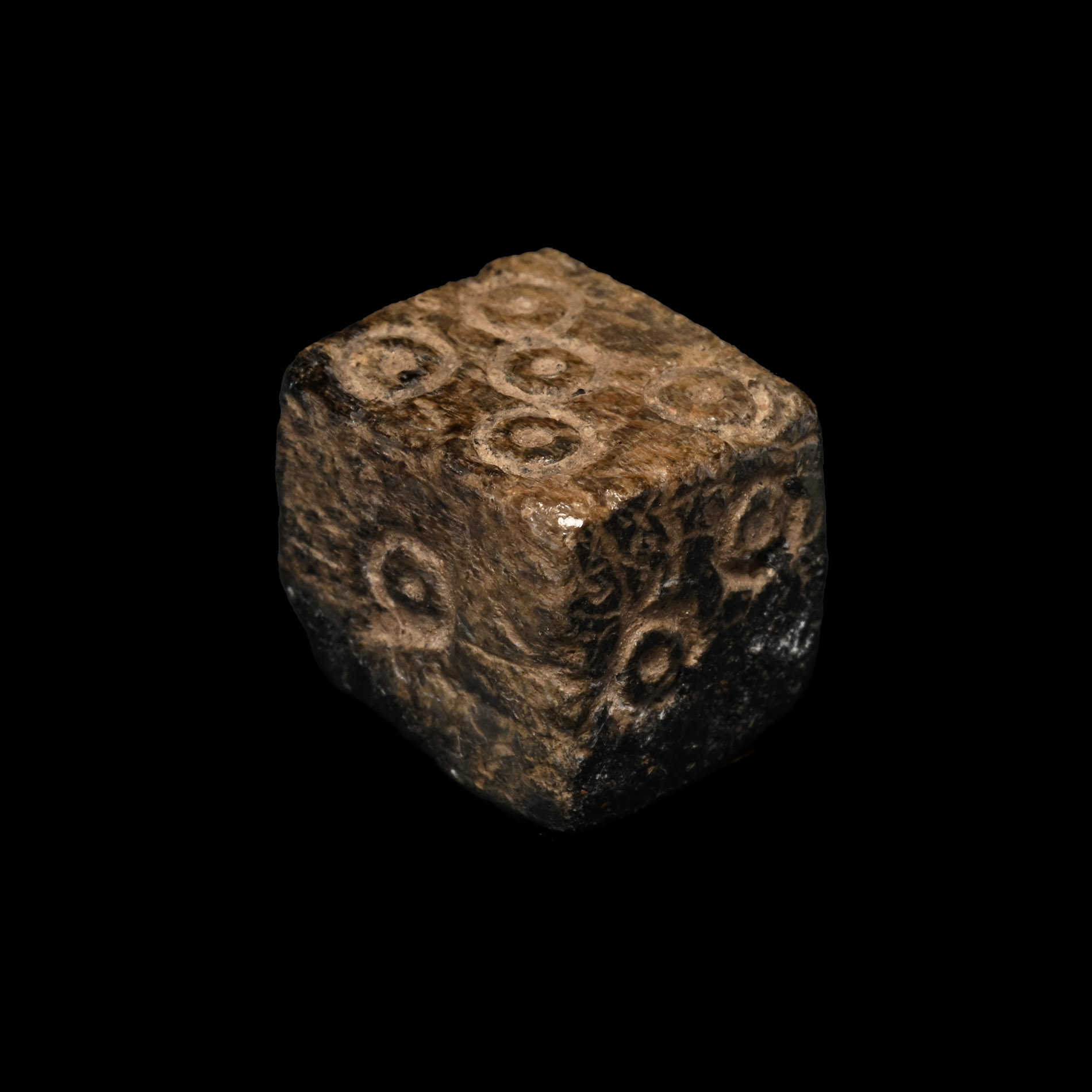
LOT 0971
Roman 'Lancashire' Jet Dice Gaming Piece
1ST-4TH CENTURY A.D.
1/2 in. (3.24 grams, 13 mm).
Cuboid with incised ring-and-dot markings disposed 1:6, 2:4, 3:5; old collector's label '12' to one face and record card; abraded through usage. [No Reserve]
ProvenanceFound Lancashire, UK.
From the important private collection of dice and gaming pieces of Colin Narbeth, London, UK, collection no.12.
Accompanied by a Colin Narbeth catalogue identification card.
See Beutler, F. et al., Der Adler Roms. Carnuntum und der Armee der Cäsaren, Bad-Deutsch Altenberg, 2017, item 724, for type.
CONDITIONTimeLine Auctions follows a vetting process to ensure the authenticity and legality of all items, reinforcing our commitment to integrity and responsible trading. Each antiquity, antique, and coin lot undergoes thorough examination by a vetting committee of at least ten external specialists, professional trade association members, scientists, and archaeologists: Our Vetting Process
AUCTIONS:
TimeLine is a leading auction house specialising in antiquities, ancient art, collectables, natural history, coins, medals, and books. Our auctions offer museums, collectors, historians, and enthusiasts the opportunity to acquire unique and historically significant pieces.
-
.jpg)
Roman Marble Head of a Satyr
Late 1st-early 2nd century A.D.Estimate: £40,000 - 60,000 (‡+bp*)
Opening Bid: £20,000
Finely carved head of a young satyr with arched brows, pointed ears and tousled curly hair, his short rounded horns projecting from the hairline, lips drawn back in a mischievous smile with the tip of his tongue protruding to his right; head turned to his right, eyes slightly downcast; traces of wattles to each side of the jaw, tip of nose abraded, forelock chipped; mounted on a custom-made display stand. 18.2 kg total, 40 cm including stand
Christoph Bernoulli (1897-1981), Basel, possibly acquired from Münzen & Medaillen AG, Basel; thence by descent. Accompanied by an academic report by Dr Raffaele D’Amato. This lot has been checked against the Interpol Database of stolen works of art and is accompanied by search certificate no.12188-222442.
The head seems a work of the 2nd century A.D., derived from Hellenistic prototypes, likely based on a Greek original of the 4th or 3rd century B.C. traditionally associated with the work of Praxiteles, Skopas or Lysippos, depicting a standing Pan playing the flute with his legs crossed. However, both the present head and the Princeton example, always after Hellenistic prototypes of the mid-2nd century B.C., are close to the statue of the so-called Young Centaur signed by Aristeas and Papias, in bigio morato, which was found at Tivoli in Hadrian’s Villa and is now in the collection of the Capitoline Museum (inv. No. MC0656). -
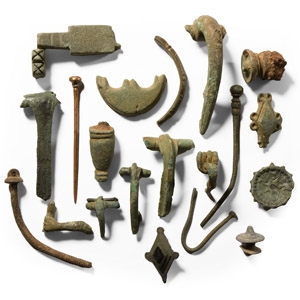
Roman Bronze Artefact Collection
1st-3rd century A.D.Sold for (Inc. bp): £33
Including fragments of a bronze key, belt-mount with glass insert, dress pins, Colchester type bow brooch, arm from a figurine, scabbard chape, Langton Down type bow brooch and other items. 208 grams total, 17-78 mm
Found on various UK sites since 1974. Property of an Essex collector. -
.jpg)
Roman and Later Artefact Group
1st-20th century A.D.Sold for (Inc. bp): £85
Comprising complete and fragmentary artefacts: a glass cameo; seal; implements; strap ends; mounting studs; brooches; weights; buckles; pendants; together with other miscellaneous artefacts. 498 grams total, 0.8-13.3 cm
Acquired on the UK art market. Property of a Ruislip, UK, gentleman, by inheritance.
