
Loading, please wait...
_900x900.jpg "Roman Julius Caesar Lead Sling Shot from the Battle of Munda")
_200x200.jpg "Roman Julius Caesar Lead Sling Shot from the Battle of Munda")
.jpg "Roman Julius Caesar Lead Sling Shot from the Battle of Munda")
LOT 0257
Roman Julius Caesar Lead Sling Shot from the Battle of Munda
45 B.C.
1 3/8 in. (65.04 grams, 37 mm).
Bearing a monogram: a combination of the letters 'C', 'A' and 'E', for 'C A E S' referring to Julius Caesar.
ProvenanceFound near to a village close to Seville, 1960-1970.
From an old Spanish collection.
Swiss private collection.
Accompanied by a copy of the Spanish export licence.
Accompanied by an academic paper by military specialist Dr Raffaele D'Amato, dated 4th May 2022 and titled Roman Res Publica - Lead Slingshots (glandes) of Caesarian Age - 45 B.C circa.
Cf. D'Amato, R. and Sumner, G., Arms and Armour of the Imperial Roman Soldier: From Marius to Commodus, 112 BC-AD 192, London, 2009, fig.32, p.45, for similar glandes from Zaragoza Museum, the one with the name of Pompey inscribed also from the Munda battlefield; Schinco, G., Small, A.M., 'A previously unknown siege of Botromagno/Silvium: the evidence of slingshots from Gravina in Puglia (Provincia di Bari, Puglia)' in Papers of the British School at Rome, 2019, pp.1-52, figs.31, 37.
FootnotesThe shot (type IIb of the Völling classification) is marked with the abbreviated name of Julius Caesar; it was used in quantity at the Battle of Monda (or Munda) against the last fellows of Pompey, the leaders of the Optimates, on the 17th March 45 B.C. Similar shots were used in the civil war among Pompey and Caesar, and in all Caesar's wars. The funditores of Caesar's age were part of the light infantry. Caesar speaks of his Balearic slingers during the conquest of Gaul, who were usually covered by a short tunic, leather or rope sandals, a coat to cover them, but which could also have been used to store projectiles. Rather, they used a satchel to carry very deadly lead-like stones or bullets. The men employed several slings: one was tied around the head for quick employment should the other break during the battle.
CONDITIONTimeLine Auctions follows a vetting process to ensure the authenticity and legality of all items, reinforcing our commitment to integrity and responsible trading. Each antiquity, antique, and coin lot undergoes thorough examination by a vetting committee of at least ten external specialists, professional trade association members, scientists, and archaeologists: Our Vetting Process
AUCTIONS:
TimeLine is a leading auction house specialising in antiquities, ancient art, collectables, natural history, coins, medals, and books. Our auctions offer museums, collectors, historians, and enthusiasts the opportunity to acquire unique and historically significant pieces.
LOT 0257
Roman Julius Caesar Lead Sling Shot from the Battle of Munda
Sold for (Inc. bp): £520
-
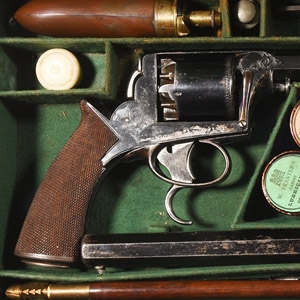
Cased 1st Model Tranter 36 Bore Revolver Pair
1853-1854 A.D.Sold for (Inc. bp): £6,500
With 19.5cm (8¾") octagonal rifled barrels of 36 bore (marked to front of frame), solid Adams patent frames with foliate engraving marked 'ADAMS PATENT ' and serial numbers 20,368Y and 20,832Y with plain loading lever pins to left side, Tranter double trigger (providing single and double action), London proof marks to 5-shot cylinders and barrels, blued finish; in wood case with two hook latches and lock (no key) with accessories including loading lever (stamped 'TRANTERS PATENT 36), wood cleaning rod with extractor screw and two brass cleaning tips), wood handled turnscrew and nipple key, pewter oil bottle, steel wad cutter (marked CAST STEEL), brass-handled double bullet mould (stamped 'TRANTERS PATENT 36); Dixon powder flask, tin of Eley's Superior caps, tin of Tranter's Lubricating Composition, turned bone container with four spare nipples and three pre-made bullets with felt wads. 5.10 kg total, case 43 x 24 cm
Acquired Brighton dealer, 2020. Property of a Kent collector. This lot has been checked against the Interpol Database of stolen works of art and is accompanied by search certificate no.204131.
The Tranter revolvers based on the Adams solid frame were numbered from 20,000 and have the Y suffix. Sold as an exempt item under Section 58 (2) of the Firearms Act, 1968, to be held as a curiosity or ornament. No license required but buyer must be over 18 years of age. Overseas bidders should note that, due to UK regulations governing export of all firearms, overseas buyers will need to make arrangements for shipping this lot out of the UK directly, by air freight, with a specialist company or agent. -
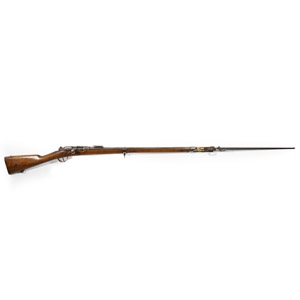
1866/74 Model Gras Rifle and Bayonet
Dated 1868 A.D.Estimate: £500 - 700 (+bp*)
Opening Bid: £222
Round rifled 90cm (35½") barrel of 11mm calibre with folding rear sight (without slide), bolt action with serial no.52431 to breech; fitted with full wood stock with steel butt cap, trigger guard, sling swivels and fore-end, steel cleaning rod; with correct Gras bayonet inscribed 'M[--] d'Armes de St Etienne 8bre 1878' to back and steel scabbard. 4.8 kg, 1.84 m
Acquired from Czerny's Auctions, Italy, 2019. The Kusmirek Collection, UK. Accompanied by a copy of Czerny's invoice and listing.
Sold as an exempt item under Section 58 (2) of the Firearms Act, 1968, to be held as a curiosity or ornament. No license required but buyer must be over 18 years of age. Overseas bidders should note that, due to UK regulations governing export of all firearms, overseas buyers will need to make arrangements for shipping this lot out of the UK directly, by air freight, with a specialist company or agent. -
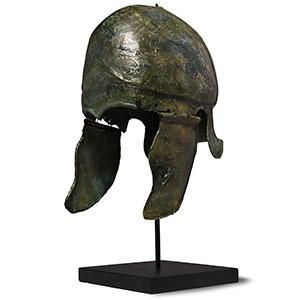
Greek Bronze Chalcidian Helmet
5th-4th century B.C.Estimate: £4,000 - 6,000 (+bp*)
Opening Bid: £1,667
Of Kunze Group VII, formed from two curved segments, each with a flared rim, nasal, raised panels to the upper section of the bowl, repoussé ridge forming curved brows, a recess for the ear to each side; star-shaped attachment to the top with slot for plumes; restored and with replica cheek pieces. 2.7 kg total, 42.5 cm high including stand
Restored, but in general good condition, rare details
Acquired in the 1970s. Ex private Austrian collection. The Kusmirek Collection, UK Accompanied by an academic report by Dr Raffaele D'Amato. Accompanied by a report of metallurgical analytical results, written by metallurgist Dr Brian Gilmour of the Research Laboratory for Archaeology and History of Art, University of Oxford. This lot has been checked against the Interpol Database of stolen works of art and is accompanied by search certificate number no.11763-203979.
Among the Chalcidian helmet types, the fifth and last typology, corresponding to the Kunze group VII (Pflug, 1988, p.138), was characterised by the presence of detached cheek-guards. By the end of the 5th century BC, the fixed cheek-pieces had been entirely abandoned on the Chalcidian helmets for the more versatile hinged cheek pieces. As is the case with most of the Greek helmets in 5th and 4th century B.C., very few originals have been found on the Greek continent. Several district regional workshops produced such helmets by the 5th century B.C.: mainland Greece, the Black Sea Coast, Thrace, Southern Italy and Iberia.
