
Loading, please wait...
LOT 0266
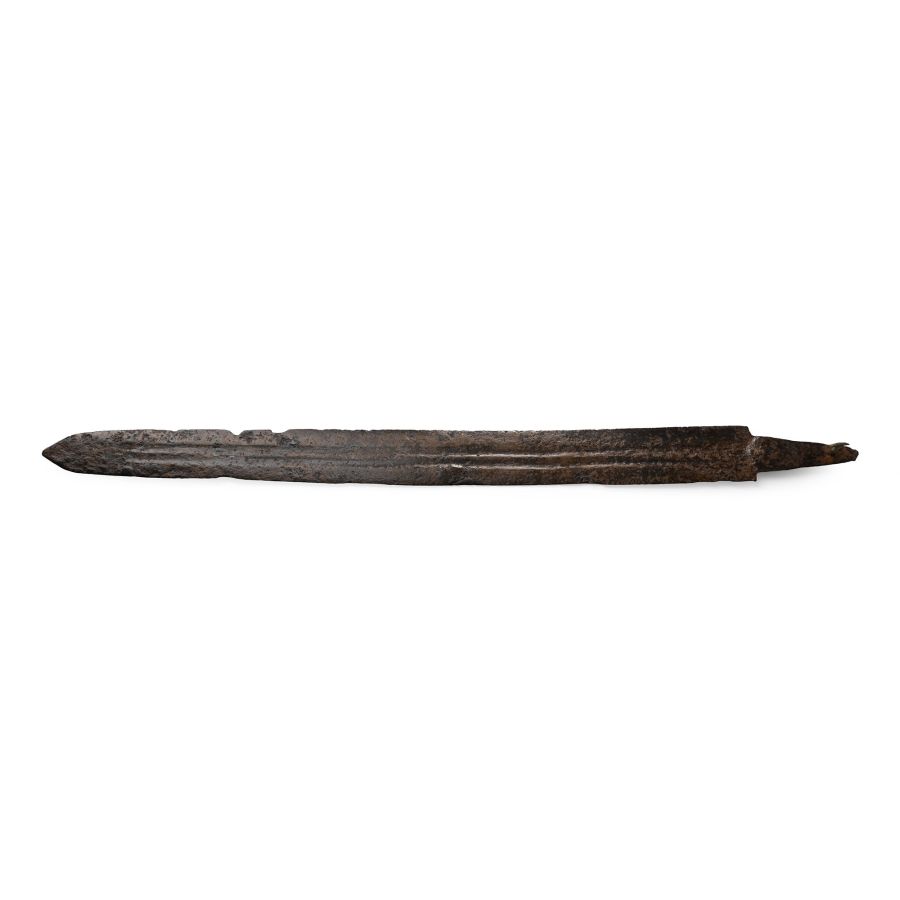
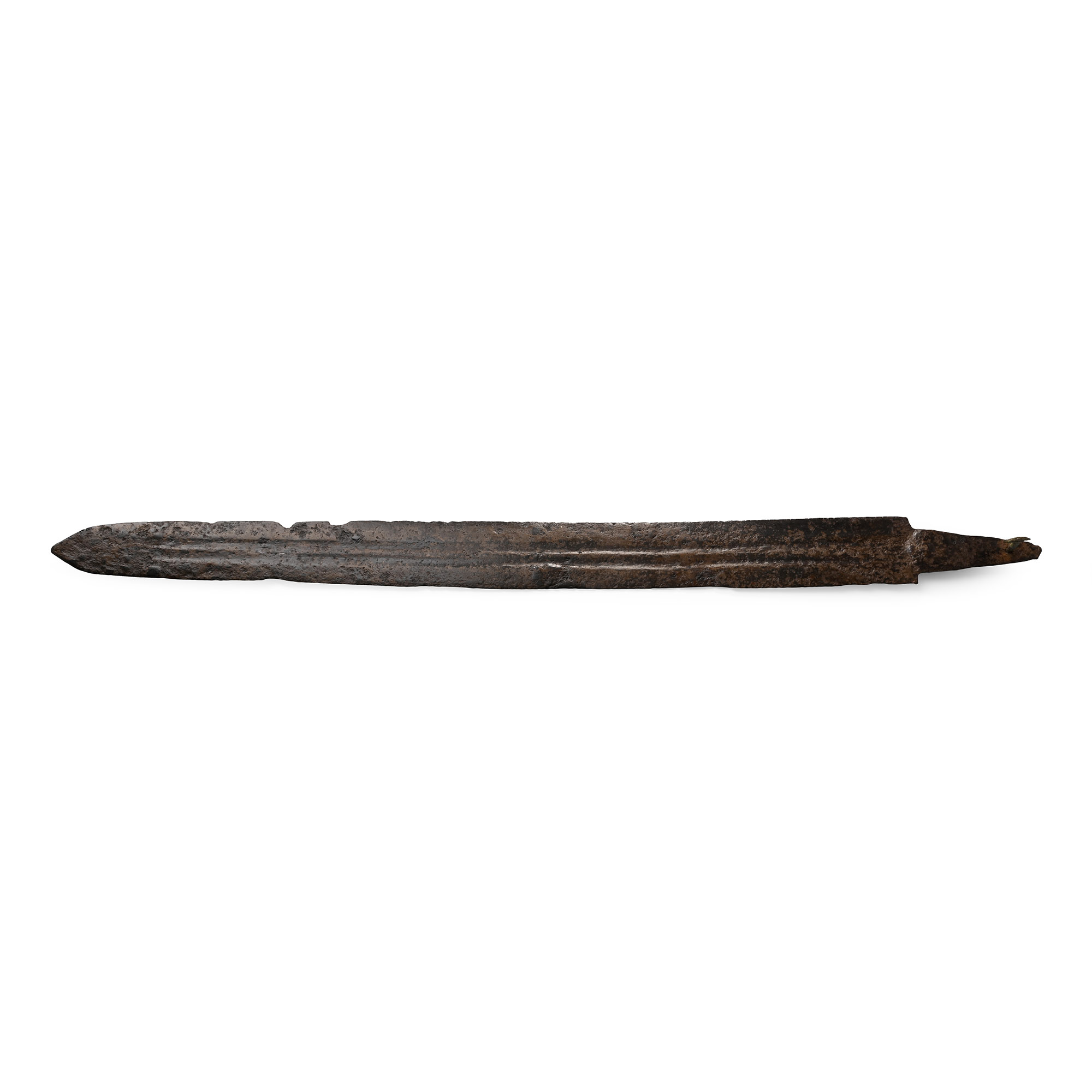
Roman Iron Spatha Sword
2ND-4TH CENTURY A.D.
27 5/8 in. (468 grams, 70.1 cm).
A double-edged blade of Lauriacum Hromówka typology with blood channels running down most of its length on both sides, parallel cutting edges tapering towards the triangular point, massive tapering tang with a bronze nail for the fastening of the pommel, and an ancient repair at the base of the tang with a flattened domed rivet.
ProvenanceFrom the private collection of a London gentleman, from his grandfather's collection formed before the early 1970s.
Accompanied by an academic report by Dr Raffaele D’Amato.
This lot has been checked against the Interpol Database of stolen works of art and is accompanied by a search certificate number no.12917-245171.
Cf. Biborski, M.,‘Miecze z okresu wpływów rzymskich na obszarze kultury przeworskiej’, in Materiały Archeologiczne XVIII, 1978, pp. 53-165; Czarnecka, K.,‘Two newly-found Roman swords from the Przeworsk culture cemetery in Oblin, Siedlce District, Poland’ in JRMES 3, 1992, pp. 41-56; Biborski, M., ‘Römische Schwerter im Gebiet des europäischen Barbaricum’, in JRMES 5, 1994, pp.169-198; Southern, P., Dixon, K.R., The Late Roman Army, London, 1996; Miks, C., Studien zur Romischen Schwertbewaffnung in der Kaiserzeit, I-II Banden, Rahden, 2007; Cascarino,G., Sansilvestri,C., L’esercito romano, armamento ed organizzazione, vol.III, dal III secolo alla fine dell’Impero d’Occidente, Rimini, 2009; for very similar specimens see Miks, 2007, nos.A106 (Chmielów Piaskowy, dated at the 2nd century A.D.); A685 (Spicymierz, dated to the mid 4th century A.D.).
FootnotesAlthough in Latin literature the late Roman sword was often still conventionally called gladius (Ammianus Marcellinus, Historiae, XIX, 6; Passio SS. Rogatiani et Donatiani, 1859, p.323), the main kind of blade of the 3rd and 4th century Roman soldier belongs to the type so-called spatha (Scriptores Historia Augusta, Divus Claudius, XXV,7,5; 8,5) which directly derived from the long cutting Celtic sword of the La Tène III period, already used by the cavalrymen and auxilia of the previous ages. The great spatha (spathì) of the Roman heavy infantryman was considered by Julius Africanus (Fragm., I, 1, 53) as the main weapon of the armoured legionary of Alexander Severus. The frequent clashes with Germanic warriors armed with long swords and the increased recruitment of them in the Roman army quickened a more intensive use of the spathae by the milites legionarii. These longer swords slowly replaced the shorter gladius, the double-edged sword of the imperial infantry, for all types of troops.
CONDITIONTimeLine Auctions follows a vetting process to ensure the authenticity and legality of all items, reinforcing our commitment to integrity and responsible trading. Each antiquity, antique, and coin lot undergoes thorough examination by a vetting committee of at least ten external specialists, professional trade association members, scientists, and archaeologists: Our Vetting Process
AUCTIONS:
TimeLine is a leading auction house specialising in antiquities, ancient art, collectables, natural history, coins, medals, and books. Our auctions offer museums, collectors, historians, and enthusiasts the opportunity to acquire unique and historically significant pieces.
-
Medieval Iron Single-Edged Dagger
12th-14th century A.D.Sold for (Inc. bp): £33
With thick straight back and gently tapering cutting edge, flat tang pierced to accept rivets to attach scales. 264 grams, 42.3 cm
Acquired 1990s-early 2000s. From an East Anglian, UK, private collection. From the property of a late Lincolnshire, UK, gentleman. -
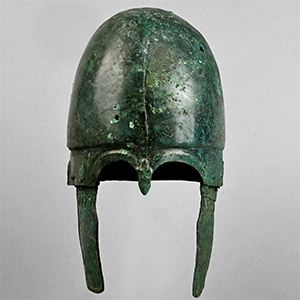
Greek Bronze Chalcidian-Type Helmet
Circa 5th-4th century B.C.Estimate: £12,000 - 17,000 (+bp*)
Opening Bid: £6,000
Hammered from sheet-bronze, hemispherical dome with a seam at the front and back, the seams secured together with a series of pins, threaded through rivet holes; from the front, a repoussé ridge forming curved brows leading down towards a nasal decorated with four pellets; two small perforations above the right brow and a perforation on either side of the top section; two cheek guards present, a characteristic of the helmet’s type, attached to the helmet with hinges, allowing for easier wear and construction; the cheek-pieces rectangular in shape and curved at the back; a horizontal band of inverted triangles decorating the top of each cheek guard, each pierced towards the bottom, where an inner lining would have been attached, two curved cut-outs behind to accommodate ears; accompanied by a custom-made display stand. 1.46 kg total, 48 cm including stand
Previously with the Parthenon Gallery, WC1, London, UK; acquired 2010. From the J.L. collection, Surrey, UK. Accompanied by an academic report by Dr Raffaele D'Amato. This lot has been checked against the Interpol Database of stolen works of art and is accompanied by search certificate number no.12909-244364.
The Chalcidian helmet was a popular type of helmet in the Hellenistic world, particularly in the Greek-occupied region of southern Italy, during the 5th and 4th centuries. However, types have also been found from the mid-6th century BC. It was a lightweight progression from the Corinthian helmet and allowed the wearer better hearing and vision than its older, bulkier Corinthian counterparts. The term ‘Chalcidian’ originates from its frequent depiction on pottery once thought to have come from the Euboean city of Chalcis. This variant of the Chalcidian helmet, featuring hinged cheekplates, is also known as the Lucanian type, as it was used extensively in Lucania. This type of helmet was still in use by the time of Alexander the Great, particularly by the hoplites, heavy infantrymen, and is thought to have developed into the Attic helmet, used well into the Imperial Roman era. -
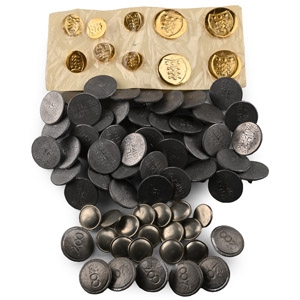
Reproduction Button Collection
20th century A.D.Estimate: £20 - 30 (+bp*)
Opening Bid: £5
Including reproductions of British Royal Artillery [10 pieces], 8th (The King's) Regiment Foot [7 pieces], Butler's Rangers [40 pieces] and others plain [15 pieces]. 561 grams total, 15-24 mm
From the private collection of author and historian Dr DeWitt Bailey, one of the global authorities on the confederate army in the US civil war; thence by descent to his grandson.
