
Loading, please wait...


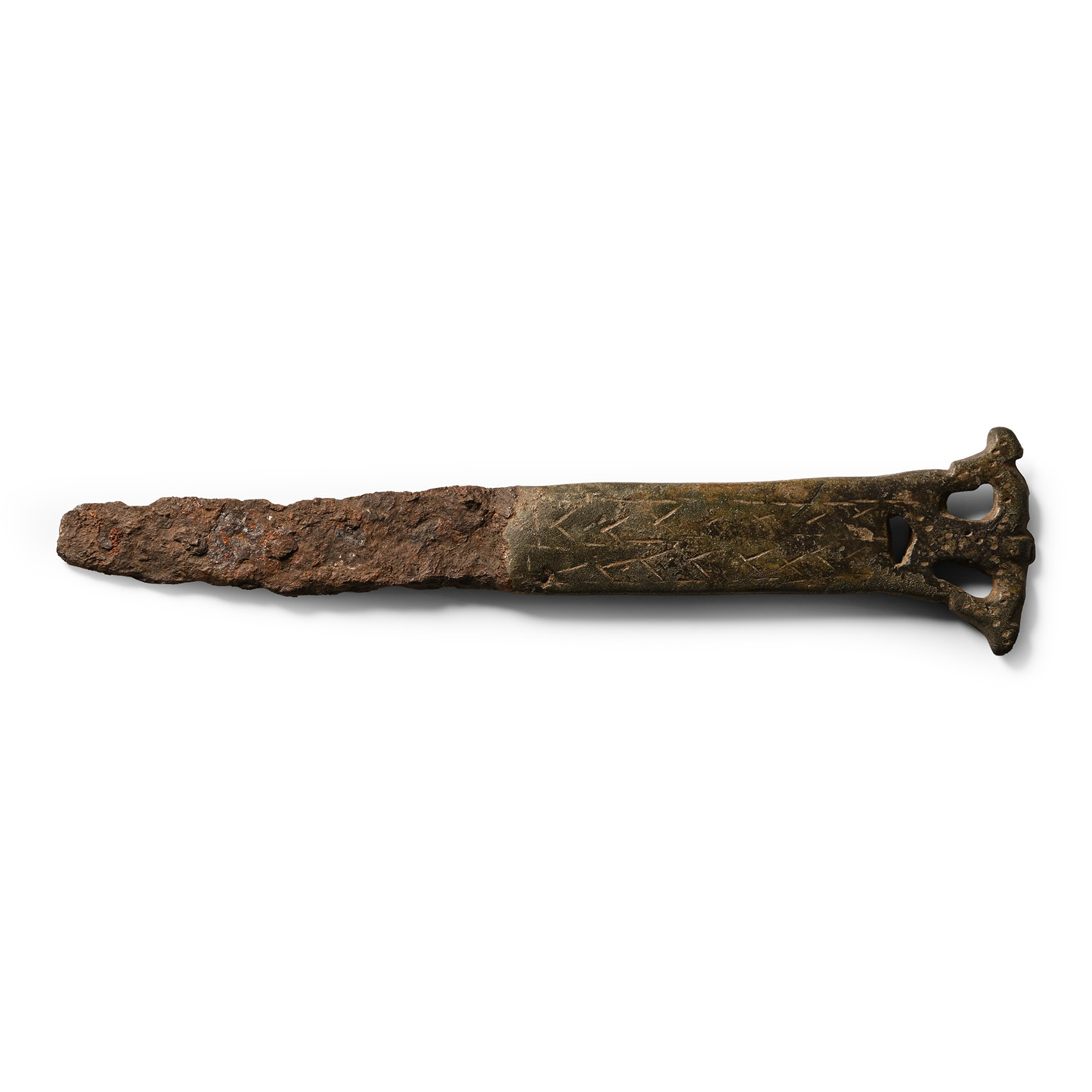
LOT 0748
Roman Iron Knife with Bronze Decorated Handle
CIRCA 2ND-3RD CENTURY A.D.
5 3/8 in. (62 grams, 13.5 cm).
Single-edged iron blade with ellipsoid-section bronze handle, openwork acanthus-leaf finial, bands of loose crosshatching to both faces. [No Reserve]
ProvenanceAcquired on the British art market.
From the collection of a South West London, UK, specialist Stone Age collector.
See Capwell, Dr. T., Knives, Daggers and Bayonets, London, 2009.
CONDITIONTimeLine Auctions follows a vetting process to ensure the authenticity and legality of all items, reinforcing our commitment to integrity and responsible trading. Each antiquity, antique, and coin lot undergoes thorough examination by a vetting committee of at least ten external specialists, professional trade association members, scientists, and archaeologists: Our Vetting Process
AUCTIONS:
TimeLine is a leading auction house specialising in antiquities, ancient art, collectables, natural history, coins, medals, and books. Our auctions offer museums, collectors, historians, and enthusiasts the opportunity to acquire unique and historically significant pieces.
-
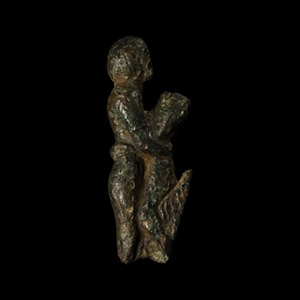
Roman Bronze Erotic Mount
1st-4th century A.D.Sold for (Inc. bp): £26
Modelled in the round fragment depicting a couple embracing. 9.14 grams, 35 mm
From a collection acquired on the UK art market from various auction houses and collections mostly before 2000. From an important Cambridgeshire estate; thence by descent. -
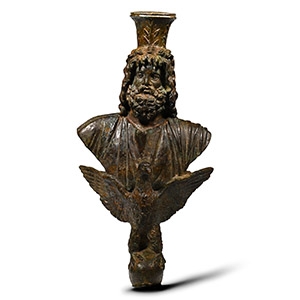
Large Roman Bronze Staff Finial with Bust of Serapis
Circa 2nd century A.D.Estimate: £50,000 - 70,000 (‡+bp*)
Opening Bid: £22,222
With luxuriant long wavy hair and characteristic vertical locks at the forehead, full beard with two large ringlets below the chin, wearing a chiton and a himation draped over the left shoulder, the head surmounted by a corn modius decorated with olive branch in relief, the bust supported on the back of an eagle standing atop an orb with spread wings, the eagle with its head slightly turned to the left, the feathers finely detailed; a finial from a staff or a ceremonial standard; repaired. 1.4 kg, 29.5 cm high
Repaired.
Ex private collection, South Germany, 1980. with Gorny and Mosch, Munich, 13 December 2003, no.74. with Christie's, New York, 8 June 2012, no.239 (US $120,000-180,000). Accompanied by an academic report by Dr Raffaele D’Amato. This lot has been checked against the Interpol Database of stolen works of art and is accompanied by search certificate number no.11789-206489.
The Emperor Septimius Severus (193-211 A.D.) modelled many of his portraits based on Serapis. But it was under Hadrian that the refurbishment of the statue in the Serapeum increased the demand for small-scale images, like this one, probably made during his reign and used atop of a processional sceptre or standard for the cult of the god. -
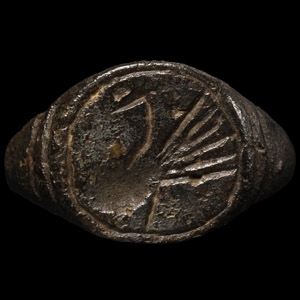
Roman Bronze Ring with Swan
1st-2nd century A.D.Sold for (Inc. bp): £52
With stepped shoulders, plaque with incuse profile bird, probably a swan. 5.13 grams, 23.34 mm overall, 19.29 mm internal diameter (approximate size British T 1/2, USA 9 3/4, Europe 21.89, Japan 21)
Private collection formed since the 1940s. UK art market. Property of an Essex, UK, gentleman.
