
Loading, please wait...
LOT 0254
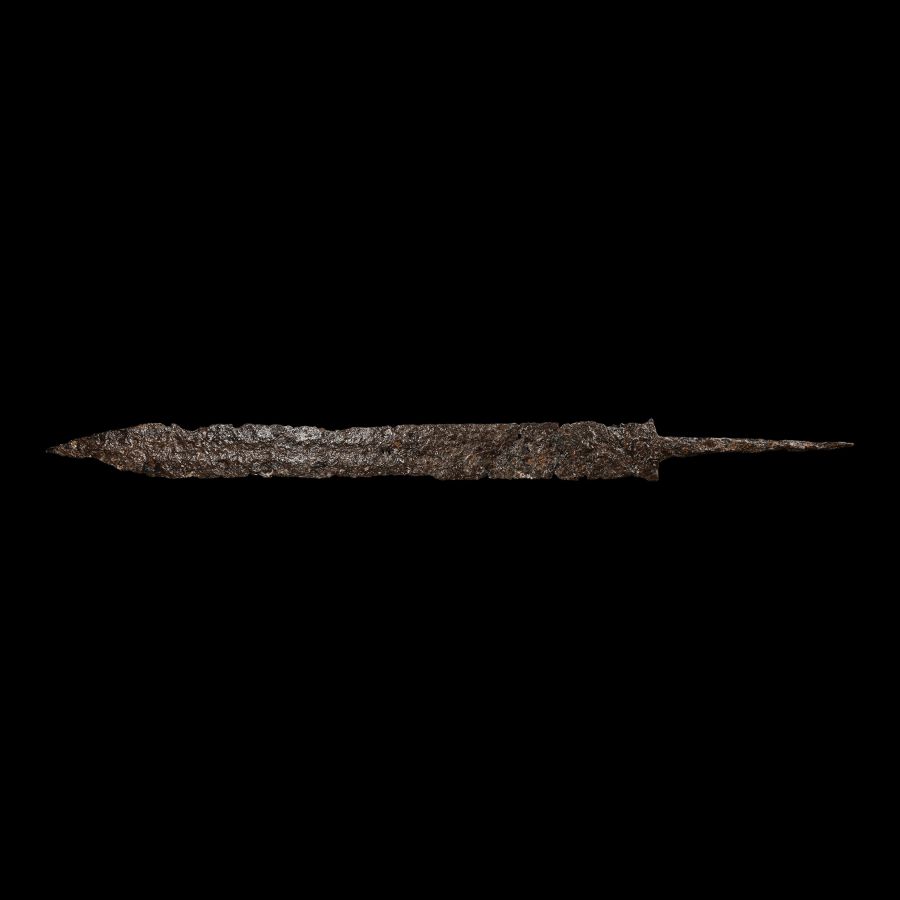
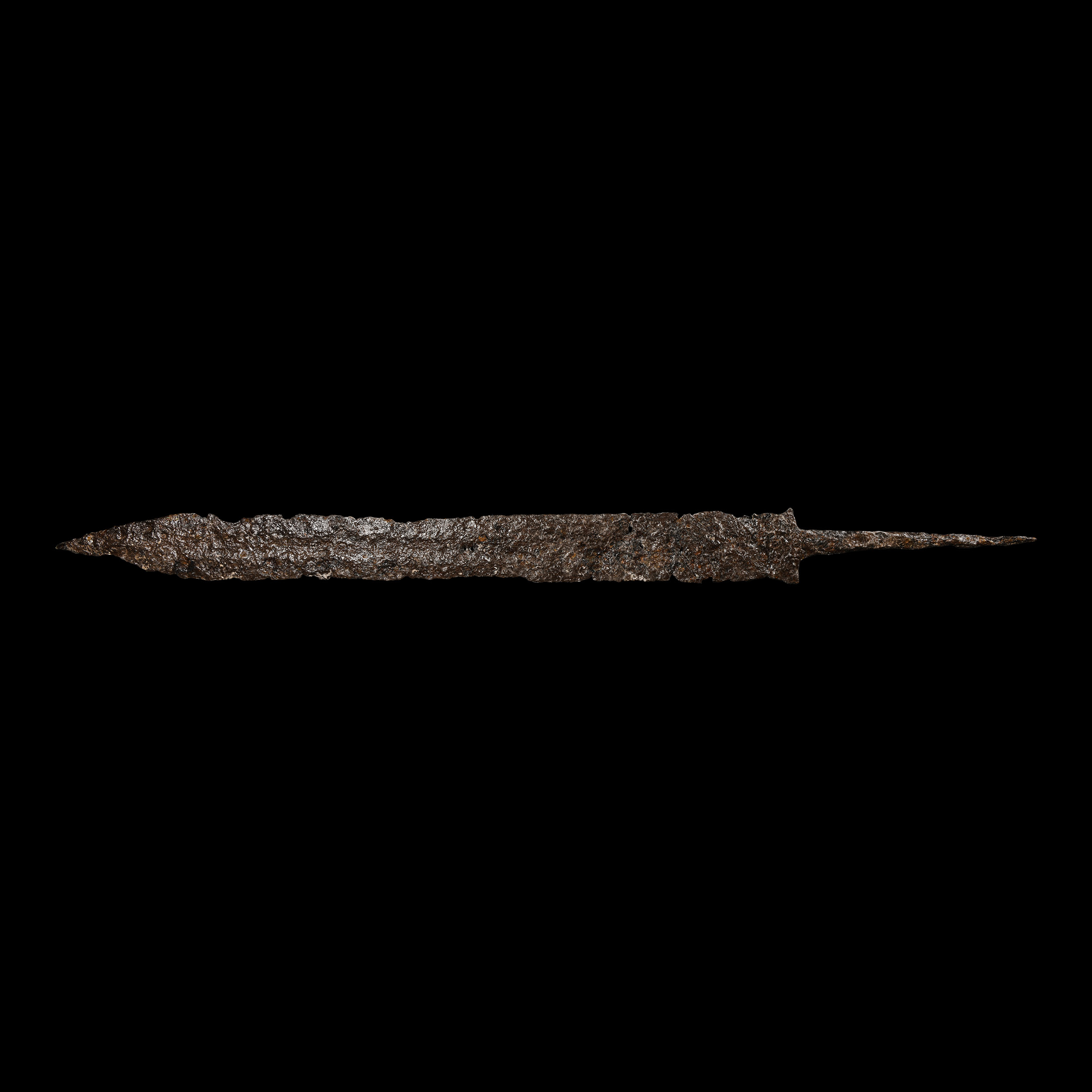
Roman Iron Gladius
1ST-2ND CENTURY A.D.
32 5/8 in. (557 grams, 83 cm).
Or semi-spatha blade with parallel-sided lentoid-section body and a long rectangular-section tang; Mainz type, Wederath-Canterbury-Kopki variant; repaired and surface treated.
ProvenanceEx South London collection, acquired 1970-1990.
The Kusmirek Collection, UK.
Accompanied by an academic report by Dr Raffaele D'Amato.
See Miks, C., Studien zur Romischen Schwertbewaffnung in der Kaiserzeit, I-II Banden, Rahden, 2007, p.637, no.A369, for similar specimen from Korytnica (Poland), found in 1999.
FootnotesIn contrast to the average length of the Roman Pompeii type gladius, some Roman swords, continuing the typology of the Mainz gladius, tend to be longer and transform themselves into a semi-spatha. Both the weapon from Eich (Miks, 2001, AI43), and especially a gladius from Korytnica with approximate blade length of 548mm (total length 762mm) is very close to the length limit of a semi-spatha. The same can be said of a blade from Godmanchester (Miks, 2001, no.A824) for its dimensions and proportions, where the tip of the blade already gives a significantly shorter impression, showing a certain relationship to 'Lauriacum-Hrornöwka', 'Mainz-Canterbury' variant type spathae.
CONDITIONTimeLine Auctions follows a vetting process to ensure the authenticity and legality of all items, reinforcing our commitment to integrity and responsible trading. Each antiquity, antique, and coin lot undergoes thorough examination by a vetting committee of at least ten external specialists, professional trade association members, scientists, and archaeologists: Our Vetting Process
AUCTIONS:
TimeLine is a leading auction house specialising in antiquities, ancient art, collectables, natural history, coins, medals, and books. Our auctions offer museums, collectors, historians, and enthusiasts the opportunity to acquire unique and historically significant pieces.
LOT 0254
Roman Iron Gladius
Estimate £1,800 - 2,400€2,090 - 2,780 (for guidance only)$2,430 - 3,240 (for guidance only)
-
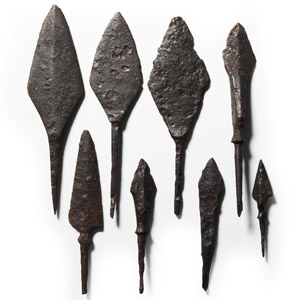
Medieval Iron Arrowhead Group
12th-15th century A.D.Sold for (Inc. bp): £169
Comprising tanged arrowheads of various types, including leaf-shaped, lozengiform, triangular and leaf-shaped examples, together with others. 66 grams total, 41-88 mm
Acquired on the German art market, before 2000. Ex German collection. The Kusmirek Collection, UK. -
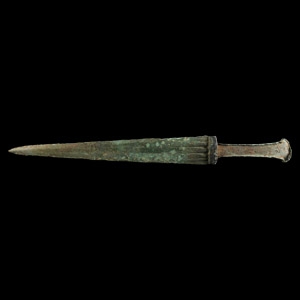
Luristan Bronze Dirk
Circa 1000 B.C.Sold for (Inc. bp): £234
Cast in one piece, with narrow blade having almost parallel edges, flanged hilt with narrow grip widening slightly towards the ricasso, decorated from five parallel grooves, and running smoothly into the blade. 188 grams, 33 cm
Ex German collection, Cologne, 1980-1990s.
The dirk belongs to the type III in the Medvedskaya classification, but with a smallest hand guard at the base. The dating of type III to the 12th century B.C., suggested by Medvedskaya and confirmed by Khorasani, was based on the series of dirks with an inscription of the Babylonian King Nebuchadnezzar I and of the name of Marduk Nadin Ahhe on similar types of daggers. -
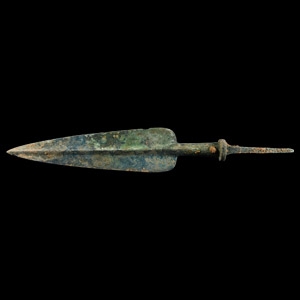
Western Asiatic Bronze Spearhead
Circa 2nd millennium B.C.Sold for (Inc. bp): £130
Triangular profile with projecting midribs, round shank with raised collar above the square-section tapered tang. 186 grams, 28.5 cm
Ex German collection, Cologne, 1980-1990s.
This variant of the tripartite spear is characterised by a rhomboidal or swollen section blade, often with a short intermediate part widened so as to form a clean stop and with a curved tang, sometimes ending in a button (here unfortunately missing). Most spears have medium dimensions (23 cm to 36 cm), but others are elongated (more than 50 cm).
