
Loading, please wait...
LOT 1390
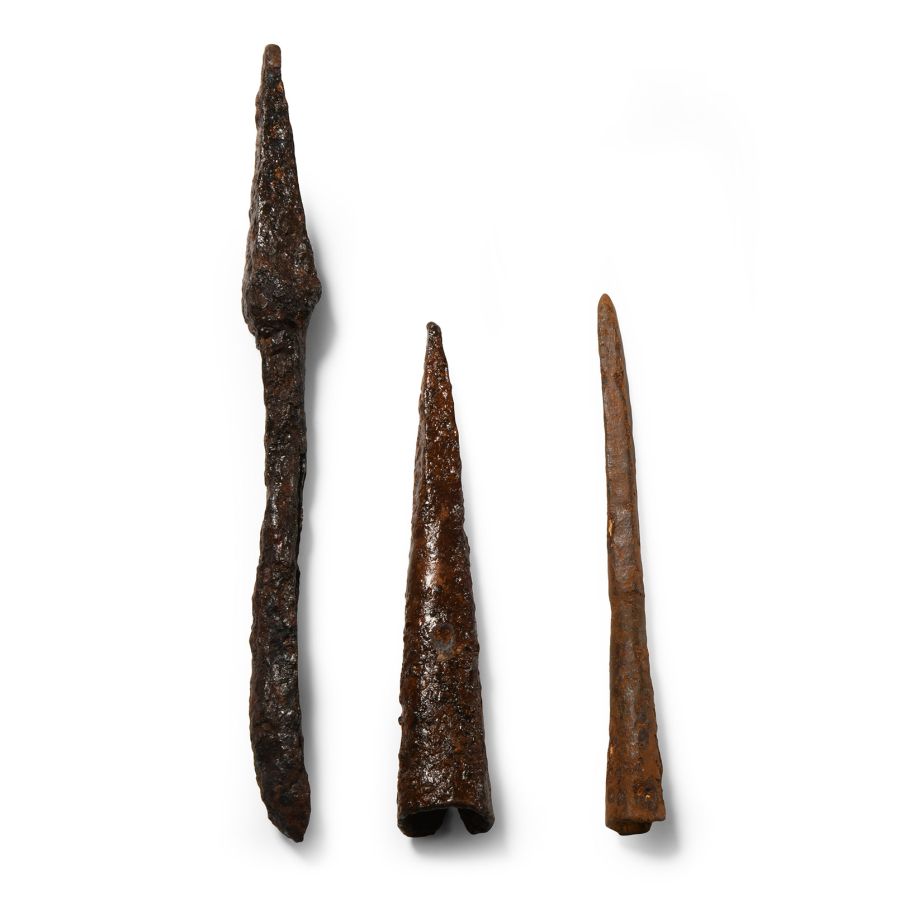
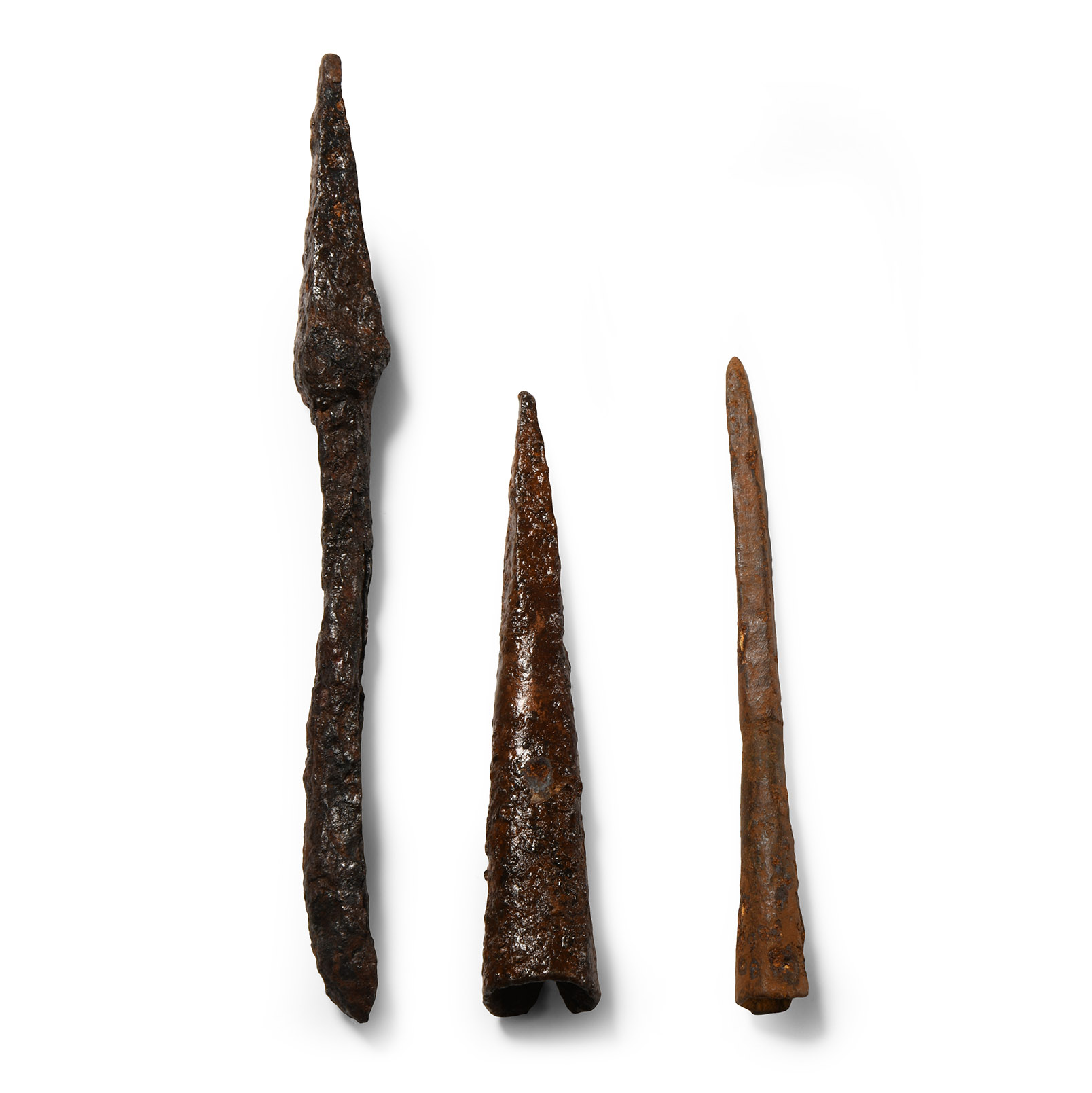
Roman Iron Ferrules and Javelin Head Group
3RD CENTURY A.D.
3 1/4 - 5 in. (64 grams total, 8.2-12.8 cm).
Comprising: square-section missile head with short neck; conical ferrule with square-section finial; conical ferrule socket with long square-section finial. [3, No Reserve]
ProvenanceFound S.E. England, UK.
Acquired from Allan Cherry, Bournemouth, UK, circa 2004.
Ian Wilkinson collection, Nottinghamshire, UK.
Cf. for the ferrule Marchant, D.J., Roman weaponry in the province of Britain from the second century to the fifth century AD, Durham, 1991, plate 14, nos.3-4; for the javelin head fig.15, no.1.
FootnotesThe usual form of the butt of the spears in this period was a cone shape, sometimes split down one side, but more often forged into a complete circle. The butt was fastened to the wooden shaft by one or more rivets. The butt or ferrule of the Roman spears essentially had two functions. Firstly it acted as a counterweight to the blade of the spear/javelin, ensuring that the weapon was balanced and therefore effective. Secondly, it kept the wooden shaft out of contact with the ground if the spear was grounded and thus avoiding damage to it.
CONDITIONTimeLine Auctions follows a vetting process to ensure the authenticity and legality of all items, reinforcing our commitment to integrity and responsible trading. Each antiquity, antique, and coin lot undergoes thorough examination by a vetting committee of at least ten external specialists, professional trade association members, scientists, and archaeologists: Our Vetting Process
AUCTIONS:
TimeLine is a leading auction house specialising in antiquities, ancient art, collectables, natural history, coins, medals, and books. Our auctions offer museums, collectors, historians, and enthusiasts the opportunity to acquire unique and historically significant pieces.
-
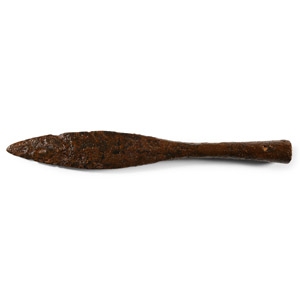
Anglo-Saxon Socketted Iron Spearhead
5th-6th century A.D.Sold for (Inc. bp): £98
Lentoid-section broad leaf-shaped blade with thick neck and split socket; Swanton's Group D1. 215 grams, 24.4 cm
Found near Wetwang, East Yorkshire, UK. Acquired circa 2005. Ian Wilkinson collection, Nottinghamshire, UK.
The chronological range of the type D1 extends over the entire Pagan period. With the group C1, of which Swanton believed this might simply be a long-socketted variant, the typology did not survive the 7th century A.D. -
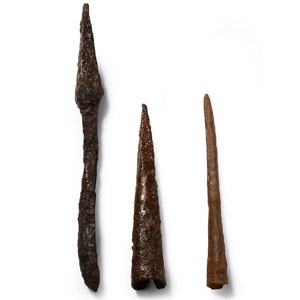
Roman Iron Ferrules and Javelin Head Group
3rd century A.D.Sold for (Inc. bp): £78
Comprising: square-section missile head with short neck; conical ferrule with square-section finial; conical ferrule socket with long square-section finial. 64 grams total, 8.2-12.8 cm
Found S.E. England, UK. Acquired from Allan Cherry, Bournemouth, UK, circa 2004. Ian Wilkinson collection, Nottinghamshire, UK.
The usual form of the butt of the spears in this period was a cone shape, sometimes split down one side, but more often forged into a complete circle. The butt was fastened to the wooden shaft by one or more rivets. The butt or ferrule of the Roman spears essentially had two functions. Firstly it acted as a counterweight to the blade of the spear/javelin, ensuring that the weapon was balanced and therefore effective. Secondly, it kept the wooden shaft out of contact with the ground if the spear was grounded and thus avoiding damage to it. -
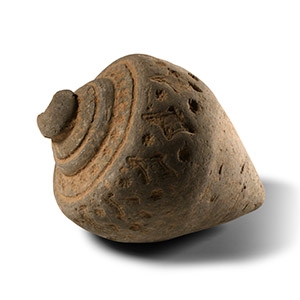
Byzantine 'Greek Fire' Ceramic Fire Bomb or Hand Grenade
9th-11th century A.D.Sold for (Inc. bp): £98
Piriform body with lattice to upper body and impressed bands to shoulder, domed filler-hole, intended to be filled with explosive liquid and wick, used as a hand grenade. 644 grams, 12.8 cm
From a specialist collection of militaria, London, UK, collected 1990s onwards. Accompanied by an academic paper by military specialist Dr Raffaele D'Amato, dated 15 July 2019 and titled 'Eastern Roman Empire - Greek Fire Bomb or Hand Grenade (μεσαίον kακάβιον) 9th-11th century AD'.
Apart from the use of siphons or manual flame-throwers called cheirosiphona, special corps of Roman soldiers employed terracotta grenades, in the form of small jars, abundantly evidenced in archaeological excavations. They were called μεσαία kακαβιά or κυτροκακάβια where the former had a bulbous shape and the latter a more cylindrical form.
