
Loading, please wait...
LOT 0255
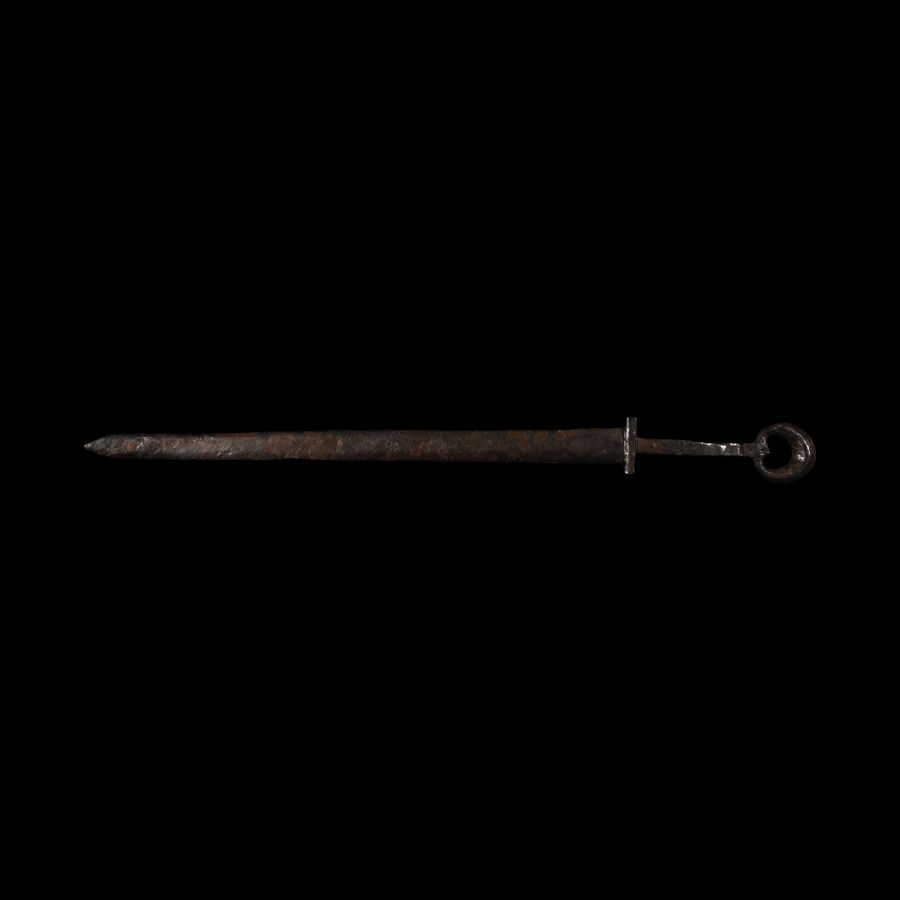
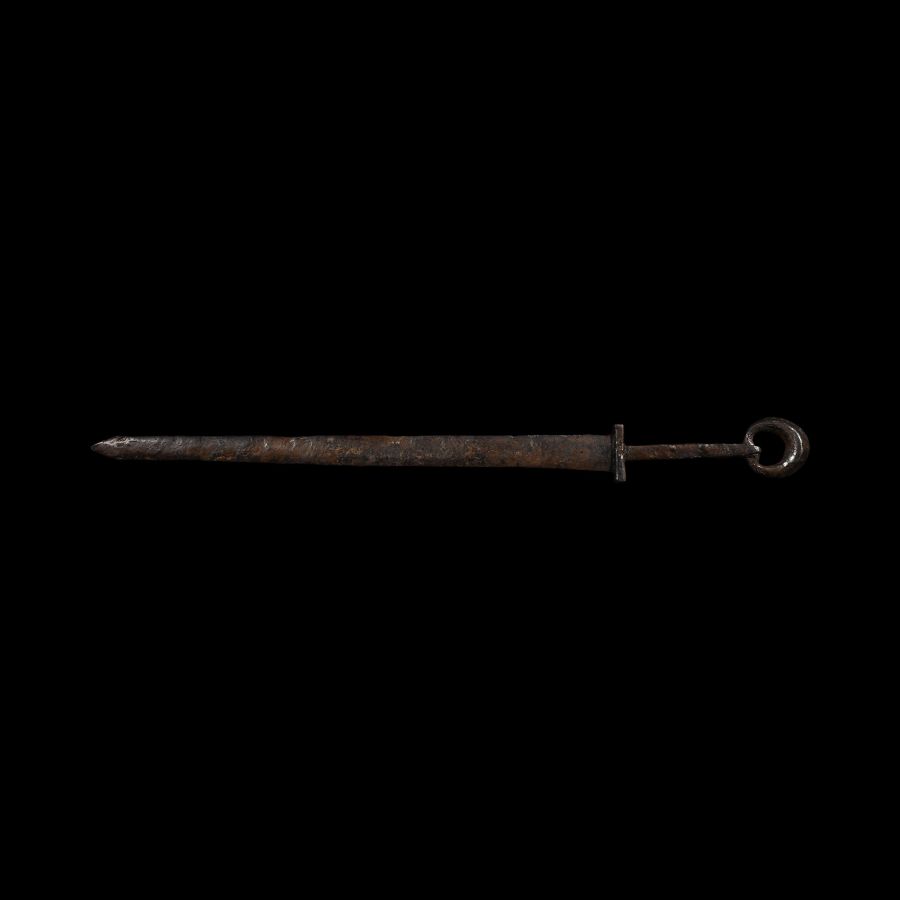
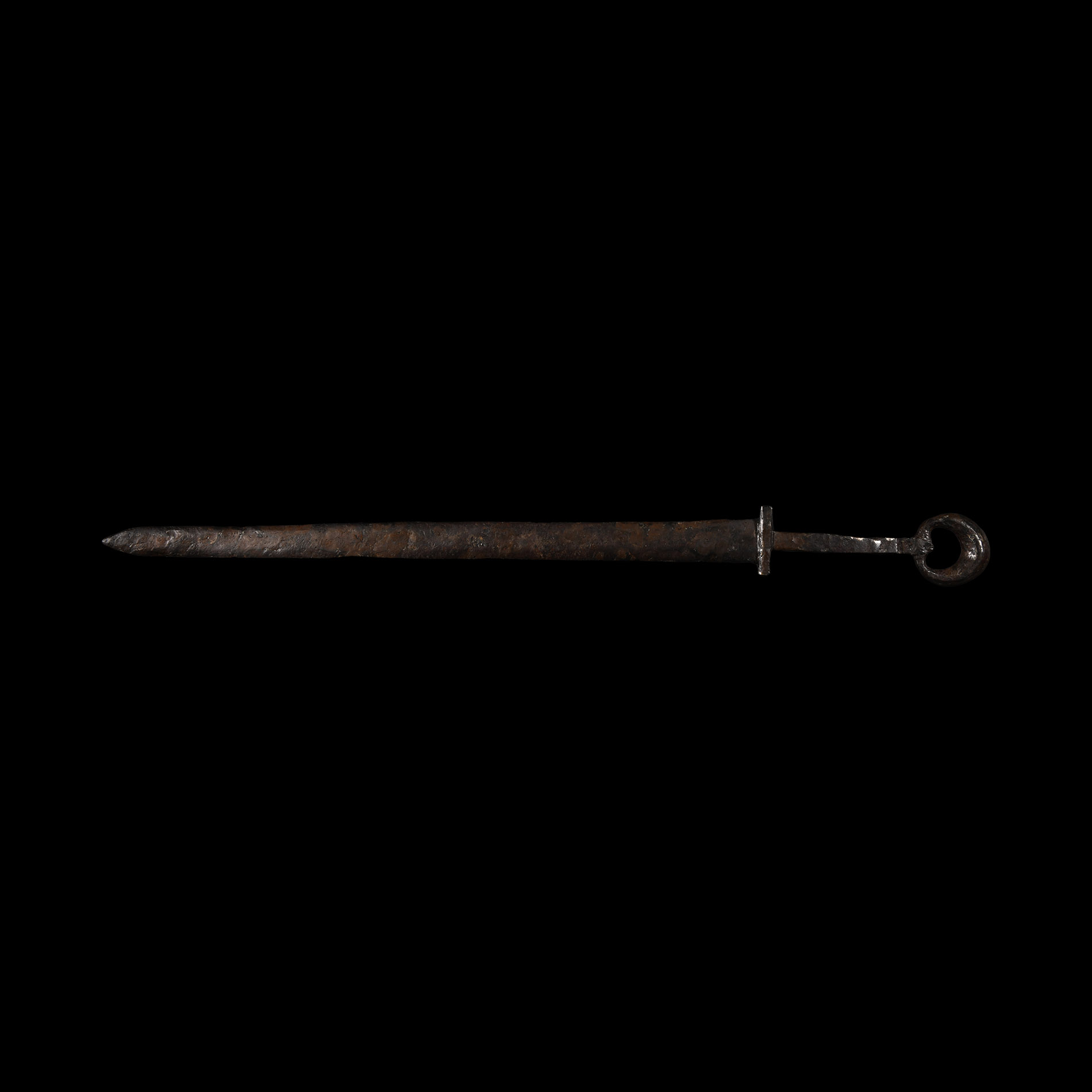
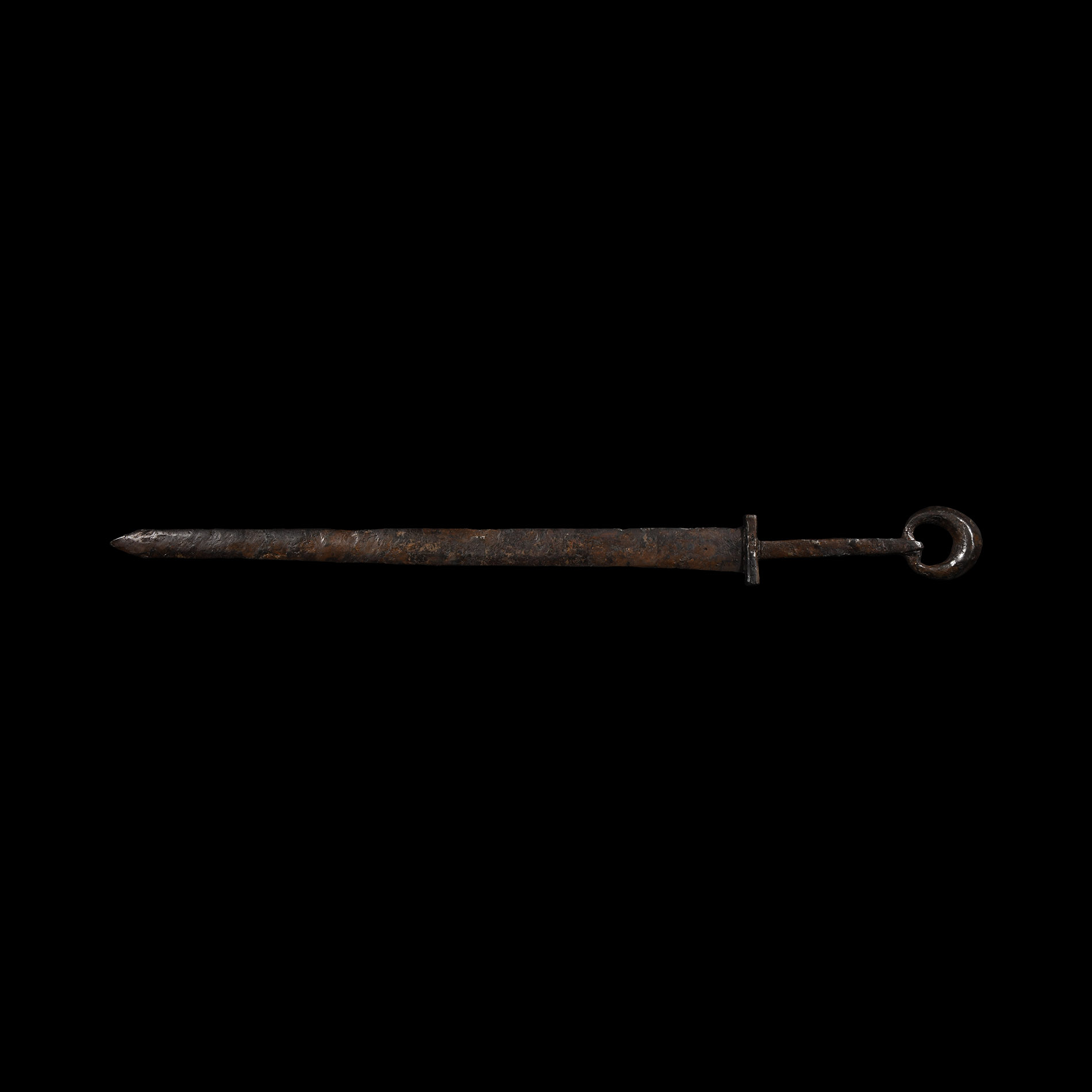
Roman Iron Dagger with Ring Pommel
CIRCA 2ND-3RD CENTURY A.D.
22 7/8 in. (376 grams, 58 cm).
Featuring a distinctively shaped ring at the end of the grip, double-edged relatively short blade and a tapered tip.
ProvenanceAcquired 1990s-early 2000s.
East Anglian private collection.
Accompanied by an academic report by Dr Raffaele D'Amato.
Cf. Miks, C., Studien zur Romischen Schwertbewaffnung in der Kaiserzeit, I-II Banden, Rahden, 2007, pls.46-51, for similar swords; also D'Amato, R., Arms and Armour of the Imperial Roman Soldier, London, 2009, p.88.
FootnotesThis kind of sword - called by modern scholars as ringknaufschwert or ring-pommel sword - was firstly diffused amongst the auxiliary troops, probably Sarmatians and Germans, and then, during the 2nd century A.D., was also commonly used amongst the milites legionis and the officers. The shape of their blades is similar to the Pompey typology, but a slightly less acute angle characterises the passage from the blade to the short point.
There were longer specimens like spatha, opening the transformation of the legionary gladius in the longer spatha specimens of the successive period, and also shorter specimens. An important dating element for earlier specimens is the sword from the Matrica grave, in Pannonia, dated exactly to 147 A.D. based on the other grave goods. Specimens of the second half of 2nd century A.D. are known from Wehringen and Geneva (180 A.D.). A specimen from Bosnia could be chronologically assigned to the same period, although such kind of swords became much more widespread for infantry and cavalry in later times. However, the importance of such swords has been recently associated with the rank of the provincial officers who used them, including miniature variations of such swords used as pendants as insignia badge of the staff of the Provincial governors. It was connected with the image of the sword and the dagger as a symbol of the Imperial power.
TimeLine Auctions follows a vetting process to ensure the authenticity and legality of all items, reinforcing our commitment to integrity and responsible trading. Each antiquity, antique, and coin lot undergoes thorough examination by a vetting committee of at least ten external specialists, professional trade association members, scientists, and archaeologists: Our Vetting Process
AUCTIONS:
TimeLine is a leading auction house specialising in antiquities, ancient art, collectables, natural history, coins, medals, and books. Our auctions offer museums, collectors, historians, and enthusiasts the opportunity to acquire unique and historically significant pieces.
-
.jpg)
Tower Yeomanry Percussion Carbine
Dated 1844 A.D.Sold for (Inc. bp): £572
Produced with a 51cm (20") round smooth-bore .65" barrel bearing set of London proof marks fitted with percussion lock marked 'crown-over-V R' and 'TOWER 1844' with steel captive ramrod and wood full stock fitted with brass butt plate, trigger guard, ferrule and fore-end, the side sling bar a later replacement; action working well to half and full cock. 2.95 kg, 90 cm
Acquired from M J Noble Ltd, 2015. The Kusmirek Collection, UK. Accompanied by a copy of invoice and information.
Sold as an exempt item under Section 58 (2) of the Firearms Act, 1968, to be held as a curiosity or ornament. No license required but buyer must be over 18 years of age. Overseas bidders should note that, due to UK regulations governing export of all firearms, overseas buyers will need to make arrangements for shipping this lot out of the UK directly, by air freight, with a specialist company or agent. -
Tudor Period Iron Dagger
16th century A.D. or laterEstimate: £100 - 140 (+bp*)
Opening Bid: £40
Comprising a single cutting edge and tang. 155 grams, 28.5 cm
Acquired 1960s-1990s. Late Alison Barker collection, a retired London barrister. -
.jpg)
Luristan Bronze Socketted Axehead
Circa 13th-7th century B.C.Sold for (Inc. bp): £59
Featuring an oval-shaped socket, straight upper edge and curved lower edge with slightly convex cutting edge. 1.2 kg, 14.5 cm
Acquired 1990s-early 2000s. East Anglian private collection.
Unadorned weapons, especially axes, adzes and picks, were made by Luristan craftsmen using simple clay or stone bivalve moulds, into which was inserted a core to form the socket for the shaft. Typically, the metallic composition consisted of a combination of arsenical bronze and copper, together with a small percentage of lead.
