
Loading, please wait...
LOT 0739
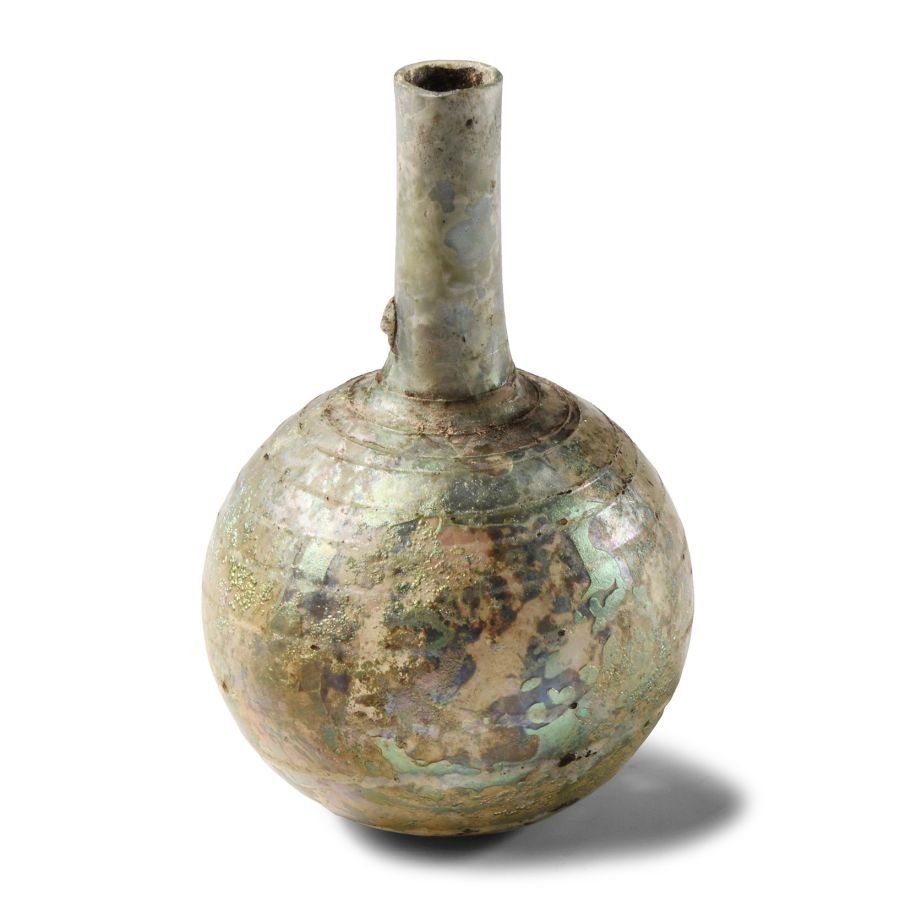
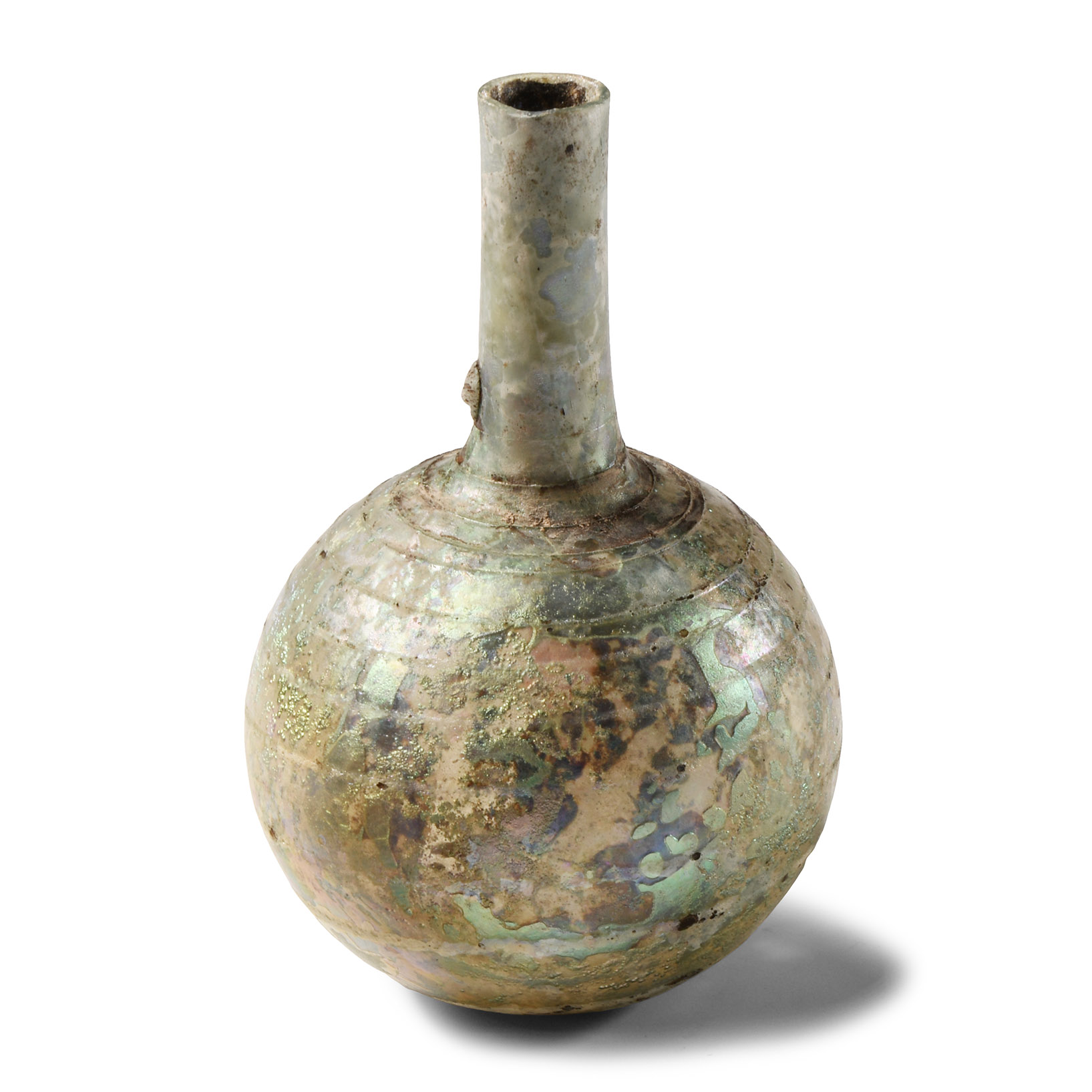
Roman Iridescent Glass Vessel
3RD-4TH CENTURY A.D.
3 1/2 in. (20.7 grams, 89 mm).
With globular body, columnar neck and ground rim; much iridescence remaining to surface.
ProvenanceAcquired 1980-2015.
Ex Abelita family collection.
Cf. Whitehouse, D., Roman Glass in the Corning Museum of Glass, vol.3, New York, 2003, item 1139.
CONDITIONTimeLine Auctions follows a vetting process to ensure the authenticity and legality of all items, reinforcing our commitment to integrity and responsible trading. Each antiquity, antique, and coin lot undergoes thorough examination by a vetting committee of at least ten external specialists, professional trade association members, scientists, and archaeologists: Our Vetting Process
AUCTIONS:
TimeLine is a leading auction house specialising in antiquities, ancient art, collectables, natural history, coins, medals, and books. Our auctions offer museums, collectors, historians, and enthusiasts the opportunity to acquire unique and historically significant pieces.
-
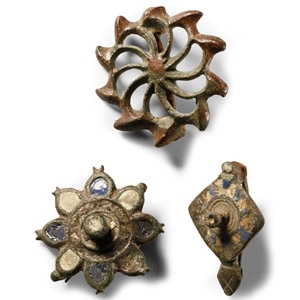
Roman Brooch Collection
2nd-3rd century A.D.Sold for (Inc. bp): £156
Comprising an openwork plate brooch of solar-wheel type; rosette plate brooch with central stud, enamelled cells; lozenge plate brooch with enamelled cells. 29.6 grams total, 35-37 mm
UK art market, acquired prior to 1980. Property of a Scottish collector, acquired in 2013. -
.jpg)
Stone Corbel with Severed Head of a Gallo-Roman
Circa 2nd century A.D.Sold for (Inc. bp): £1,690
Statue or frieze fragment with male head modelled in the half-round; circular face with large almond-shaped eyes, heavy brow, thick tousled hair framing the face, drooping moustache and short beard; presented at an oblique angle to the lower face of the block; two mounting holes to the underside. 22.8 kg, 43 cm
Found in Norfolk, UK. Acquired from Michael Booth, 1998. From an important Cambridgeshire estate; thence by descent.
The angle of the face in respect of the block suggests that the head is both tilted and detached, i.e. that it is a tête coupé or severed head. The practice of headhunting is documented among the natives of both Gaul and Britain (and elsewhere) in the Iron Age. The head is then considered to have special powers to avert evil and promote fertility, cure disease and provide other benefits. This is the case with the carved head - a male mask with copious hair and beard - from the Roman baths at Bath, Somerset (the ancient Aquae Sulis) which was a site of worship long before the arrival of a Roman presence in the area (Ross, p.91). The head takes on the character of a deity and is believed to respond favourably to prayer. -
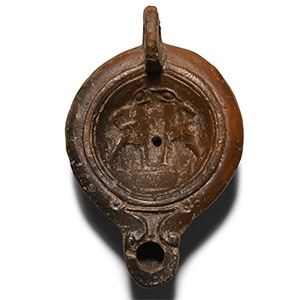
Roman Terracotta Lamp with Fighting Gladiators
1st-2nd century A.D.Estimate: £1,000 - 1,400 (+bp*)
Opening Bid: £417
Composed of a discoid body with sunken discus bearing a scene of two gladiators in combat in relief, tabula ansata below, ring handle and roughly D-shaped nozzle with volutes; old crack to base. 84 grams, 12.4 cm
From a German collection. Ex Cambridge, UK, collection, 1980s.
The two gladiators seem to be wearing the armaturae of murmillones. All gladiators began their career as provocatores; the learning of their combat technique was polyvalent and allowed the fighters to specialise as a large shield-bearer (the scutati) like murmillones, or as a small shield-bearer, parmati, like the oplomachus.
