
Loading, please wait...
LOT 0977
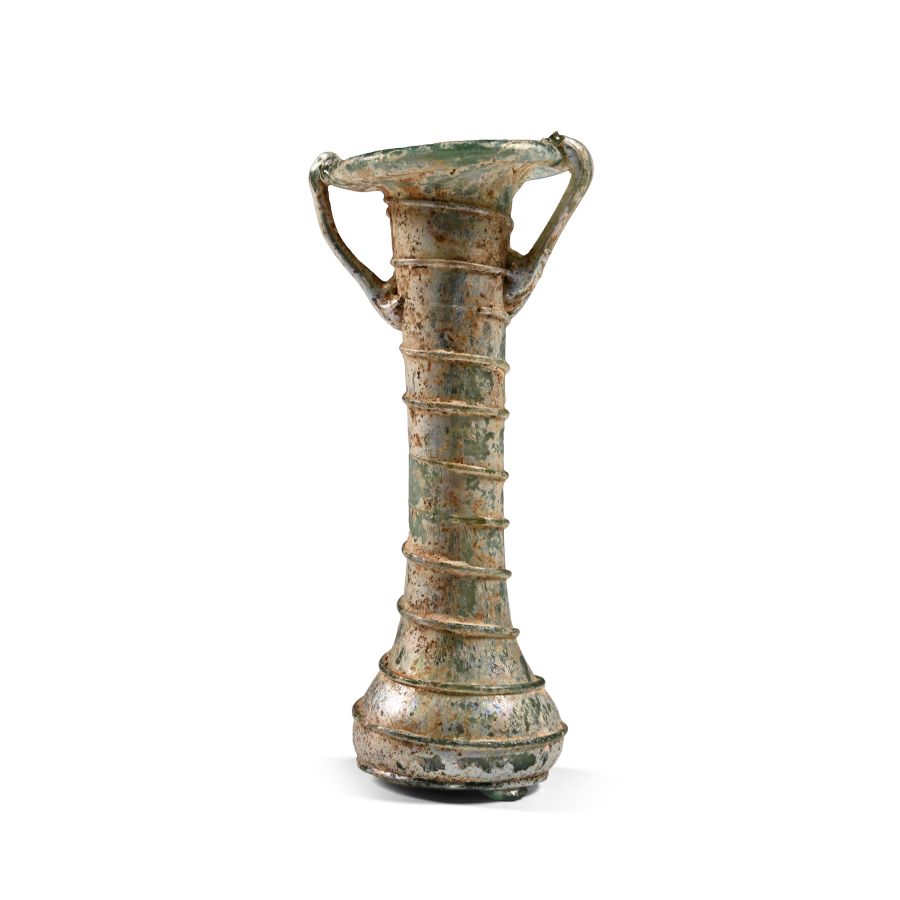
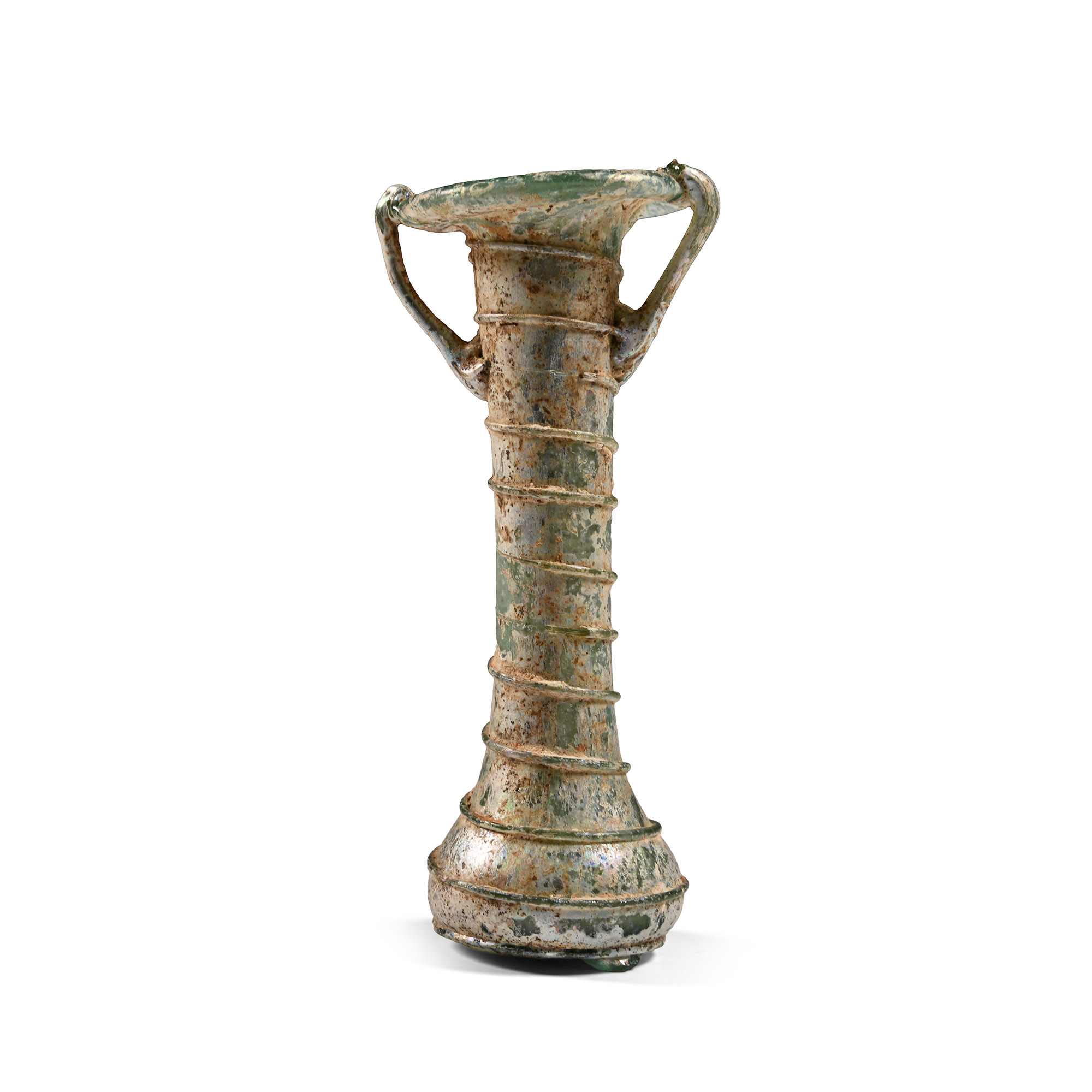
Roman Iridescent Glass Cosmetic Flask with Spiral Trail
3RD-4TH CENTURY A.D.
3 in. (14.6 grams, 76 mm).
Bulbous body with long funicular neck and everted rim, applied strap handles to the top, applied spiral decoration to the body.
ProvenanceEx London gallery, UK, 1986.
Ex private UK collection.
This lot is accompanied by an illustrated lot declaration signed by the Head of the Antiquities Department, Dr Raffaele D'Amato.
Cf. Whitehouse, D., Roman Glass in the Corning Museum of Glass, vol.1, New York, 1997, item 738, for type.
FootnotesSmall cosmetic flasks with tubular bodies, conical feet and trailed decoration were a common product of the Syro-Palestinian workshops in the Eastern Roman Empire, during the 4th-5th century A.D. Many such vessels had elaborate basket-handles, from which they could be suspended.
CONDITIONTimeLine Auctions follows a vetting process to ensure the authenticity and legality of all items, reinforcing our commitment to integrity and responsible trading. Each antiquity, antique, and coin lot undergoes thorough examination by a vetting committee of at least ten external specialists, professional trade association members, scientists, and archaeologists: Our Vetting Process
AUCTIONS:
TimeLine is a leading auction house specialising in antiquities, ancient art, collectables, natural history, coins, medals, and books. Our auctions offer museums, collectors, historians, and enthusiasts the opportunity to acquire unique and historically significant pieces.
LOT 0977
Roman Iridescent Glass Cosmetic Flask with Spiral Trail
Estimate £200 - 300€230 - 350 (for guidance only)$270 - 410 (for guidance only)
-
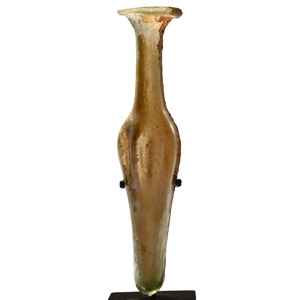
Roman Glass Bottle
1st century A.D.Sold for (Inc. bp): £260
Comprising a tapering round-section body with narrow shoulder and flared neck, median bulb with pinched flanges; supplied with a custom-made stand. 20.5 grams, 13.4 cm (82.2 grams total, 15.2 cm including stand)
From an important London collection of glass, 1990s. This lot is accompanied by an illustrated lot declaration signed by the Head of the Antiquities Department, Dr Raffaele D'Amato.
Examples of similar form have been found in the Western Provinces of the Roman Empire, particularly from the grave 12 in the Liverpool Sotto Cemetery at Muralto Locarno, Canton Ticino, Switzerland. The archaeologist assign it to the period between A.D.20 and 50. -
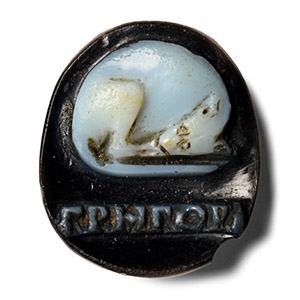
Roman Sardonyx Cameo of a Sleeping Dog with Greek Inscription
2nd-3rd century A.D.Sold for (Inc. bp): £1,690
With a cameo image of a lying dog curled to the right, ancient Greek lettering below 'ΓΡΗΓΟΡΙ (sic)': either 'Be wakeful' or '(ring/seal) of Gregory. 0.61 grams, 12 mm
Private English collection, formed between the late 1970s and early 1990s. Private collection, London, UK. -
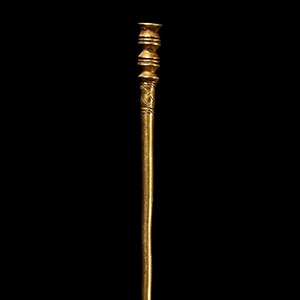
Roman Decorated Gold Dress Pin
1st-4th century A.D.Estimate: £700 - 900 (‡+bp*)
Opening Bid: £350
Slender body with balustered finial, a band of hatched herringbone decoration beneath the finial. 2.74 grams, 72 mm
Ex 'Neuburg' Collection, Germany, 1970. with Gorny & Mosch, Munich, Germany. with Galerie Rhéa, Zurich, Switzerland.
