
Loading, please wait...
LOT 1031
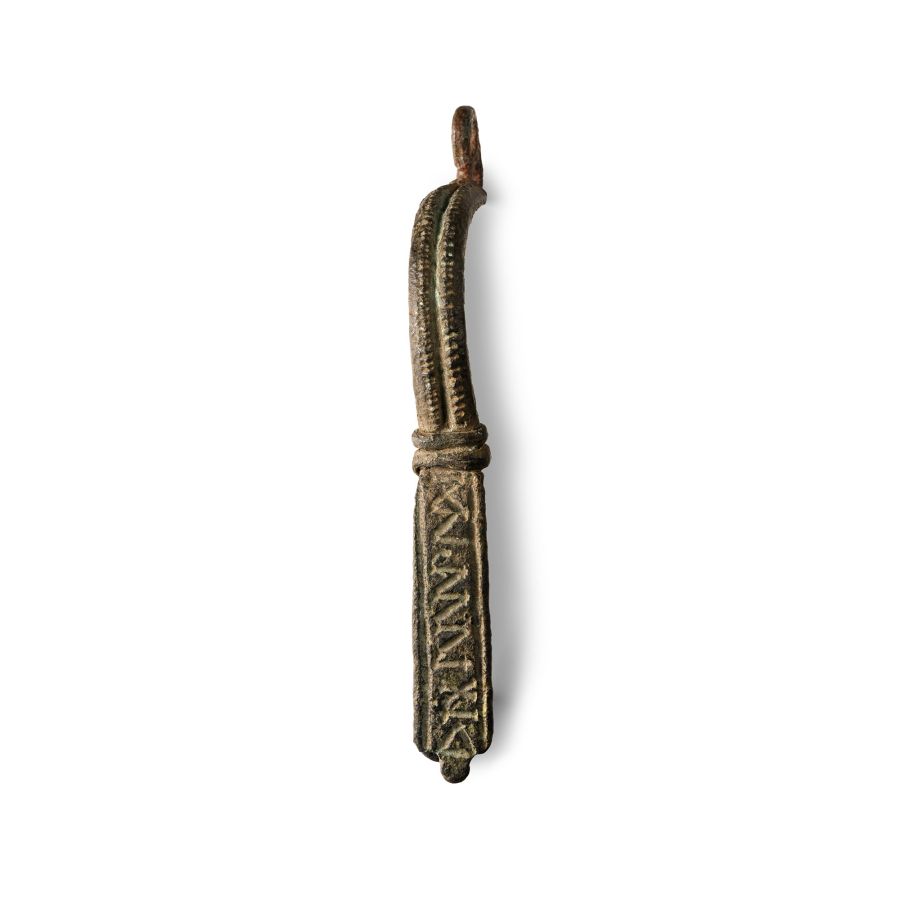
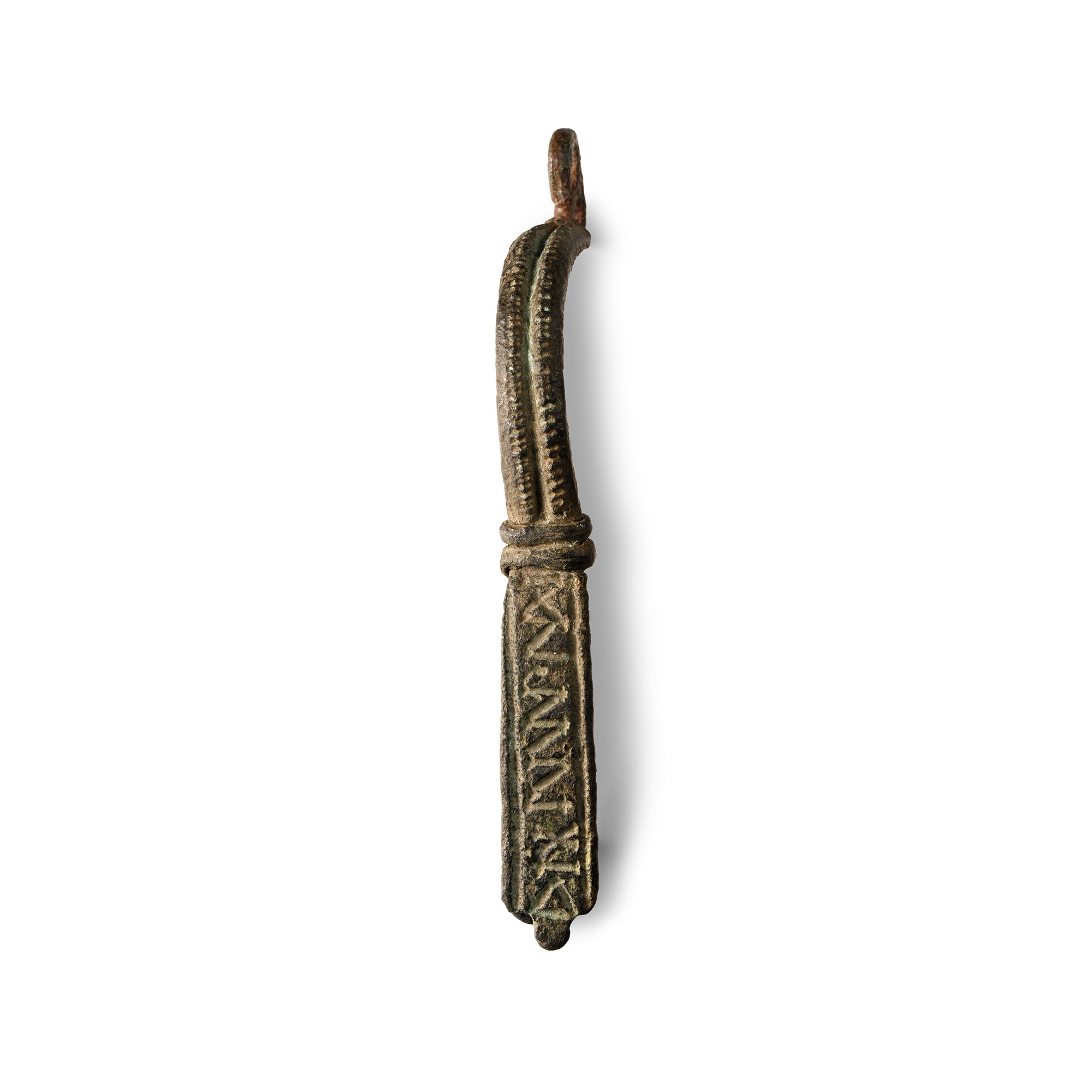
Roman Inscribed Bronze Bow Brooch
3RD-4TH CENTURY A.D.
3 in. (8.19 grams, 78 mm).
Colchester-type brooch shank with seriffed enigmatic legend 'DIXMNM'.
ProvenanceEx important German collection of brooches, 1980s.
This lot is accompanied by an illustrated lot declaration signed by the Head of the Antiquities Department, Dr Raffaele D'Amato.
Cf. Various, Report of Colchester and Essex Museum, for the period April Ist, 1937 to March 31st, 1944, Colchester, 1944, pl.III no.3, p.25, for the type.
FootnotesThe inscription 'DIXMNM' is not easy to interpretate. MNM was possibly used as abbreviation for Dis Manibus Monumentum, i.e. ‘Monument to the spirit of the dead’. DIX was a shorter form for he/she/it said (dixit), but also refers sometimes to the numeral 12 (duodecimus).
CONDITIONTimeLine Auctions follows a vetting process to ensure the authenticity and legality of all items, reinforcing our commitment to integrity and responsible trading. Each antiquity, antique, and coin lot undergoes thorough examination by a vetting committee of at least ten external specialists, professional trade association members, scientists, and archaeologists: Our Vetting Process
AUCTIONS:
TimeLine is a leading auction house specialising in antiquities, ancient art, collectables, natural history, coins, medals, and books. Our auctions offer museums, collectors, historians, and enthusiasts the opportunity to acquire unique and historically significant pieces.
-
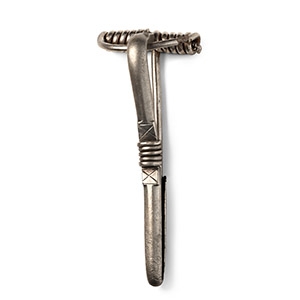
Roman Silver Bow Brooch
2nd-3rd century A.D.Sold for (Inc. bp): £312
Comprising an elliptical-section bow with D-shaped chord and spring extending to the pin; rectangular foot with catch to the reverse; top of catch extended to a wire coiled about the lower bow. 29 grams, 81 mm
Private collection formed in Europe in the 1980s. Westminster collection, central London, UK. -
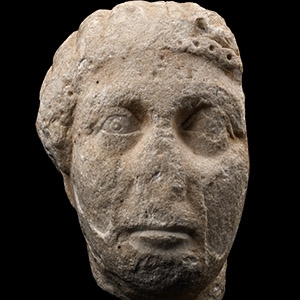
Roman Marble Head of a Woman
3rd-4th century A.D.Estimate: £6,000 - 8,000 (+bp*)
Opening Bid: £3,000
Carved in three-quarter view, with hair dressed in a chignon with frontal band and wavy segments; soft facial features with much detailing remaining to the proper right eye and mouth; likely a frieze fragment; mounted on an old collector's display stand with typed label 'Marble, woman's head / Egypt / C.25-100 A.D. / Cat.No. 6169'. 8.45 kg, 39 cm high
Acquired in trade from the San Franciscanum Museum, Israel, prior to 1980. with Archaeologia, pre 1983, Switzerland and Canada. Accompanied by an academic report by Dr Raffaele D’Amato. This lot has been checked against the Interpol Database of stolen works of art and is accompanied by search certificate number no.12964-242755.
The arrangement of the hair is characteristic of female portraits dating between the late Severan and Tetrarchic periods. The head, due to the treatment of the hair, finds comparisons with a female portrait in the Museo Nazionale Romano, depicting an elderly woman of the Antonine era, and with another female portrait in the same museum, dated to the third decade of the 3rd century A.D., reworked in the Tetrarchic period, and which showed a Severan so-called Nest Frisur hairstyle. The sculpture in question can therefore be dated between the full 3rd century A.D. and the first decades of the 4th century A.D. based on the hairstyle, the shape of eyes and eyebrows. -
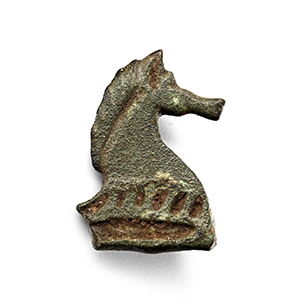
Roman Bronze Horse Plate Brooch
2nd century A.D.Sold for (Inc. bp): £78
Formed as the foreparts of a horse in profile, with catch to verso. 2.41 grams, 21 mm
From the collection of a Buckinghamshire, UK, collector established from the earlier 1960s.
