
Loading, please wait...
LOT 0120
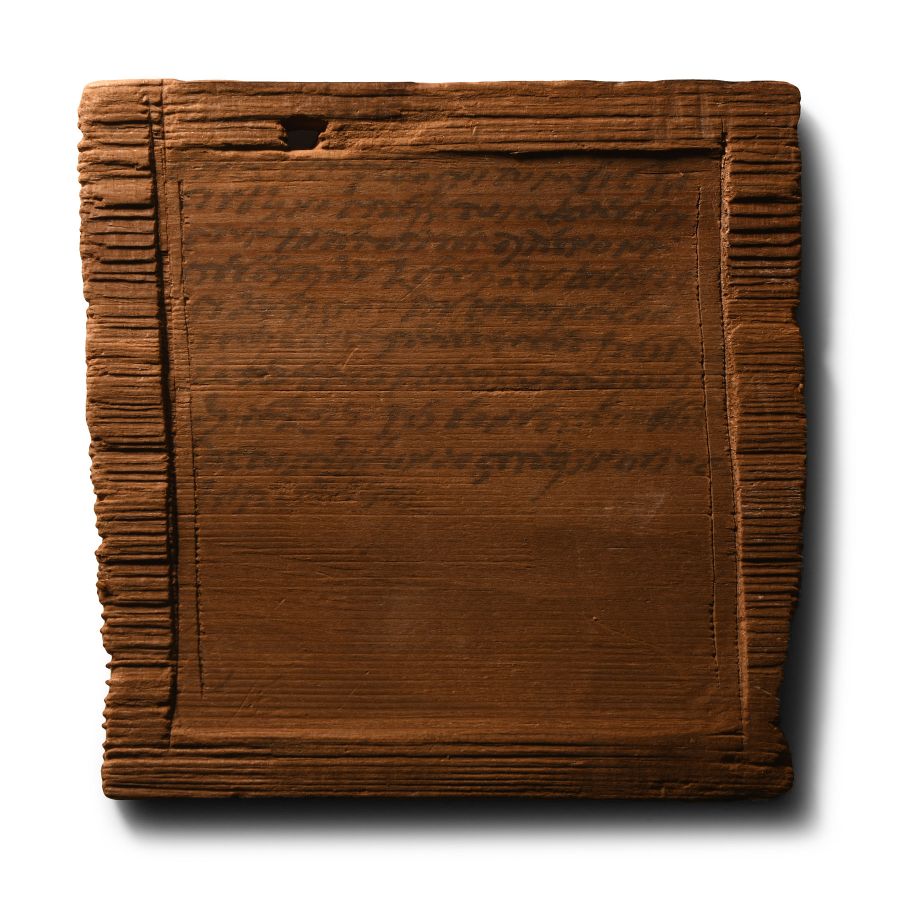
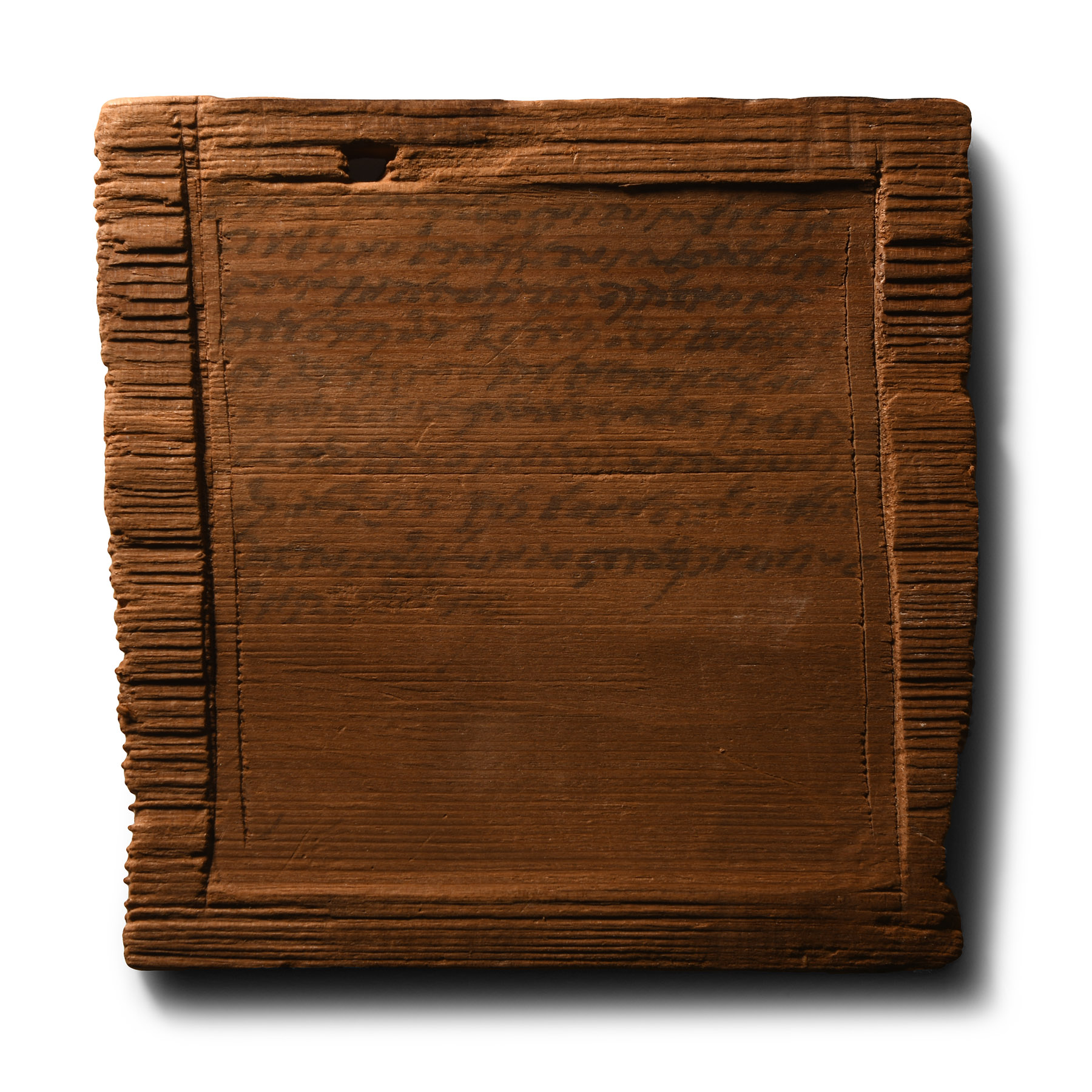
Roman Inked Wooden Tablet, a Legal Document from the Rascotiano Estate
4TH CENTURY A.D.
4 7/8 x 5 in. (23.7 grams, 12.3 x 12.5 cm).
A reused tablet with a recessed panel on one side, the last tablet of a legal document which consisted of two (diptychon) or three tablets (triptychon); ten black inked lines of New Roman cursive script, the end of a record of a transaction in a highly formulaic legal language, confirmed between heirs and elders (heredes et seniores), negotiated on an estate called Rascotiano; one edge irregular, pierced for addition of a thong or string. [No Reserve]
ProvenanceFrom an important London collection since 1975.
Accompanied by a collection of eighteen 1970s photographs of the the tablet.
Rothenhoefer, P., Neue römische Rechtsdokumente aus dem Byzacena-Archiv / New Roman Legal Documents from the Byzacena Archive, (forthcoming).
LiteratureCf. Rothenhöfer, P., Blänsdorf, Jürgen, Sana mente sanaque memoria testa-mentum feci: Eine testamentarische Verfügung vom 12. April 340 n. Chr., Gephyra 13, 2016, pp.153-163; Rothenhöfer, P., Neues zum Testament des Pomponius Maximus aus dem Jahr 371 n. Chr., (forthcoming); see also Masi Doria, C., Dal testamento di Pomponius Maximus: prospettive del diritto ereditario tardo antico, in: Isola, L. (ed.), Klauselgestaltungen in Römischen Testamenten, Berlin, 2022, pp.151-175; also see Thomas, J. D., Vindolanda: The Latin Writing Tablets, Britannia Monograph Series No 4, London, 1983, for examples of wooden tabulae re-used as writing surfaces; for examples of testamentary documents on wooden tablets that have survived, see FIRA III, p.47, for Anthony Silvanus from 142 AD, also see BGU VII 1695 for Safinnius Herminus; for another from Transfynydd, North Wales, see Arch. Camb. 150, pp.143-156; and see Bowman, A.K., Life and letters on the Roman frontier : Vindolanda and its people, London, 1994, for discussion of the uses of Roman writing tablets.
FootnotesThe contract follows standard Roman legal formulae.
CONDITIONTimeLine Auctions follows a vetting process to ensure the authenticity and legality of all items, reinforcing our commitment to integrity and responsible trading. Each antiquity, antique, and coin lot undergoes thorough examination by a vetting committee of at least ten external specialists, professional trade association members, scientists, and archaeologists: Our Vetting Process
AUCTIONS:
TimeLine is a leading auction house specialising in antiquities, ancient art, collectables, natural history, coins, medals, and books. Our auctions offer museums, collectors, historians, and enthusiasts the opportunity to acquire unique and historically significant pieces.
LOT 0120
Roman Inked Wooden Tablet, a Legal Document from the Rascotiano Estate
Sold for (Inc. bp): £13,000
-
Roman Marble Female Head
Circa 3rd century A.D.Sold for (Inc. bp): £936
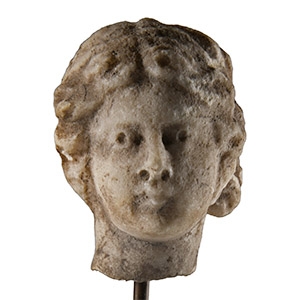
From a relief with hair centre-parted and drawn back from the face, gathered at the nape in a chignon; rounded face with soft features, drilled eyes and nostrils; mounted on a custom-made stand. 523 grams total, 78 mm high (12.7 cm high including stand)
London art market, 2000s. Property of a London gentleman. -
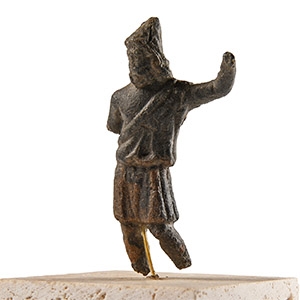
Roman Bronze Vulcan Statuette
1st-2nd century A.D.Sold for (Inc. bp): £312
Standing wearing a tunic draped from the left shoulder and a conical hat, left arm extended at shoulder-height; mounted on a custom-made stand. 110 grams total, 71 mm including stand
From a collection acquired on the UK art market from various auction houses and collections mostly before 2000. From an important Cambridgeshire estate; thence by descent. -
.jpg)
Large Roman Marble Bull's Head Sculpture
Circa 2nd century B.C.- 2nd century A.D.Sold for (Inc. bp): £2,080
Life-size bull's head (bucranium) on a rectangular field with flattened upper face and small ledge overhang; modelled in the half-round with detailed eyes, muzzle and dewlap, plain background; tooled texture to the forehead and dewlap; Eastern Empire. 98 kg, 51 cm
From a collection acquired on the UK art market from various auction houses and collections mostly before 2000. From an important Cambridgeshire estate; thence by descent. Accompanied by an academic report by Dr Raffaele D’Amato. This lot has been checked against the Interpol Database of stolen works of art and is accompanied by search certificate number no.12081-213373.
The bucranium was used as a prominent motif on the exterior of Graeco-Roman temples where it replaced the use of genuine severed heads from the sacrificial rites. Garlands were draped over the heads on feast-days and occasions of special religious observance. The flattened upper face suggests an architectural use, perhaps as a corbel.
