
Loading, please wait...


LOT 0107
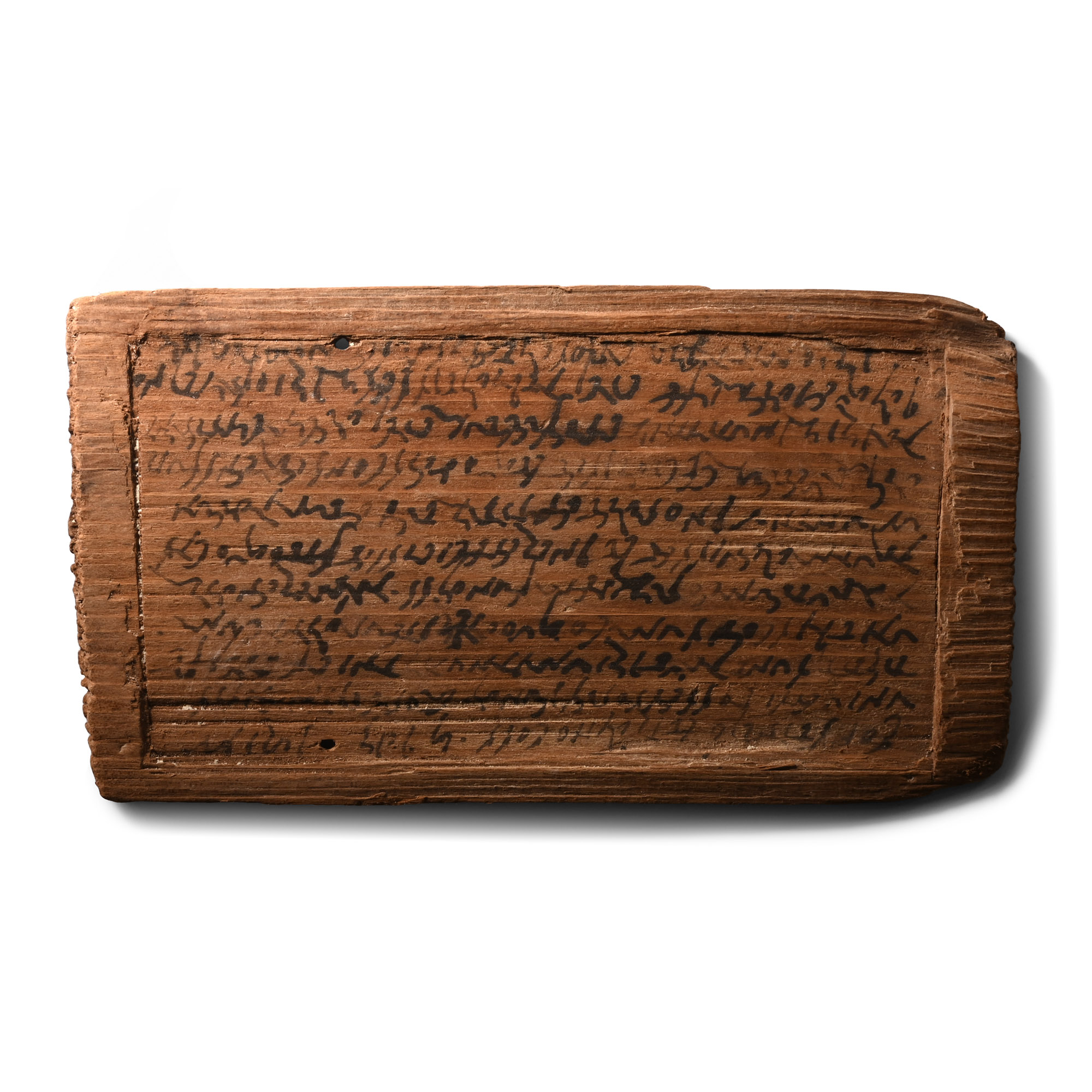
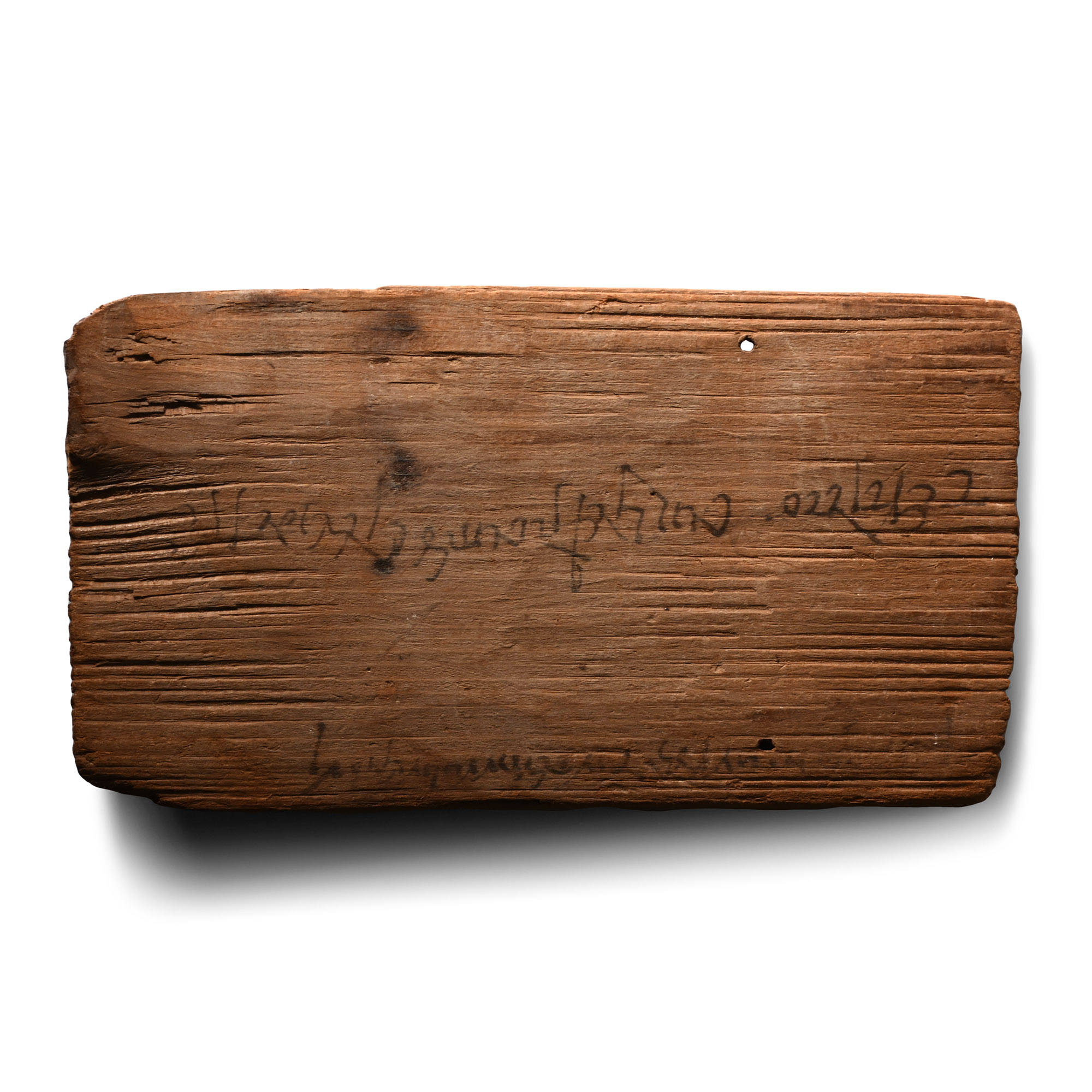
Roman Inked Wooden Legal Document
LATE 4TH CENTURY A.D.
5 7/8 x 3 1/8 in. (11 grams, 15 x 8.1 cm).
With a recessed panel on one side and scored frame with securing holes close to both long sides; eleven lines of inked text in Roman cursive containing the record of a legal document in a formulaic legal language; two lines of cursive text to reverse; supplied with six monochrome photographs of the tablet displaying the text to advantage. [No Reserve]
ProvenanceFrom an important London collection since 1975.
Accompanied by a collection of six 1970s photographs of the the tablet.
Cf. Rothenhöfer, P., Blänsdorf, Jürgen, Sana mente sanaque memoria testa-mentum feci: Eine testamentarische Verfügung vom 12. April 340 n. Chr., Gephyra 13, 2016, pp.153-163; Rothenhöfer, P., Neues zum Testament des Pomponius Maximus aus dem Jahr 371 n. Chr., (forthcoming); see also Masi Doria, C., Dal testamento di Pomponius Maximus: prospettive del diritto ereditario tardo antico, in: Isola, L. (ed.), Klauselgestaltungen in Römischen Testamenten, Berlin, 2022, pp.151-175; also see Thomas, J. D., Vindolanda: The Latin Writing Tablets, Britannia Monograph Series No 4, London, 1983, for examples of wooden tabulae re-used as writing surfaces; for examples of testamentary documents on wooden tablets that have survived, see FIRA III, p.47, for Anthony Silvanus from 142 AD, also see BGU VII 1695 for Safinnius Herminus; for another from Transfynydd, North Wales, see Arch. Camb. 150, pp.143-156; and see Bowman, A.K., Life and letters on the Roman frontier : Vindolanda and its people, London, 1994, for discussion of the uses of Roman writing tablets. Rothenhoefer, P., Neue römische Rechtsdokumente aus dem Byzacena-Archiv / New Roman Legal Documents from the Byzacena Archive, (forthcoming). The contract follows standard Roman legal formulae.
CONDITIONTimeLine Auctions follows a vetting process to ensure the authenticity and legality of all items, reinforcing our commitment to integrity and responsible trading. Each antiquity, antique, and coin lot undergoes thorough examination by a vetting committee of at least ten external specialists, professional trade association members, scientists, and archaeologists: Our Vetting Process
AUCTIONS:
TimeLine is a leading auction house specialising in antiquities, ancient art, collectables, natural history, coins, medals, and books. Our auctions offer museums, collectors, historians, and enthusiasts the opportunity to acquire unique and historically significant pieces.
-
Roman Polychrome Glass Bead Necklace
1st-4th century A.D. and laterSold for (Inc. bp): £39
Comprising a necklace restrung from beads of drilled ancient glass bangle fragments. 11 grams, 72 cm
UK gallery, early 2000s. -
Roman Bronze Trumpet Brooch
1st-2nd century A.D.Sold for (Inc. bp): £65
Kräftig profilierte 'anchor' type, with a broad plaque in front of the spring and pin, trumpet-type bow with lateral flukes and central knop, D-section collar, scooped footplate with disc and knops, catch to the rear. 21.5 grams, 35 mm
Ex German art market, 2000s. Acquired from an EU collector living in London. From the collection of Surrey, UK, gentleman. -
.jpg)
Roman Bronze Decorated Bracelet
1st-3rd century A.D.Sold for (Inc. bp): £117
Composed of a D-section hoop, flattened terminals with rounded ends decorated with horizontal rows of shallow dots and quatrefoils between parallel tracks. 17 grams, 53 mm wide
German art market, 1990s. Mr A.H., a North American collector living in the UK.
