

LOT 3246
Roman Imperial, Terracotta Forger's Casting Mould. 4th century AD.
Laureate head (Constantine I?) to right / D N VAL LICIN LICINIVS NOB C, laureate, draped and cuirassed bust of Licinius II to right. Condition as seen. Casting mould sharing two obverse types.(4.65gr, 27mm, 9h.).
ProvenanceFrom the collection of a gentleman, acquired on the London art market in the 1990s.
FootnotesWith an impression of the obverse on one side, and the reverse on the other, of the coin being counterfeited this ancient forger's casting mould would have been stacked with others, the molten metal being poured from above and allowed to cool.
TimeLine Auctions follows a vetting process to ensure the authenticity and legality of all items, reinforcing our commitment to integrity and responsible trading. Each antiquity, antique, and coin lot undergoes thorough examination by a vetting committee of at least ten external specialists, professional trade association members, scientists, and archaeologists: Our Vetting Process
AUCTIONS:
TimeLine is a leading auction house specialising in antiquities, ancient art, collectables, natural history, coins, medals, and books. Our auctions offer museums, collectors, historians, and enthusiasts the opportunity to acquire unique and historically significant pieces.
-
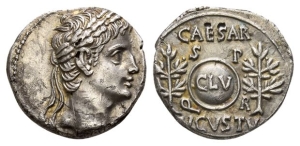
Augustus Fourrée Denarius. 27 BC-AD 14.
Estimate: £800 - 1,000 (‡+bp*)
Opening Bid: £360
Uncertain Spanish mint (Colonia Caesaraugusta?). Struck circa 19-18 BC. Head to right, wearing oak wreath / CAESAR above, AVGVSTVS below, S P above and Q R beneath shield inscribed CL V; laurel branches (or trees) flanking. For prototype: RIC I 36a; ACIP 4037; RSC 51. 2.69gr, 16mm, 12h.
Extremely Fine. Light old cabinet tone.
Acquired from cgb.fr, Paris on 11 December 2010. -
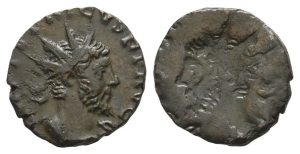
Tetricus I, Romano-Gallic Emperor BI Antoninianus. AD 271-274.
Sold for (Inc. bp): £46
Uncertain mint. IMP TETRICVS P F AVG, radiate and cuirassed bust to right / Incuse of obverse. 2.26gr, 17mm.
Very Fine. Brockage of obverse.
From a private, UK, collection in the 1980s. Property of a London, UK, antiquarian.
Brockage errors are caused when an already minted coin sticks to the coin die and impresses onto another blank that hasn't been struck yet, pressing a mirror image of the other coin into the blank. -
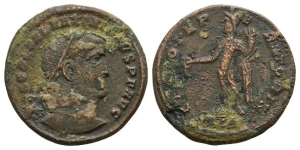
Galerius BI Nummus. AD 305-311.
Sold for (Inc. bp): £7
Heraclea mint; struck AD 308-309. 1st officina. IMP C GAL VAL MAXIMIANVS P F AVG, laureate head to right / GENIO IMPERATORIS, Genius, wearing modius on head, standing to left, holding cornucopia and patera; •HTA• in exergue. RIC VI 37a. 6.71gr, 26mm, 6h.
Near Very Fine.
Acquired on the UK market before 2000. Property of a London, UK, gentleman.
