
Loading, please wait...
_900x900.jpg "Roman Horse Gemstone in Gold Ring")
_200x200.jpg "Roman Horse Gemstone in Gold Ring")
.jpg "Roman Horse Gemstone in Gold Ring")
LOT 0184
Roman Horse Gemstone in Gold Ring
1ST-2ND CENTURY A.D. AND LATER
1 in. (5.65 grams, 24.27 mm overall, 20.92 mm internal diameter (approximate size British P, USA 7 1/2, Europe 16.23, Japan 15)).
An oval garnet cabochon engraved with a horse on a baseline in a dynamic pose with lowered head; set in a possibly Byzantine gold ring with a grooved hoop supporting a box bezel, a pellet to each lower corner.
ProvenanceAcquired from London galleries during the 1990s.
From the jewellery collection of a London, UK, gentleman.
This lot has been checked against the Interpol Database of stolen works of art and is accompanied by search certificate no.12115-214296.
Cf. Melchart, W., Antike Kostbarkeiten aus Osterreichischem privatbesitz, Wien, 1997, fig.79, for a similar gemstone.
CONDITIONTimeLine Auctions follows a vetting process to ensure the authenticity and legality of all items, reinforcing our commitment to integrity and responsible trading. Each antiquity, antique, and coin lot undergoes thorough examination by a vetting committee of at least ten external specialists, professional trade association members, scientists, and archaeologists: Our Vetting Process
AUCTIONS:
TimeLine is a leading auction house specialising in antiquities, ancient art, collectables, natural history, coins, medals, and books. Our auctions offer museums, collectors, historians, and enthusiasts the opportunity to acquire unique and historically significant pieces.
LOT 0184
Roman Horse Gemstone in Gold Ring
Estimate £3,000 - 4,000€3,480 - 4,640 (for guidance only)$4,050 - 5,400 (for guidance only)
-
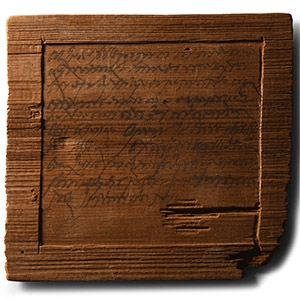
Roman Inked Wooden Tablet for a Contract Between Bassus and Neronianus
4th century A.D.Sold for (Inc. bp): £15,600
A reused tablet with a recessed panel on one side, the last tablet of a legal document which consisted of two (diptychon) or three tablets (triptychon); ten black inked lines of New Roman cursive script, the end of a record of a transaction in formulaic legal language, probably a sales contract, between the buyer (emptor) Bassus and a person called Neronianus; traces of text (perhaps in rustic capitals) to the reverse. 40 grams, 15.1 x 13.9 cm
From an important London collection since 1975. Accompanied by a collection of two 1970s photographs of the the tablet.
The contract follows standard Roman legal formulae. -
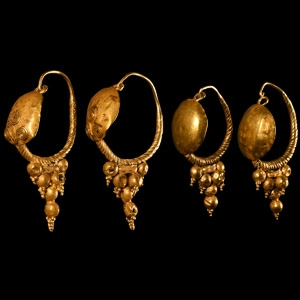
Roman Gold Earring Pairs
2nd-3rd century A.D. or earlierEstimate: £1,500 - 2,000 (‡+bp*)
Opening Bid: £750
Two pairs of earrings with decoratively twisted hoops, domed plaques and pyramid bulbs embellished with granule clusters; one pair with gold wire spirals to the plaques. 16.97 grams total, 42-50 mm
Acquired between 1950-1970s. Ex Swiss private collection. -
.jpg)
Roman Silver Fish Brooch
2nd century A.D.Sold for (Inc. bp): £416
Plate brooch formed as a fish with broad, gently curved lozengiform body, small lateral fins, chevron tail, D-shaped head with large discoid eye; the body with five rows of crescent punchmarks denoting scales; hinge-plate and catch to the reverse. 4.98 grams, 38 mm
Fine condition.
Property of a gentleman from Vienna; from his private collection formed since 1970.
The brooch is of a type found in Britain, corresponding to Hull's type 223. The fish represented here is likely a salmon.
