Loading, please wait...
LOT 1040
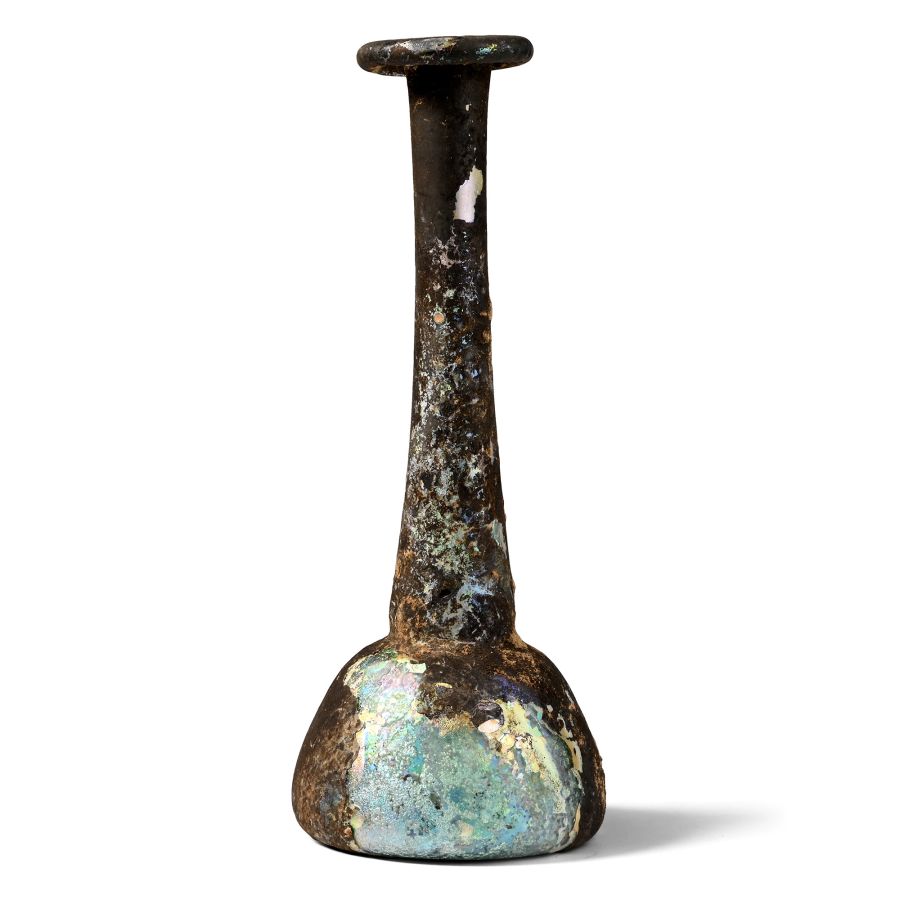
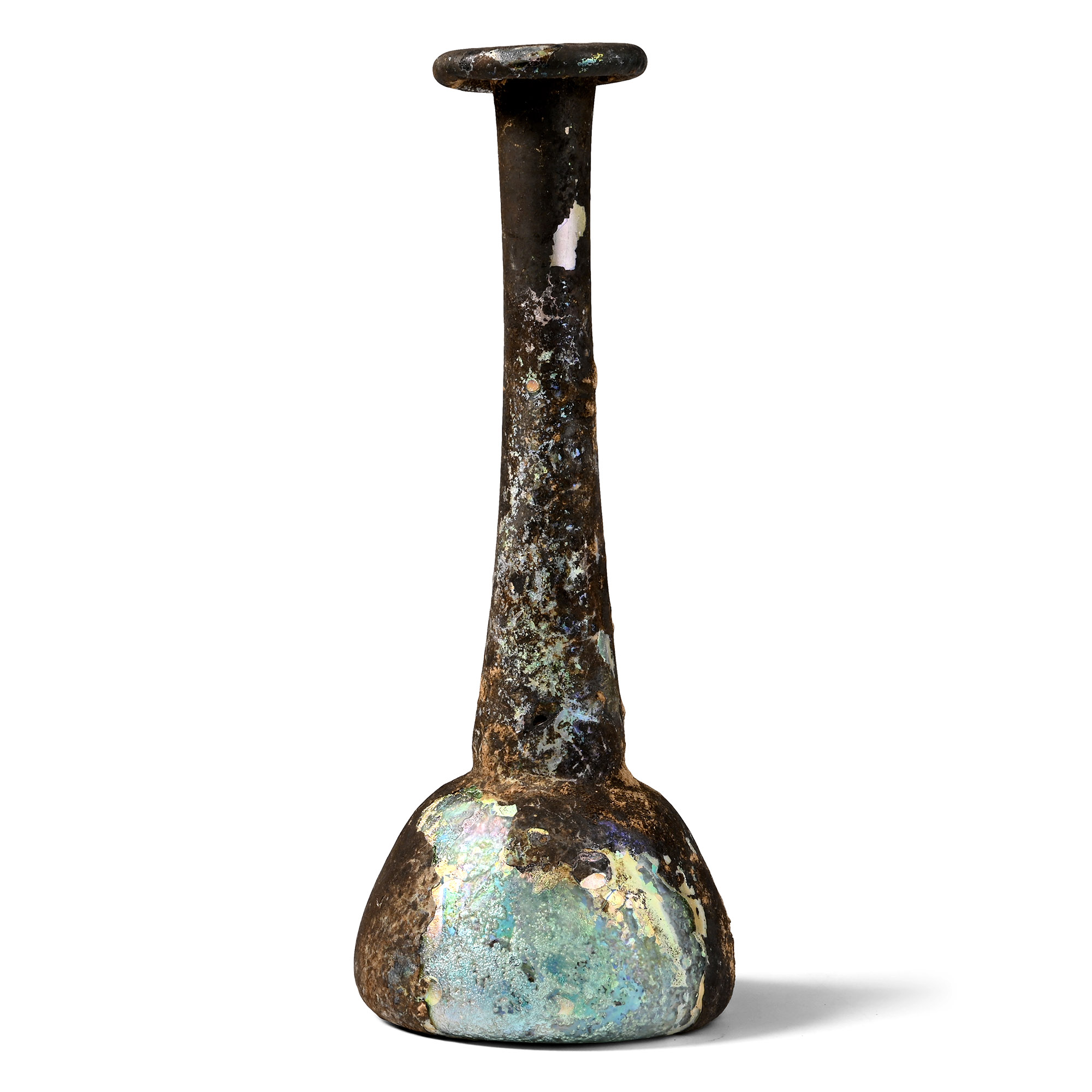
Roman Highly Iridescent Glass Bottle
CIRCA 1ST CENTURY A.D.
6 3/8 in. (37 grams, 16.3 cm).
With a domed body and a pontil base, a tall neck with trumpet-shaped mouth and rolled rim; some iridescence.
ProvenanceFrom an important collection of glass, London, UK, 1990s.
LiteratureCf. Whitehouse, D., Roman Glass in the Corning Museum of Glass, vol.1, New York, 1997, item 268, for type.
CONDITIONTimeLine Auctions follows a vetting process to ensure the authenticity and legality of all items, reinforcing our commitment to integrity and responsible trading. Each antiquity, antique, and coin lot undergoes thorough examination by a vetting committee of at least ten external specialists, professional trade association members, scientists, and archaeologists: Our Vetting Process
AUCTIONS:
TimeLine is a leading auction house specialising in antiquities, ancient art, collectables, natural history, coins, medals, and books. Our auctions offer museums, collectors, historians, and enthusiasts the opportunity to acquire unique and historically significant pieces.
LOT 1040
Roman Highly Iridescent Glass Bottle
Estimate £200 - 300€230 - 350 (for guidance only)$270 - 410 (for guidance only)
-
Roman Wooden Tablet with Testamentary Dispositions of Iulius Pomp(onius)
Mid 4th century A.D.Sold for (Inc. bp): £2,600
The third and last tablet of a Roman will made by Iulius Pomp(onius?), parts of lost surface on the inner face, two small holes both at the upper and lower rim (for binding the tablets of this document together); on the inner face the recess inscribed with twenty-one lines of Roman cursive script consisting of testamentary dispositions regarding a special category of fields (gemiones), ending with the mancipatory formula of Roman testaments; on the outer face two sulci and signatures of witnesses. 106 grams, 20.2 x 16.2 cm
Acquired by Albert Sfez in the early 1950s. Formerly the property of Monsieur Alain Sfez, a Belgium collector; acquired by gift from his father Albert Sfez, in 1965. Acquired by a London dealer in 1973. From an important London collection since 1975; thence by descent. Accompanied by a copy of an illustrated academic report by Professor Dr phil. Peter Rothenhöfer. This lot has been checked against the Interpol Database of stolen works of art and is accompanied by search certificate number no.12601-230811.
Professor Dr phil. Peter Rothenhöfer writes: 'Without any doubts this tablet is an original document from Roman times. Because only few Roman testaments have survived this document is of great importance both for Roman Legal and Social History'. -
Roman Bronze and Iron Ring Group
2nd-3rd century A.D.Sold for (Inc. bp): £72
Comprising four rings, including one with a conical glass insert. 15.07 grams total, 19-24 mm
From a Dunmow, UK, collection; formed from 1970. -
Roman Silver Mirror
1st-3rd century A.D.Sold for (Inc. bp): £1,755
Discoid with raised, rounded rim; a 19th-century collection label bearing a handwritten inscription: ‘GAS, Miroir, Gallo Romain’ indicating the findspot; mounted on a custom-made display stand with serpentine column base. 239 grams, 13.8 cm (426 grams total, 20.1 cm including stand)
19th century collection label inscribed in ink ‘GAS, Miroir, Gallo-Romain’, indicating that the mirror was discovered at Gas, Eure-et-Loir, northern France. Private collection, UK.
The British Museum houses several notable ancient Roman silver hand mirrors, including: 1. Bursa Treasure Mirror – Part of the Bursa Treasure, a 1st-century AD Roman silver hoard discovered near Bursa, Turkey. This collection includes a large silver mirror, reflecting the luxurious personal items used by elite Roman women. 2. Chaourse Treasure Mirror – found in 1883 near Chaourse, France, this 2nd–3rd century AD hoard contains various silver objects, including a silvered bronze mirror, offering insights into the affluent lifestyles of Roman society. These mirrors exemplify the exquisite craftsmanship and refined artistry of Roman silverwork, providing a glimpse into the daily grooming practices and material culture of the Roman elite.