
Loading, please wait...
LOT 0870
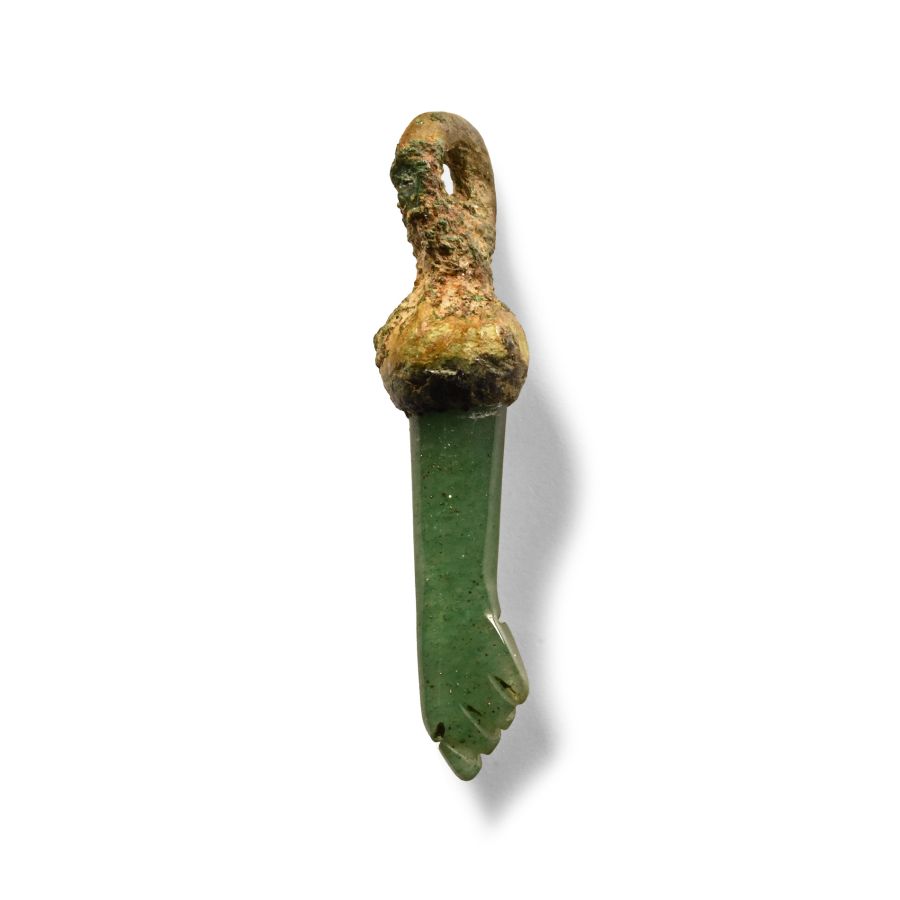
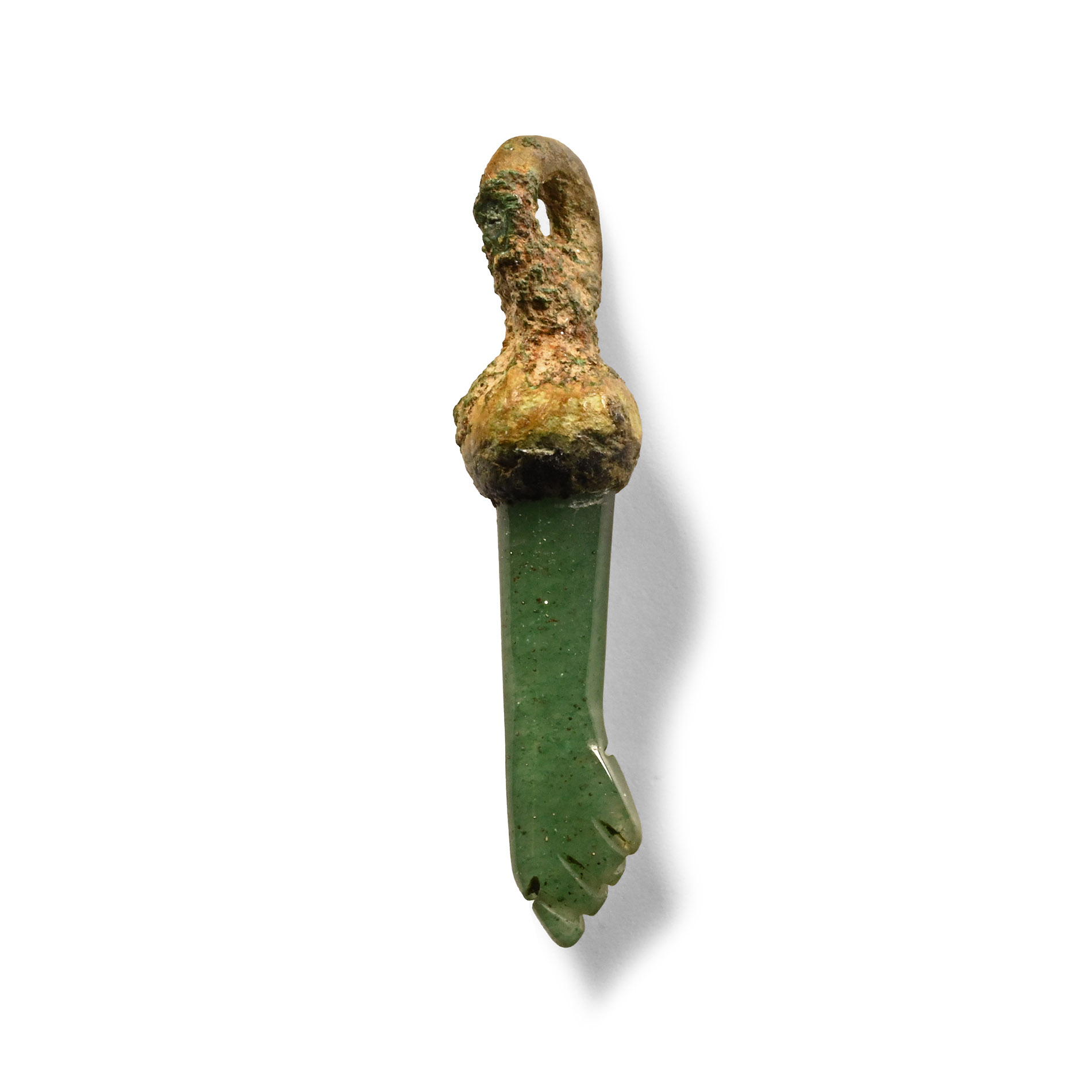
Roman Hardstone Hand Amulet
1ST-2ND CENTURY A.D.
1 3/8 in. (2.49 grams, 35 mm).
An amuletic arm with hand in the fica gesture, bulb and loop above.
Provenancewith Hotel des Ventes, Drouot, Paris, France.
From the collection of Mr H. Naudy, Paris, France.
Acquired at between 2004-2010.
Property of a French collector.
Cf. Andrews, C., Amulets of Ancient Egypt, London, 1994, item 74(f.
FootnotesSmall amulets of hands were commonly included in bracelets. They served not only as decorative pieces but also as symbols of protection for the limbs and extremities of their wearers. Some believed these amulets could even confer abilities such as increased dexterity or heightened creativity.
CONDITIONTimeLine Auctions follows a vetting process to ensure the authenticity and legality of all items, reinforcing our commitment to integrity and responsible trading. Each antiquity, antique, and coin lot undergoes thorough examination by a vetting committee of at least ten external specialists, professional trade association members, scientists, and archaeologists: Our Vetting Process
AUCTIONS:
TimeLine is a leading auction house specialising in antiquities, ancient art, collectables, natural history, coins, medals, and books. Our auctions offer museums, collectors, historians, and enthusiasts the opportunity to acquire unique and historically significant pieces.
-
.jpg)
Roman Children's Leather Shoe Collection
Circa 1st-2nd century A.D.Sold for (Inc. bp): £7,800
Comprising: the sole of a carbatina type shoe, formed as two thick layers of leather with a third, thinner layer beneath, slits to the upper face to accept securing straps and punched ornamentation (lines of concentric-ring motifs), underside with a line of domed iron studs to the outer edge and others at he middle of the sole and heel; a soft shoe made from a single piece of leather with pierced triangular tags to the open upper face, the toe and heel sewn so that the seam does not contact the ground; a similar soft shoe with openwork sides resembling arcading, no covering at the toes, heel sewn. 150 grams total, 13-17.5 cm
Found City of London, UK. Acquired from mudlark Steve Brooker in the early 2000s. Ian Wilkinson collection, Nottinghamshire, UK, formed since 1985. Accompanied by several original handwritten letters regarding the conservation of the shoes. This lot has been checked against the Interpol Database of stolen works of art and is accompanied by a search certificate number no.12093-214631.
In Great Britain, examples of carbatinai dated to the last quarter of the 1st century A.D. have been found in Castleford. Others dated to the 2nd century have been found in London and Bar Hill. Carbatinae were often worn by children: two well-preserved specimens were discovered at the Vindolanda fort, which housed a mixed population of soldiers and their families. -
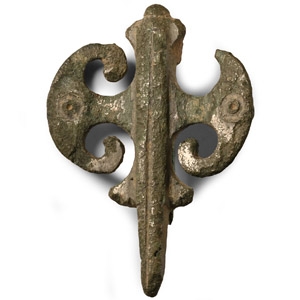
Roman Bronze Double Axe-Shaped Plate Brooch
2nd century A.D.Sold for (Inc. bp): £117
With vertical spine and peltoid lateral extensions with silvered surface, enamelled annular motif to the centre of each; pin and catchplate to the reverse. 10 grams, 42 mm
UK art market, acquired prior to 1980. Property of a Kent lady collector. -
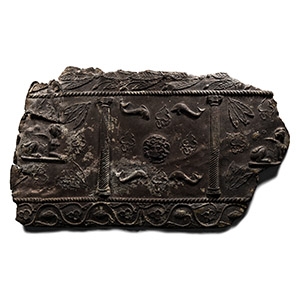
Roman Lead Sarcophagus Panel Fragment
2nd-3rd century A.D.Sold for (Inc. bp): £1,430
Irregular rectangular panel with decoration in three zones: upper area with horizontal laurel leaves and ropework border below; middle area divided by vertical fluted columns, masks of Medusa among dolphins alternating with a sphinx; lower area with running vine tendrils, leaves and bunches of grapes. 8.56 kg, 61 cm
Acquired from Cadogan Tate, Paris, 2011. From the Keane private collection, Kent, UK. Accompanied by a copy of the official shipping document (4,000 euros). Accompanied by an original French certificate of export issued by the French Ministry of Culture, no.129472.
