
Loading, please wait...

LOT 0839
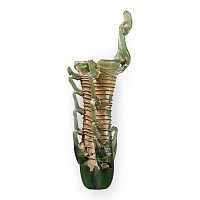
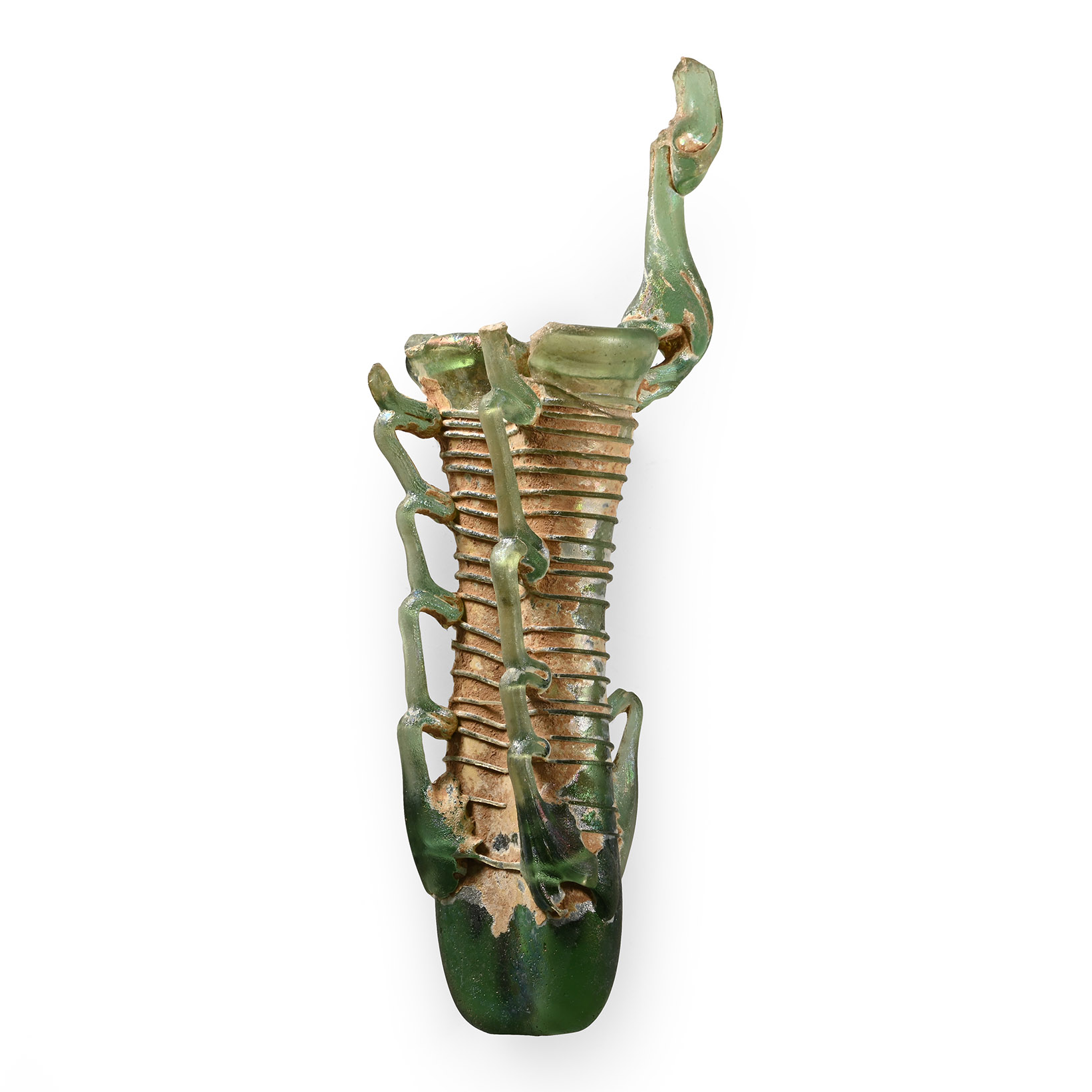
Roman Green Glass Double Balsamarium
4TH CENTURY A.D.
7/8 - 6 3/4 in. (175 grams total, 2.3-17.2 cm).
Comprising two parallel tubes joined at the base and sides, each with flared rim and covered with fine glass trails, applied lateral loops to the rim and handle above; iridescent aqua glass; handle absent; accompanied by a group of handle fragments. [13, No Reserve]
ProvenanceFrom a collection acquired on the UK art market from various auction houses and collections, primarily before 2000.
From an important Cambridgeshire estate; thence by descent.
Cf. Whitehouse, D., Roman Glass in the Corning Museum of Glass, vol.2, New York, 2001, item 743, for type.
CONDITIONTimeLine Auctions follows a vetting process to ensure the authenticity and legality of all items, reinforcing our commitment to integrity and responsible trading. Each antiquity, antique, and coin lot undergoes thorough examination by a vetting committee of at least ten external specialists, professional trade association members, scientists, and archaeologists: Our Vetting Process
AUCTIONS:
TimeLine is a leading auction house specialising in antiquities, ancient art, collectables, natural history, coins, medals, and books. Our auctions offer museums, collectors, historians, and enthusiasts the opportunity to acquire unique and historically significant pieces.
-
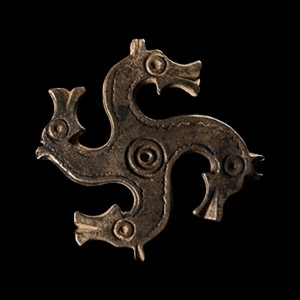
Roman Silver Horse Head Whorl Brooch
3rd-4th century A.D.Sold for (Inc. bp): £208
A swastika-shaped fibula with horse-head decoration, each head with punched ring-and-dot eye, a similar motif to the centre, catchplate and pin hinge to verso. 10.8 grams, 37 mm
Property of the vendor's grandfather, thence by family descent, circa 1985. From the private collection of a New York, USA gentleman.
In the 3rd century A.D., several examples of fibulae in the shape of four horses’ heads forming a swastika (type Almgren 232) seem to be related to the creation of the Illyrian cavalry corps in Roman army. Many examples of these military fibulae were found in ancient Roman Dacia (Romania), in Roman Illyricum and Moesia. -
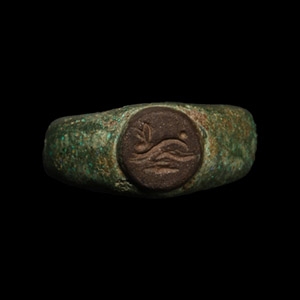
Roman Bronze Ring with Dolphin Gemstone
3rd century A.D.Sold for (Inc. bp): £195
With lateral carinations and inset glass intaglio of a dolphin breasting the waves; supplied with a museum-quality impression. 9.75 grams, 27.00 mm overall, 17.29 mm internal diameter (approximate size British N, USA 6 1/2, Europe 13.72, Japan 13)
Private collection, England. -

Roman Bronze Plate Brooch Collection
1st century B.C-2nd century A.D.Sold for (Inc. bp): £72
One tinned with central boss; one bell-shaped with glass inlay; another shaped as an amphora with remains of enamelling. 12 grams total, 22-38 mm
Ex property of an Austrian private collector since the 1970s.
The group includes an Alesia type brooch (25 B.C.-15 A.D.); a skeuomorphic plate brooch; and a possible variant of the fan-headed or radiate brooch.
