
Loading, please wait...


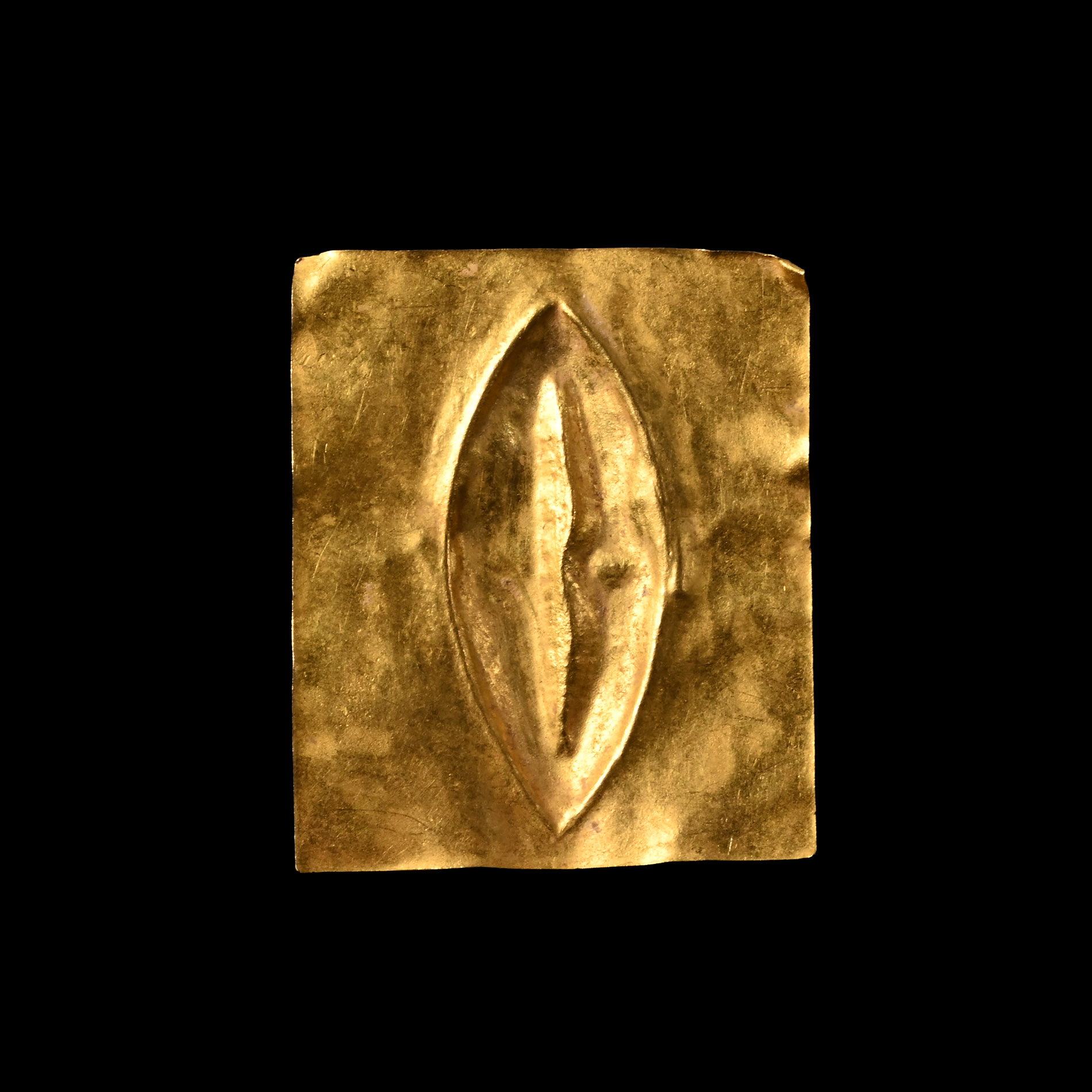
LOT 0085
Roman Gold Votive Plaque
2ND-3RD CENTURY A.D.
1 1/4 in. (2.32 grams, 30 mm).
Rectangular sheet-gold with boss to the centre, repoussé vulva motif.
ProvenanceAcquired in the mid 1980s-1990s.
Private collection, Switzerland, thence by descent.
Private collection, since the late 1990s.
Cf. Beutler, F. et al., Der Adler Roms. Carnuntum und der Armee der Cäsaren, Bad-Deutsch Altenberg, 2017, items 772, 773, for similar in bronze.
CONDITIONTimeLine Auctions follows a vetting process to ensure the authenticity and legality of all items, reinforcing our commitment to integrity and responsible trading. Each antiquity, antique, and coin lot undergoes thorough examination by a vetting committee of at least ten external specialists, professional trade association members, scientists, and archaeologists: Our Vetting Process
AUCTIONS:
TimeLine is a leading auction house specialising in antiquities, ancient art, collectables, natural history, coins, medals, and books. Our auctions offer museums, collectors, historians, and enthusiasts the opportunity to acquire unique and historically significant pieces.
-

Roman Silver Ring with Later Inscribed Gemstone
3rd-4th century A.D. and laterEstimate: £300 - 400 (+bp*)
Opening Bid: £150
With baluster detailing to the shoulders, later inset jasper stud with legend 'ΙXΘYС' (= ICTUS = fish = Jesus Christ). 9.18 grams, 21.93 mm overall, 18.60 mm internal diameter (approximate size British O, USA 7, Europe 14.98, Japan 15)
Private collection, England. -

Roman Bronze Mars Rider Statuette
2nd-3rd century A.D.Sold for (Inc. bp): £221
Modelled in the round, nude male with legs in straddling pose, left hand thrust forward and right arm raised with hand open; head exaggerated with shoulder-length hair and crested helmet. 35.6 grams, 60 mm
From a collection acquired on the UK art market from various auction houses and collections mostly before 2000. From an important Cambridgeshire estate; thence by descent.
The pseudo-Corinthian or Apulo-Corinthian helmet, here represented on the head of the divinity, was originally a legionary helmet, then became, in the Late Consular Age, an officer's helmet, then a typical attribute of military commanders and then of the war god, Mars. However, this statuette of Mars has strong Celtic connotations, as evidenced by the torques around the neck and the warrior god's hair. -

Roman Coloured Glass Bracelet Group
Circa 2nd-4th century A.D.Sold for (Inc. bp): £124
Comprising one round-section in deep blue, one similar in deep red, and a D-section in pale blue/turquoise. 14.3 grams total, 42-55 mm
Formerly with a Bournemouth gentleman. Ex Essex collection. Property of a Scottish collector, acquired in 2013.
Bangles did not occur in a vacuum after the Roman invasion but were an integral part of globalising networks of cross-Channel trade and connections with the European mainland in the early first century A.D. According to J. Price bangles were first developed in southern Britain in the late Claudio-Neronian period (A.D. 43–65/70) and that in subsequent periods the craft of bangle-making quickly spread further north with the advance of the Roman army.
