
Loading, please wait...
LOT 0100
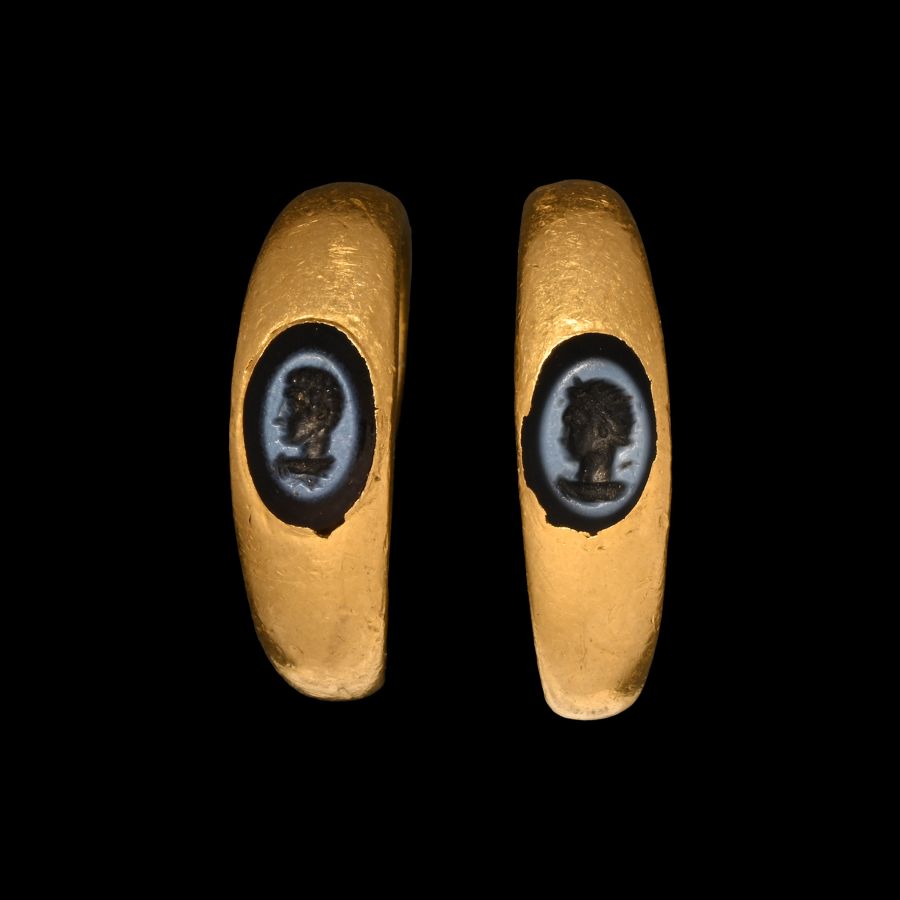
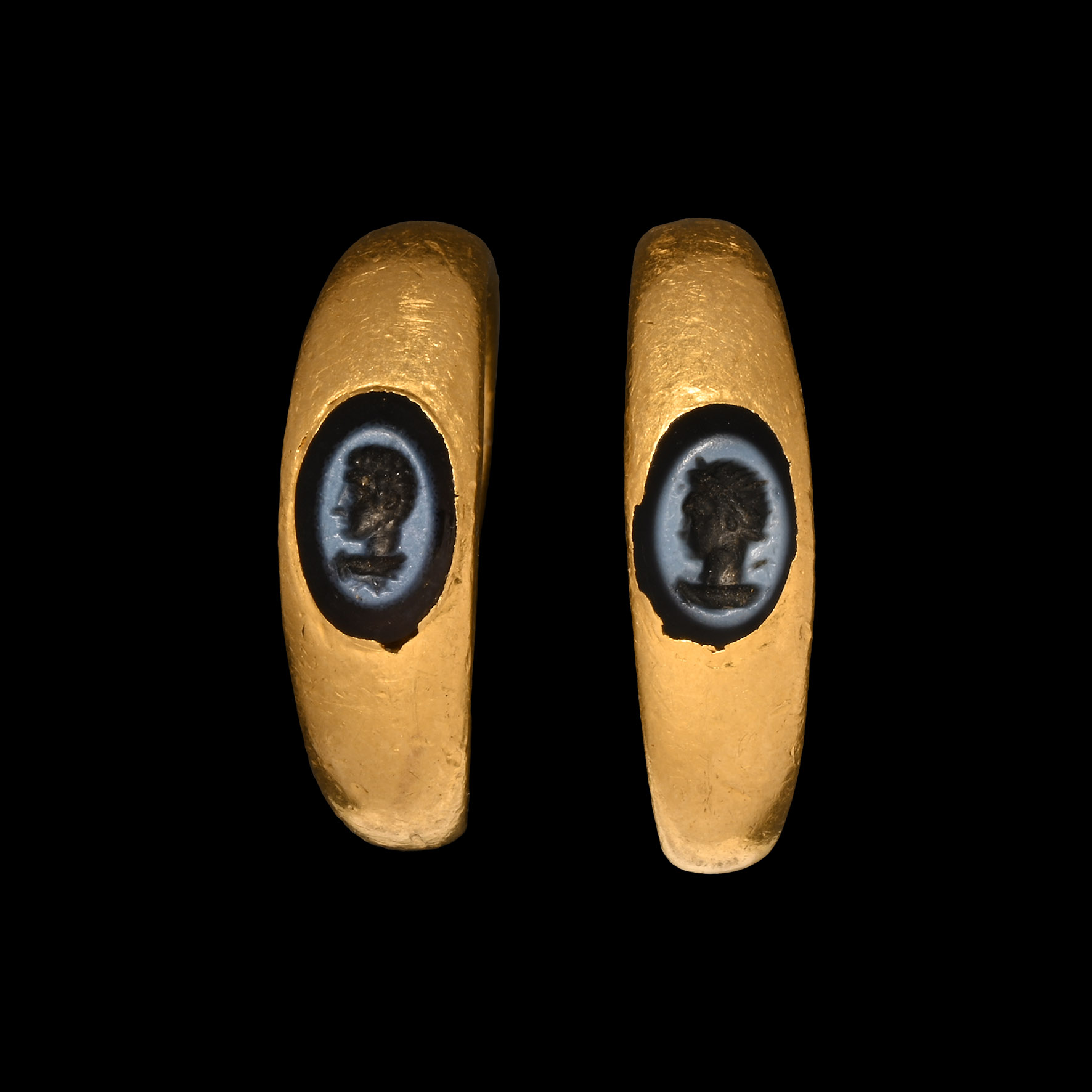
Roman Gold Rings for a Married Couple with Nicolo Bust Gemstones
2ND CENTURY A.D.
3 3/4 in. (12.83 grams total, 20.25 mm overall, 15.50 mm internal diameter (approximate size British G, USA 3 1/4, Europe 4.92, Japan 4) 20.86 mm overall, 16.35 mm internal diameter (approximate size British H, USA 3 3/4, Europe 6.18, Japan 6)).
Comprising two matching solid hoops with expanding shoulders, each set with a dark blue nicolo intaglio, one bearing a profile bust of a young Hercules, and the other with a profile bust of a woman wearing a taenia or a wreath on her head. [2]
ProvenanceFrom the private collection of the late A.B., London, UK; acquired before 1989.
Accompanied from an archaeological report of Dr. Raffaele D’Amato.
This lot has been checked against the Interpol Database of stolen works of art and is accompanied by a search certificate number no.12006-213034.
Cf. variant 3, type I, of the Ruseva-Slokoska classification of gold rings with gemstones, see Ruseva-Slokoska, L., Roman Jewellery, Sofia, 1991, p.170 no.192; cf. similar artefact in the Koch collection, in Chadour, A.B., Rings. The Alice and Louis Koch Collection, volume I, Leeds, 1994, item 226; Gołyźniak, P., Engraved Gems and Propaganda in the Roman Republic and under Augustus, Oxford, 2020, figs.22-23, pl.6.2, for similar profiles.
FootnotesThe iconography here is simple, possibly referring to a married couple, or to important public persons. The 5th century Roman writer Macrobius wrote that the engagement ring was worn on the fourth finger. Legend has it that the vena amoris, literally the ‘vein of love’, ran from the heart to the fourth finger of the left hand. Gemstones and fancy embellishments have been found in Roman rings of every age, although usually for engagement or wedding rings the iconography of clasped hands, symbolising the ‘fides’ among the spouses, was used. Intaglio portraits were engraved into a large variety of stones but nicolo, carnelian and red jasper were generally the most popular for imperial portraits or for the members of the imperial family.
CONDITIONTimeLine Auctions follows a vetting process to ensure the authenticity and legality of all items, reinforcing our commitment to integrity and responsible trading. Each antiquity, antique, and coin lot undergoes thorough examination by a vetting committee of at least ten external specialists, professional trade association members, scientists, and archaeologists: Our Vetting Process
AUCTIONS:
TimeLine is a leading auction house specialising in antiquities, ancient art, collectables, natural history, coins, medals, and books. Our auctions offer museums, collectors, historians, and enthusiasts the opportunity to acquire unique and historically significant pieces.
LOT 0100
Roman Gold Rings for a Married Couple with Nicolo Bust Gemstones
Sold for (Inc. bp): £4,160
-
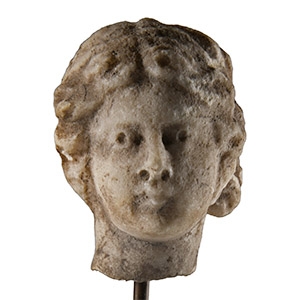
Roman Marble Female Head
Circa 3rd century A.D.Sold for (Inc. bp): £936
From a relief with hair centre-parted and drawn back from the face, gathered at the nape in a chignon; rounded face with soft features, drilled eyes and nostrils; mounted on a custom-made stand. 523 grams total, 78 mm high (12.7 cm high including stand)
London art market, 2000s. Property of a London gentleman. -
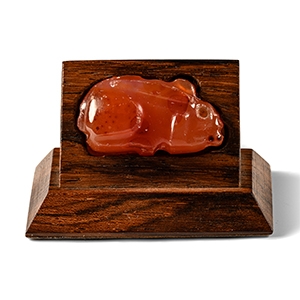
Roman Carnelian Hare Amulet
Circa 1st-2nd century A.D.Estimate: £800 - 1,000 (+bp*)
Opening Bid: £300
Carved in the round with sockets to the eyes for insertion of a contrasting material; mounted in a wooden stand. 19 grams total, 27 mm
French private collection. UK art market. Property of a London gentleman. -
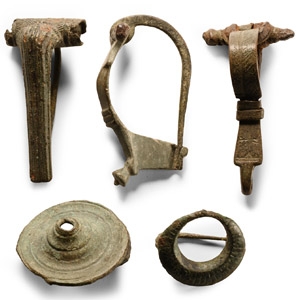
Roman Bronze Brooch Collection
1st-3rd century A.D.Sold for (Inc. bp): £111
Mixed group including tutulus, Langton Down, Aucissa and other types. 35.6 grams total, 23-45 mm
From a collection acquired on the UK art market from various auction houses and collections mostly before 2000. From an important Cambridgeshire estate; thence by descent.
