
Loading, please wait...
LOT 0874
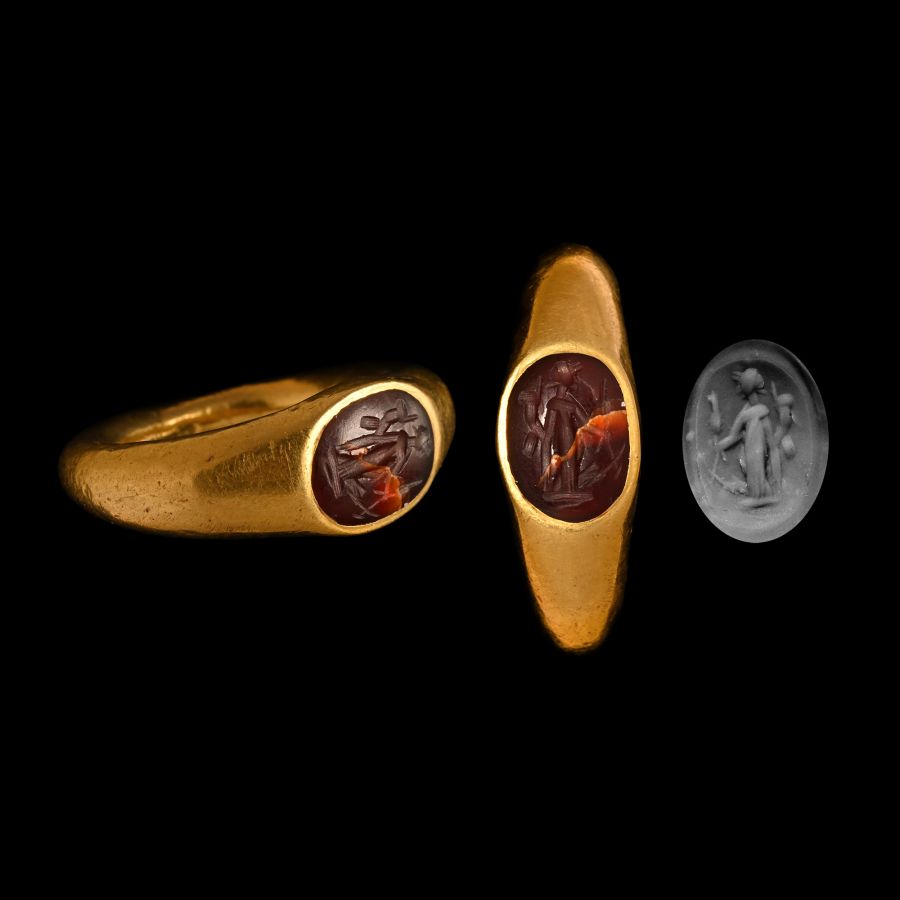
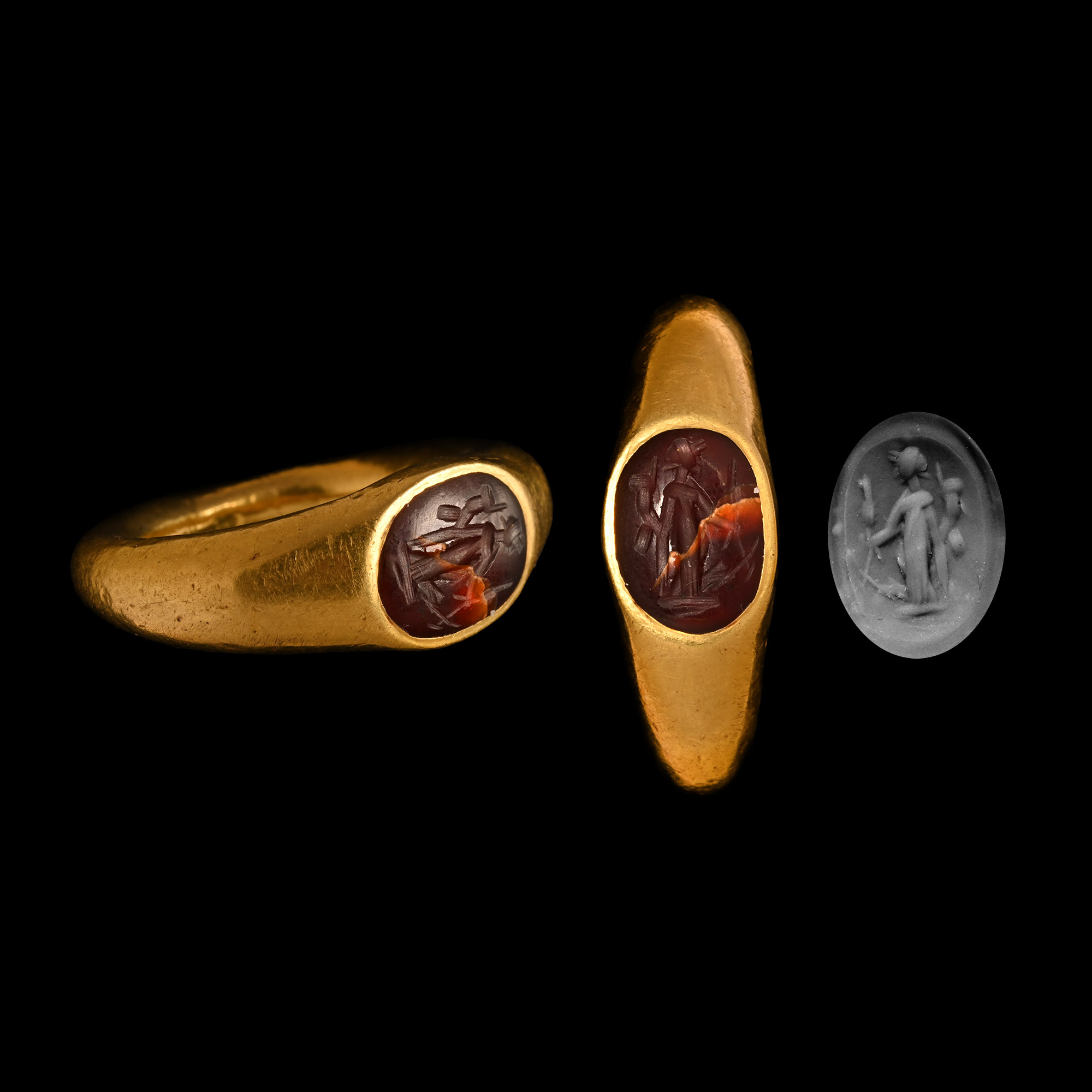
Roman Gold Ring with Sard Gemstone
1ST-2ND CENTURY A.D.
1 in. (3.47 grams, 24.99 mm overall, 12.25 x 15.59 mm internal diameter (approximate size British E 1/2, USA 2 1/2, Europe 3, Japan 3)).
Hollow-formed with inset ellipsoid intaglio figure of Abundantia standing with a cornucopia.
ProvenanceAcquired by the current owner's family in the 1980s.
with Christie’s, New York, Ancient Jewellery, 11 December 2003, no.397.
Cf. Chadour, A.B., Rings. The Alice and Louis Koch Collection, volume I, Leeds, 1994, item 450, for type.
CONDITIONTimeLine Auctions follows a vetting process to ensure the authenticity and legality of all items, reinforcing our commitment to integrity and responsible trading. Each antiquity, antique, and coin lot undergoes thorough examination by a vetting committee of at least ten external specialists, professional trade association members, scientists, and archaeologists: Our Vetting Process
AUCTIONS:
TimeLine is a leading auction house specialising in antiquities, ancient art, collectables, natural history, coins, medals, and books. Our auctions offer museums, collectors, historians, and enthusiasts the opportunity to acquire unique and historically significant pieces.
-
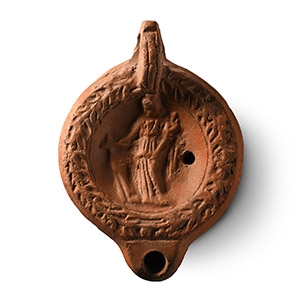
Roman Terracotta Oil Lamp with Goddess Fortuna
2nd century A.D.Sold for (Inc. bp): £416
Discoid in plan with D-shaped nozzle, loop handle, discus with low-relief image of the Fortuna-Tyche with modius and rudder, standing and looking left; base marked off with two circular grooves. 38 grams, 80 mm
From the collection of Mr W.A. Stewart, Director of School of Arts and Crafts, Cairo, 1919-1929. Acquired Christie's, London, Antiquities, Works of Art and Important Renaissance Bronzes, Plaquettes and Limoges Enamels, 8 July 1981, no.126 (part). From a private Wiltshire, UK, collection. Accompanied by a copy of the relevant Christie's catalogue page.
The lamp belongs to the Bussière type, form D I 3, from a period between the late Flavian era to the second half of the second century A.D. -
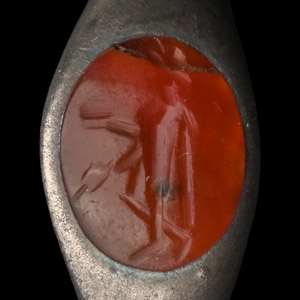
Roman Silver Ring with Apollo Gemstone
Circa 2nd century A.D.Sold for (Inc. bp): £195
A round-section hoop expanding to broad shoulders, flat plaque with inset carnelian cloison, intaglio image of Apollo (Sol), cloaked, advancing with a patera in each hand. 4.53 grams, 22.48 mm overall, 17.58 mm internal diameter (approximate size British H, USA 3 3/4, Europe 6.18, Japan 6)
From an important collection of jewellery formed over 40 years by a German collector. -
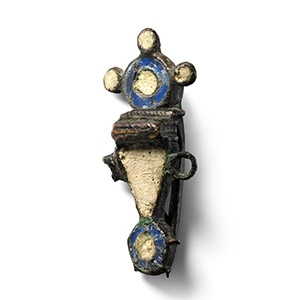
Roman Enamelled Bronze Plate Brooch
2nd century A.D.Sold for (Inc. bp): £169
Of stepped profile comprising: annular head with three radiating lobes, stepped bow, triangular body with lateral loops, annular foot; hinged pin to reverse with catch. 10.6 grams, 43 mm
Ex Chris Rudd collection, no.806. Ex David Miller, Hemel Hempstead, London, UK. From the private collection of a West London, UK, gentleman, formed since the early 2000s. Accompanied by a hand written dealer's ticket.
