
Loading, please wait...
LOT 0183
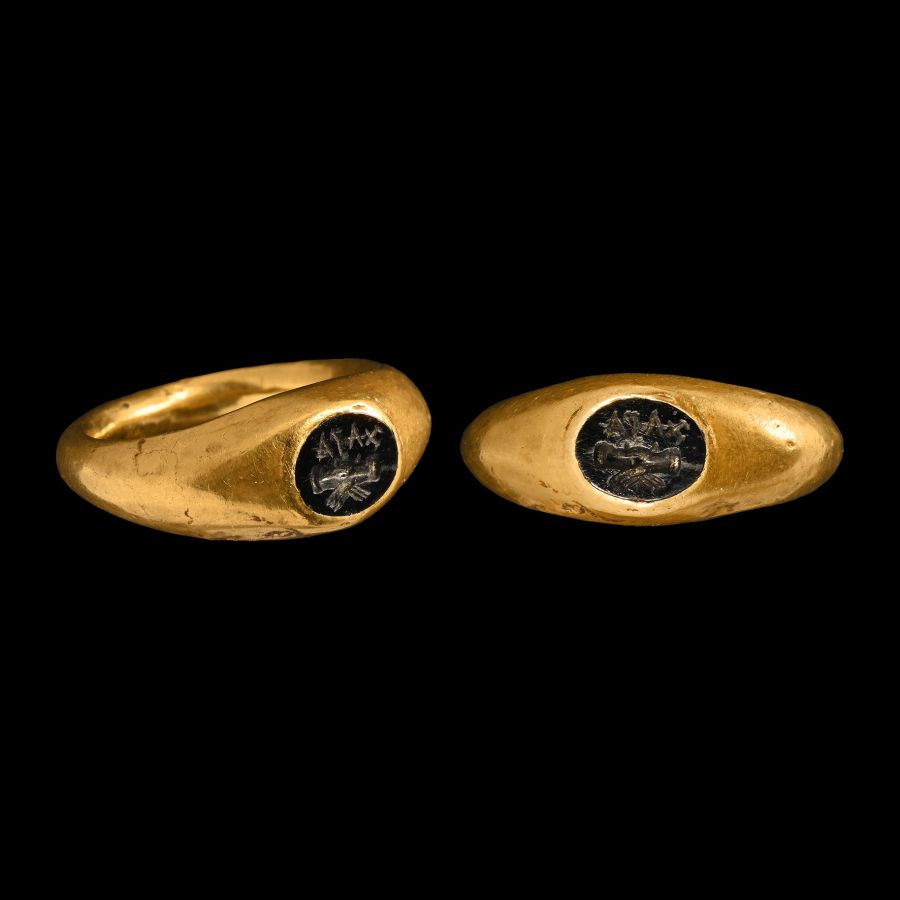
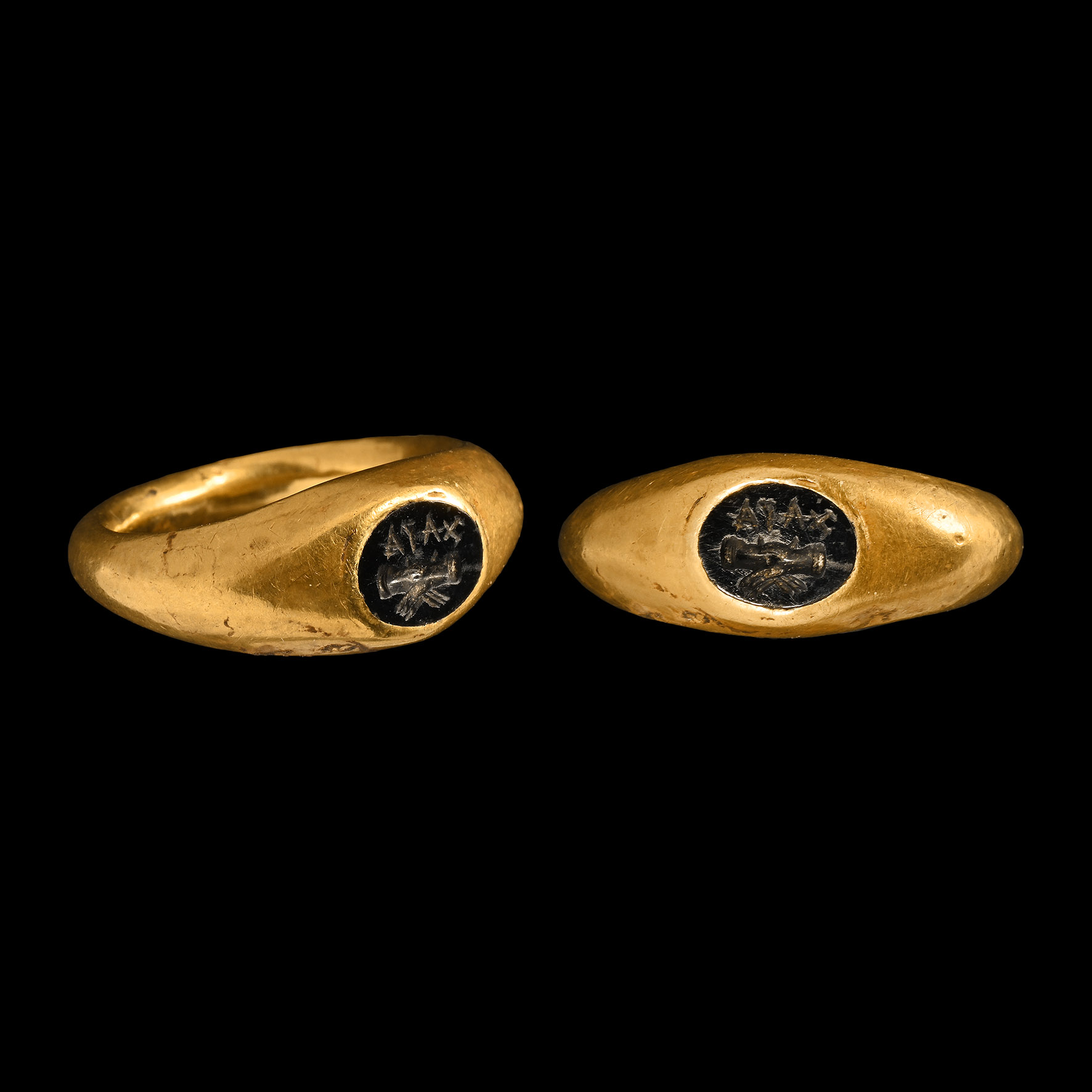
Roman Gold Ring with Mani in Fede Gemstone for Aiax
2ND CENTURY A.D.
7/8 in. (2.79 grams, 21.00 mm overall, 14.90 mm internal diameter (approximate size British E, USA 2 1/4, Europe 2.41, Japan 2)).
Comprising a hollow-formed hoop with rounded shoulders, inset garnet intaglio with clasped hands and 'AIAX' inscription.
ProvenanceAcquired in Europe in 1992.
with Million Cornette de Saint Cyr, Hotel Regina, 12 December 2009.
European private collection.
Cf. Ruseva-Slokoska, L., Roman Jewellery, Sofia, 1991, item 189, for type.
FootnotesThe Romanised name 'Aiax' is given to the hero Αἴας of the Trojan war, who carried off the body of Achilles and fought Hector. The subject of two clasped hands (dextrarum junctio) symbolising the fides (loyalty, trust), was very popular on Roman rings and gems. It was mainly used on marriage rings, sometimes with the equivalent Greek inscription 'OMONOIA'. Sometimes it was used in terms of military loyalty between commander and army. In this case it is most probable the name of the groom (AIAX).
CONDITIONTimeLine Auctions follows a vetting process to ensure the authenticity and legality of all items, reinforcing our commitment to integrity and responsible trading. Each antiquity, antique, and coin lot undergoes thorough examination by a vetting committee of at least ten external specialists, professional trade association members, scientists, and archaeologists: Our Vetting Process
AUCTIONS:
TimeLine is a leading auction house specialising in antiquities, ancient art, collectables, natural history, coins, medals, and books. Our auctions offer museums, collectors, historians, and enthusiasts the opportunity to acquire unique and historically significant pieces.
-
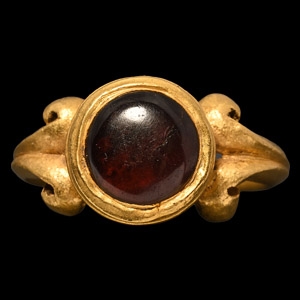
Roman Gold Ring with Garnet Cabochon
Circa 2nd-3rd century A.D.Estimate: £3,000 - 4,000 (+bp*)
Opening Bid: £1,600
Comprising a keeled hoop forked at the shoulders to form two elegant scrolls supporting the raised bezel, decorative grooves framing the garnet cabochon. 8.16 grams, 23.85 mm overall, 19.37 mm internal diameter (approximate size British N, USA 6 1/2, Europe 13.72, Japan 13)
Acquired from London galleries during the 1990s. From the jewellery collection of a London, UK, gentleman. This lot has been checked against the Interpol Database of stolen works of art and is accompanied by search certificate no.12114-214295.
The type of ring seems to date (with the volutes on the shoulders) to the late 2nd-early 3rd century A.D., although the model is certainly derived from the Hellenistic world. The use of carnelian and garnet was abundant in Hellenistic and Roman rings, and the style of the rings continued without change in the Roman Hellenised east. -
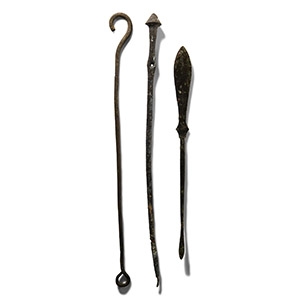
Roman Bronze Implement Group
1st-4th century A.D.Sold for (Inc. bp): £85
Group of three implements comprising: cloak pin with conical bulb finial and piercing; hooked rod; spear-shaped surgical blade with probe to the other end. 104 grams total, 19.7-25.5 cm
From a collection acquired on the UK art market from various auction houses and collections mostly before 2000. From an important Cambridgeshire estate; thence by descent. -
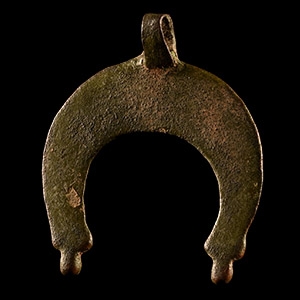
Roman Bronze Lunar Pendant
Circa 2nd-3rd century A.D.Sold for (Inc. bp): £78
Comprising a crescentic pendant with applied suspension loop. 9.1 grams, 49 mm
Found Worcestershire, UK.
