Loading, please wait...

Use mousewheel to zoom in and out, click to enlarge

Details

LOT 0090

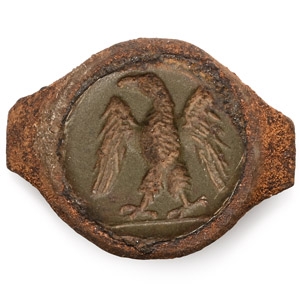
Roman Gold Ring with Kneeling Soldier Gemstone

2ND-3RD CENTURY A.D.

5/8 in. (4.73 grams, 17.88 mm overall, 15.40 mm internal diameter (approximate size British H, USA 3 3/4, Europe 6.18, Japan 6)).

With flared shoulders and ellipsoid cell, inset carnelian intaglio warrior kneeling on a baseline, Pseudo-Corinthian-style helmet pushed back on the head, spear held in one hand the other touching his ankle.

Provenance

Acquired on the European art market in the 1990s.
UK collection of a European gentleman.

Literature

Cf. Ruseva-Slokoska, L., Roman Jewellery, Sofia, 1991, item 187, for type.

Footnotes

The type is defined from Ruseva-Slokoska as Eastern Influence, widespread in the 2nd-3rd centuries A.D. The scene possibly alludes to the incident in the Trojan Cycle where Achilles is wounded by an arrow in his heel, the only portion of his body which was not impervious to injury.

CONDITION

VETTING:

TimeLine Auctions follows a vetting process to ensure the authenticity and legality of all items, reinforcing our commitment to integrity and responsible trading. Each antiquity, antique, and coin lot undergoes thorough examination by a vetting committee of at least ten external specialists, professional trade association members, scientists, and archaeologists: Our Vetting Process


AUCTIONS:

TimeLine is a leading auction house specialising in antiquities, ancient art, collectables, natural history, coins, medals, and books. Our auctions offer museums, collectors, historians, and enthusiasts the opportunity to acquire unique and historically significant pieces.

LOT 0090

Roman Gold Ring with Kneeling Soldier Gemstone

Sold for (Inc. bp): £1,040

Print page

RELATED LOTS

  • Roman Bronze Military Belt Mount Collection
    Roman Bronze Military Belt Mount Collection
    4th-5th century A.D.

    Sold for (Inc. bp): £85

    Comprising: an amphora-shaped strap end decorated with rings and dots, the centre ornamented by a star surrounded by small dots and circles; a shield-shaped strap end, with a concave crescent on each side; an openwork decorated fitting with a kidney shaped motif in each quarter; a shield-shaped decorated strap end, with kidney-shaped openwork design; and a propeller shaped mount. 75 grams total, 29-66 mm


    From the collection of the famous author, writer and speaker, Gordon Bailey, Essex, UK; formed since 1968.

    In Britain like in all of the West, all the elements intended for the embellishment of belts and harnesses also evolved towards new forms, the geometry of which bears witness to strong Germanic influences. Beside the typical propeller stiffener belts (Richborough), probably of Danubian origin, we have less ornate wide-belt types, represented by the Winchester example. Belt-plaques of triangular shape, often gilded, beast-shaped at the extremity, were excavated in the south of Britain (Cirencester). Rigid belt-plates with the buckle shaped like a dolphin came from Richborough, Wye and Sleaford (class 3, type B, Sommer), Tripontium, Mucking, Wycombe, Alwalton (type I-B, Hawkes, also in Richborough) and type Mainz, Savgar, Totanés (Colchester, often with associated propeller stiffeners). Type Hawkes I-A and I-B present similarities with the Simancas typologies, found in Lankhills. The type Tirig is attested at Lydney Park, the Böhme A in Richborough. Strap ends are usually heart-shaped or amphora-shaped (Richborough). These belt fittings were characteristic of the Roman army in Britain at the beginning of the 5th century.

    Lot Details

  • Roman Blue Glass Flask with Trail
    Roman Blue Glass Flask with Trail
    3rd-4th century A.D.

    Estimate: £500 - 700 (+bp*)

    Opening Bid: £250

    Piriform in profile with slight dimple to base, squat body, tubular neck with flared and rolled mouth; fine applied spiral trail from shoulder to base. 8 grams, 62 mm


    From an important London, UK, collection, 1970-1990s.

    Lot Details

  • Large Late Roman Sigma-Shaped Marble Offering Table Top
    Large Late Roman Sigma-Shaped Marble Offering Table Top
    Eastern Mediterranean, 4th-6th century A.D.

    Sold for (Inc. bp): £3,900

    Semi-circular with raised and slightly everted edge, the top with a recessed area with a funnel-shaped outlet; for votive offerings within a church; restored. 84.5 kg including backplate, 91 cm wide

    In general good condition, re-assembled.

    Acquired in the late 1960s or early 1970s. Ex David Read collection. Accompanied by an academic report by Dr Raffaele D’Amato. This lot has been checked against the Interpol Database of stolen works of art and is accompanied by search certificate number no.12080-214035.

    Marble tables such as the present example are called in archaeological terms sigma tables, in consideration of their resemblance to the Greek letter sigma. Sigma-shaped tables appeared in the banquet halls at the end of the 4th century and within Christian buildings from the following century. Most of the undecorated slabs were used as liturgical table tops for feasts to honour the deceased. This commemorative practice was known throughout the late Roman world in west and east, where it continued in the daily life of the citizens of the Eastern Roman Empire. In ecclesiastical settings, circular and sigma-shaped tables were used to collect offerings or for celebrating the agape, more generally as secondary furniture, while the rectangular form was preferred for use as an altar.

    Lot Details

Stay up-to-date with the latest from TimeLine Auctions by joining our mailing list