
Loading, please wait...
LOT 0101
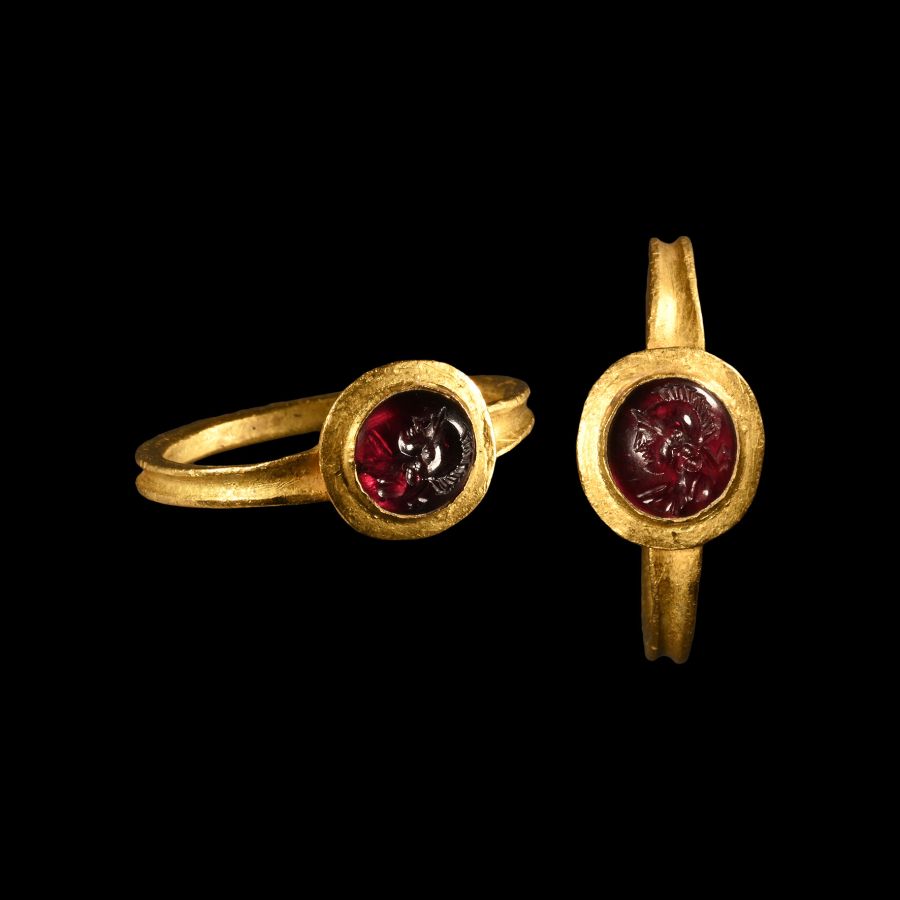
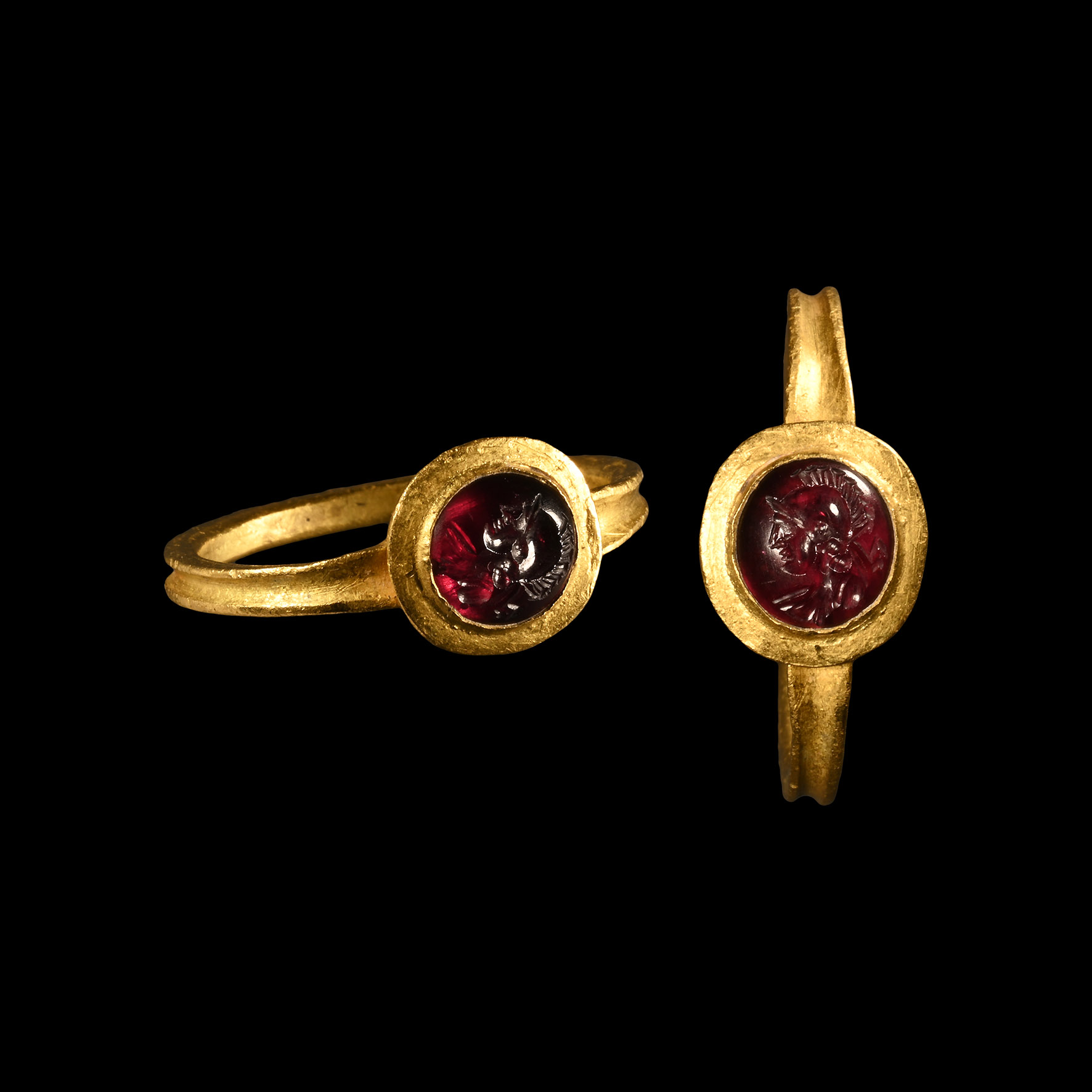
Roman Gold Ring with Head of Roma Garnet Gemstone
CIRCA 1ST CENTURY B.C.-1ST CENTURY A.D.
1 in. (4.50 grams, 24.32 mm overall, 20.69 mm internal diameter (approximate size British N 1/2, USA 6 3/4, Europe 14.35, Japan 13)).
With a grooved hoop, round bezel with flared rim, set with a cabochon engraved with profile bust of Roma wearing a crested helmet.
ProvenanceAcquired from London galleries during the 1990s.
From the jewellery collection of a London, UK, gentleman.
This lot has been checked against the Interpol Database of stolen works of art and is accompanied by search certificate no.12110-214298.
Cf. Chadour, A.B., Rings. The Alice and Louis Koch Collection, volume I, Leeds, 1994, item 162, for type, with a similar profile view of a stylised female head.
FootnotesBoth the ring and the gem show characteristic compatible with 1st century B.C.-1st century A.D. dating. Some scholars identify the female head with a theatre mask, but here the strong profile and the helmet points to the goddess Rome, a divine personification of the eternal city.
CONDITIONTimeLine Auctions follows a vetting process to ensure the authenticity and legality of all items, reinforcing our commitment to integrity and responsible trading. Each antiquity, antique, and coin lot undergoes thorough examination by a vetting committee of at least ten external specialists, professional trade association members, scientists, and archaeologists: Our Vetting Process
AUCTIONS:
TimeLine is a leading auction house specialising in antiquities, ancient art, collectables, natural history, coins, medals, and books. Our auctions offer museums, collectors, historians, and enthusiasts the opportunity to acquire unique and historically significant pieces.
-
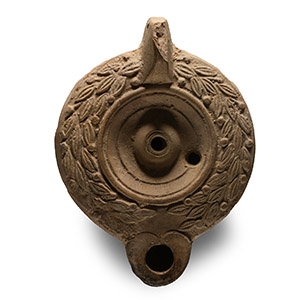
Roman Terracotta Oil Lamp with Wreath
2nd-3rd century A.D.Sold for (Inc. bp): £260
Lug handle to rear, deep discus with a dome filling hole, another filling hole to the side; wide shoulder with low-relief laurel wreath; low basal ring and incised maker's mark in Greek letters (ΗΙϹΧΛ). 138 grams, 11.8 cm
Acquired on the European art market, 1980s. English private collection.
This form of lamps is characterised by their shoulder decoration - a laurel wreath. This decoration may be treated realistically or be stylised. Both groups appear on lamps found in Italy. The hypothesis that they might only be African imports is contradicted by the signature on many lamps of L.C A E S A E, a prolific Italic lamp maker (late Antonine and early Severan); his products are scarce in North Africa. -
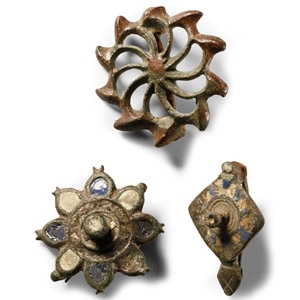
Roman Brooch Collection
2nd-3rd century A.D.Sold for (Inc. bp): £156
Comprising an openwork plate brooch of solar-wheel type; rosette plate brooch with central stud, enamelled cells; lozenge plate brooch with enamelled cells. 29.6 grams total, 35-37 mm
UK art market, acquired prior to 1980. Property of a Scottish collector, acquired in 2013. -
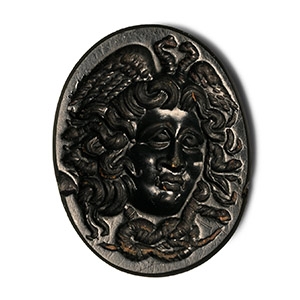
Graeco-Roman Green Jasper Gemstone with Medusa
1st century B.C.-1st century A.D.Estimate: £3,000 - 4,000 (+bp*)
Opening Bid: £1,600
An exceptional intaglio engraved with head of Medusa in three-quarter view, depicted with a sorrowful expression, full lips and large eyes gazing up; voluminous hair composed of entangled snakes framing her face, large wings to the brow flanking a pair of rearing serpents, a knot of serpents below her chin. 1.34 grams, 20.82 mm
Acquired in Switzerland 1970-1980. From a London, UK, collection. This lot has been checked against the Interpol Database of stolen works of art and is accompanied by search certificate no.12034-214098.
In ancient mythology, Medusa was one of three monstrous winged female creatures who had venomous snakes living in her hair. In classical antiquity, representations of the head of Medusa appeared in the apotropaic device known as the Gorgoneion, designed to ward-off evil and bad luck.
