
Loading, please wait...
_900x900.jpg "Roman Gold Ring with Gemstone for Servius")
_200x200.jpg "Roman Gold Ring with Gemstone for Servius")
.jpg "Roman Gold Ring with Gemstone for Servius")
LOT 0185
Roman Gold Ring with Gemstone for Servius
MID 3RD CENTURY A.D.
3/4 in. (11.63 grams, 20.37 mm overall, 16.48 mm internal diameter (approximate size British J, USA 4 3/4, Europe 8.69, Japan 8)).
With balustered hoop, broad shoulders with scrolled foliage detailing, discoid bezel with cell, inset nicolo gemstone with reversed 'SER/VIV' for SER(VI) VIV(AS) inscription in seriffed capitals, meaning 'Long may you live Servius'.
ProvenanceUK private collection formed before 2000.
Ex North London, UK, gallery.
Accompanied by an academic report by Dr Raffaele D’Amato.
This lot has been checked against the Interpol Database of stolen works of art and is accompanied by a search certificate number no.11995-211017.
Cf. Higgins, R.A., Greek and Roman Jewellery, London, 1961; Ruseva-Slokoska, L., Roman Jewellery, Sofia, 1991, item 184, for type; for the inscription see Glare P.G.W., A Latin Dictionary, London, 1968-82, page 1,746/3; for the use of nicolo gemstones with inscription on Roman rings and of nicolo gemstones on the same typology of rings see Chadour, A.B., Rings. The Alice and Louis Koch Collection, volume I, Leeds, 1994, items 347, 420; similar finds are known in the collection of the British Museum (Higgings, 1961, p.190, no.3, pl.62E, 63D) and Mainz.
Footnotes'Serviu[s]' is a second declension praenomen (Glare, P.G.W., A Latin Dictionary, London, 1968-82, page 1,746/3) apparently based on the noun 'servus' (servant, minister, office-holder). The name was in use in Consular and Imperial times, and was the patronym of important Roman Gens, like the Gens Servilia.
CONDITIONTimeLine Auctions follows a vetting process to ensure the authenticity and legality of all items, reinforcing our commitment to integrity and responsible trading. Each antiquity, antique, and coin lot undergoes thorough examination by a vetting committee of at least ten external specialists, professional trade association members, scientists, and archaeologists: Our Vetting Process
AUCTIONS:
TimeLine is a leading auction house specialising in antiquities, ancient art, collectables, natural history, coins, medals, and books. Our auctions offer museums, collectors, historians, and enthusiasts the opportunity to acquire unique and historically significant pieces.
-
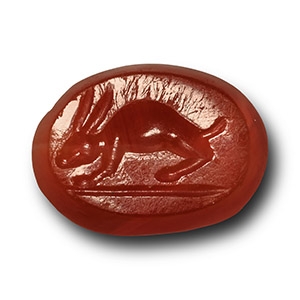
Roman Carnelian Gemstone with Hare
Circa 2nd-3rd century A.D.Sold for (Inc. bp): £390
Intaglio profile image of a hare running on a baseline. 0.28 grams, 9 mm
Acquired on the London art market in the late 1980s-1990s. From the family collection of an East London, UK, gentleman. -
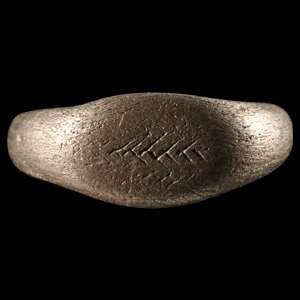
Roman Silver Ring with Palm Branch
1st century A.D.Sold for (Inc. bp): £143
Rounded ellipsoid plaque with incised palm frond. 4.89 grams, 20.04 mm overall, 14.82 mm internal diameter (approximate size British G 1/2, USA 3 1/2, Europe 5.55, Japan 5)
Acquired on the London art market in the late 1980s-1990s. From the family collection of an East London, UK, gentleman. -
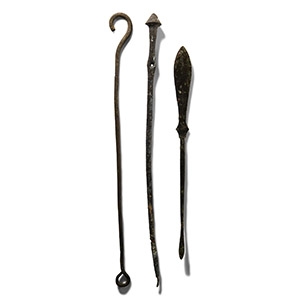
Roman Bronze Implement Group
1st-4th century A.D.Sold for (Inc. bp): £85
Group of three implements comprising: cloak pin with conical bulb finial and piercing; hooked rod; spear-shaped surgical blade with probe to the other end. 104 grams total, 19.7-25.5 cm
From a collection acquired on the UK art market from various auction houses and collections mostly before 2000. From an important Cambridgeshire estate; thence by descent.
