
Loading, please wait...
LOT 0181
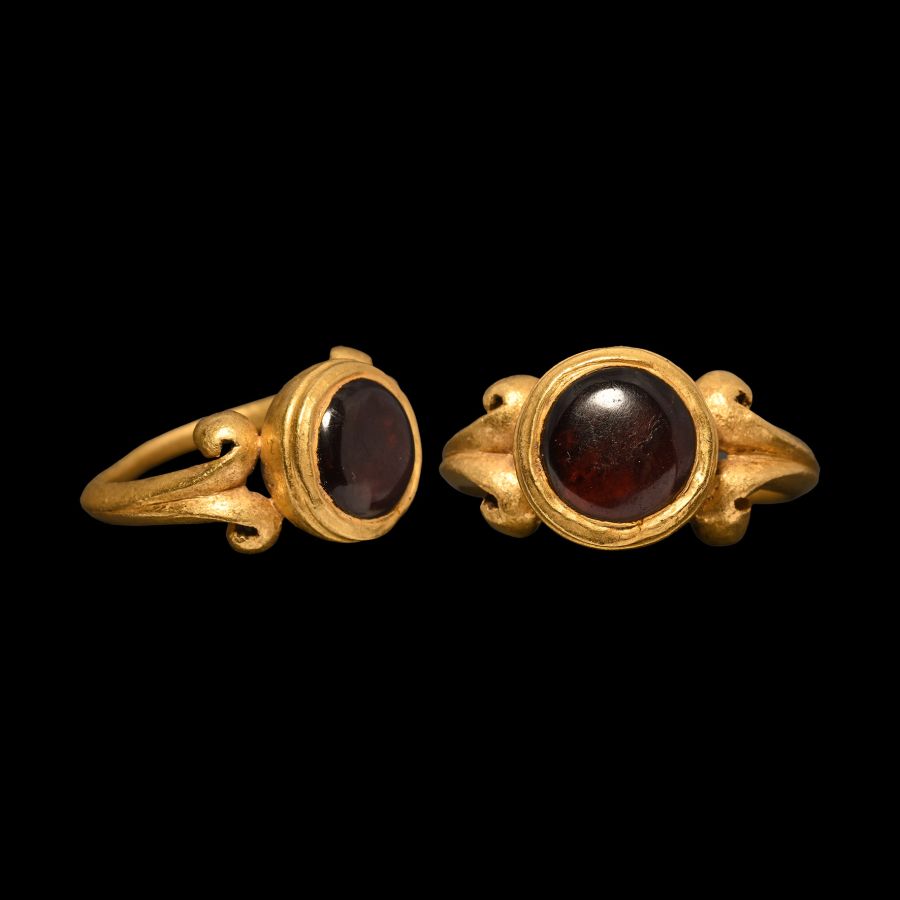
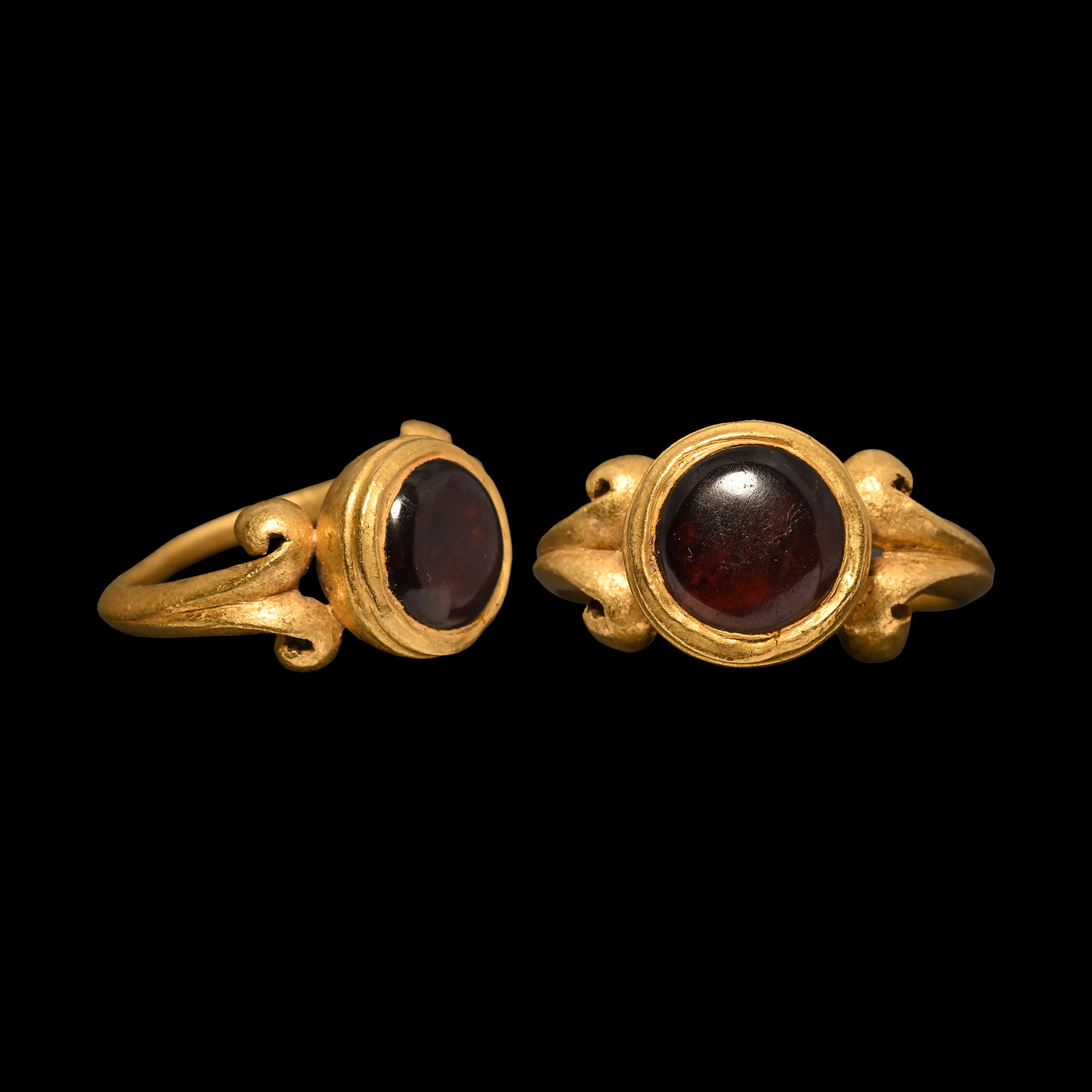
Roman Gold Ring with Garnet Cabochon
CIRCA 2ND-3RD CENTURY A.D.
1 in. (8.16 grams, 23.85 mm overall, 19.37 mm internal diameter (approximate size British N, USA 6 1/2, Europe 13.72, Japan 13)).
Comprising a keeled hoop forked at the shoulders to form two elegant scrolls supporting the raised bezel, decorative grooves framing the garnet cabochon.
ProvenanceAcquired from London galleries during the 1990s.
From the jewellery collection of a London, UK, gentleman.
This lot has been checked against the Interpol Database of stolen works of art and is accompanied by search certificate no.12114-214295.
Cf. Chadour, A.B., Rings. The Alice and Louis Koch Collection, volume I, Leeds, 1994, item 368, for type.
FootnotesThe type of ring seems to date (with the volutes on the shoulders) to the late 2nd-early 3rd century A.D., although the model is certainly derived from the Hellenistic world. The use of carnelian and garnet was abundant in Hellenistic and Roman rings, and the style of the rings continued without change in the Roman Hellenised east.
CONDITIONTimeLine Auctions follows a vetting process to ensure the authenticity and legality of all items, reinforcing our commitment to integrity and responsible trading. Each antiquity, antique, and coin lot undergoes thorough examination by a vetting committee of at least ten external specialists, professional trade association members, scientists, and archaeologists: Our Vetting Process
AUCTIONS:
TimeLine is a leading auction house specialising in antiquities, ancient art, collectables, natural history, coins, medals, and books. Our auctions offer museums, collectors, historians, and enthusiasts the opportunity to acquire unique and historically significant pieces.
LOT 0181
Roman Gold Ring with Garnet Cabochon
Estimate £3,000 - 4,000€3,480 - 4,640 (for guidance only)$4,050 - 5,400 (for guidance only)
-
.jpg)
Roman Silver Fish Brooch
2nd century A.D.Sold for (Inc. bp): £416
Plate brooch formed as a fish with broad, gently curved lozengiform body, small lateral fins, chevron tail, D-shaped head with large discoid eye; the body with five rows of crescent punchmarks denoting scales; hinge-plate and catch to the reverse. 4.98 grams, 38 mm
Fine condition.
Property of a gentleman from Vienna; from his private collection formed since 1970.
The brooch is of a type found in Britain, corresponding to Hull's type 223. The fish represented here is likely a salmon. -
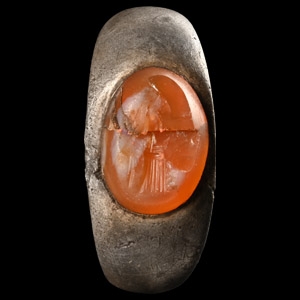
Roman Silver Ring with Bust Gemstone
2nd-3rd century A.D.Sold for (Inc. bp): £572
With broad tapering plaque, inset carnelian intaglio of a profile bust; intaglio repaired. 8.92 grams, 25.80 mm overall, 20.28 mm internal diameter (approximate size British G, USA 3 1/2, Europe 4.92, Japan 4)
Acquired on the London art market in the late 1980s-1990s. From the family collection of an East London, UK, gentleman. -
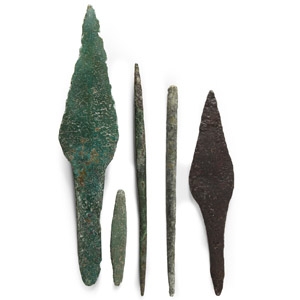
Bronze Age to Roman Bronze Artefact Collection
11th century B.C.-3rd century A.D.Sold for (Inc. bp): £46
Comprising two arrowheads with foliate head and square-sectioned tang and three awls. 45 grams total, 3.6-10.8 cm
Acquired prior to 2000. Ex private collection, Cambridgeshire, UK.
The two arrowheads are similar to specimens found in Luristan. They belong to the type V of the Khorasani classification. The bow was widely used by the Luristan people. The shape of the blade is often flat or ovate in the cross section with lanceolate profile and two cutting edges.
