
Loading, please wait...
LOT 0097
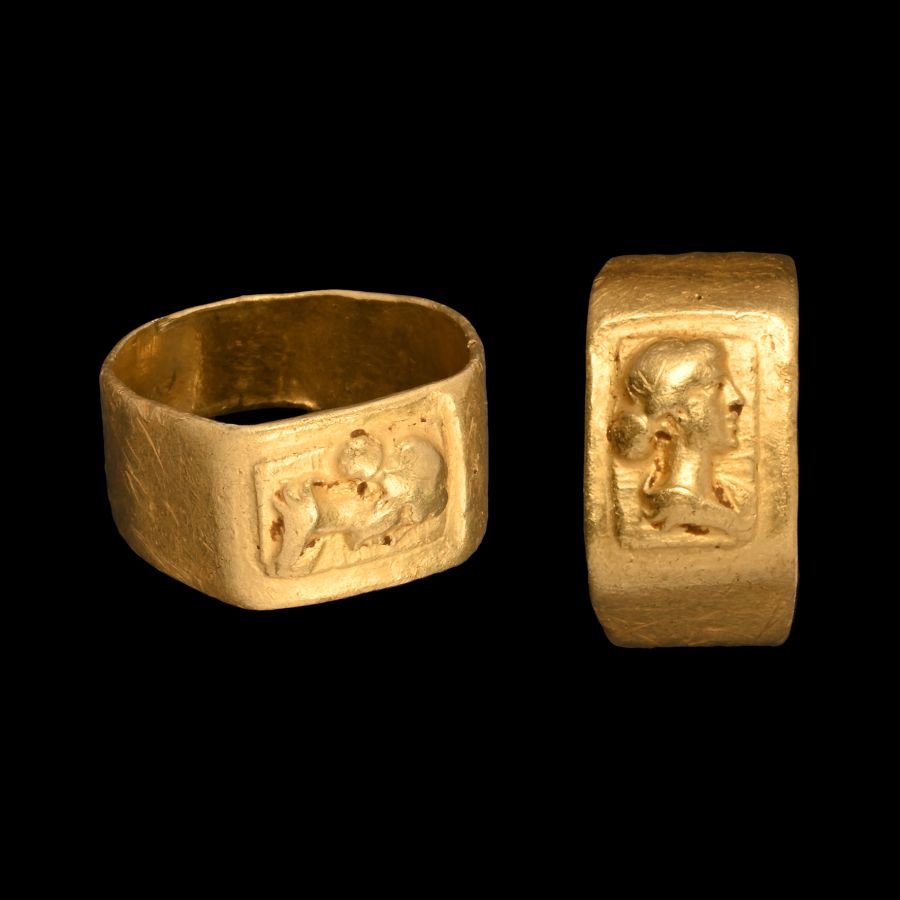
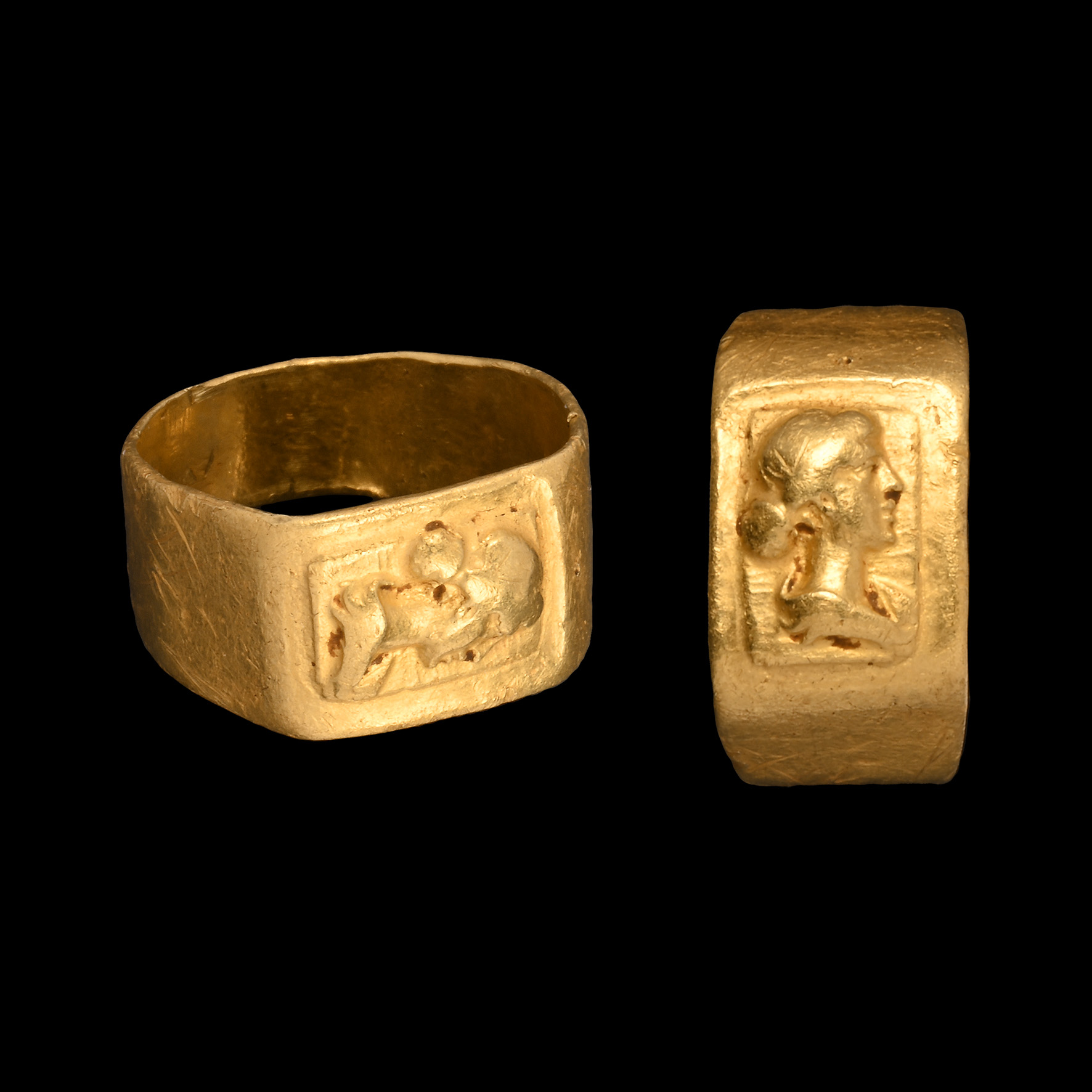
Roman Gold Ring with Bust of a Lady
LATE 2ND CENTURY A.D.
3/4 in. (6.15 grams, 18.78 mm overall, 16.51 mm internal diameter (approximate size British K 1/2, USA 5 1/2, Europe 10.58, Japan 10)).
Composed of a broad, flat-section hoop and a rectangular bezel displaying a high-relief bust of a lady in profile right.
ProvenanceAcquired in the 1970s.
From a deceased lady’s estate, by descent.
This lot has been checked against the Interpol Database of stolen works of art and is accompanied by search certificate no.202900.
Cf. Chadour, A.B., Rings. The Alice and Louis Koch Collection, volume I, Leeds, 1994, item 313; for similar Isis iconography on a ring see Schmidtová, J., Daňová, M., Šefčáková, A., 'New finds of roman rings from a rich grave in Cemetery III, Rusovce‑Gerulata,' in Studia Hercynia, XX/1, pp.83-99, pl.5/7.
FootnotesIn 2014, a grave of a woman was discovered in Gerulata cemetery III, containing an unusual number of rings. The buried woman, aged 40-49, had two rings on each hand, one of which was a signet ring with a gem depicting the Egyptian deities Serapis and Isis, whose hairstyle and profile are identical to the present ring. Although, the bust of Isis is opposed to Serapis in the rings, the cult of the goddess was widespread inside the provinces already in the 1st century A.D.
CONDITIONTimeLine Auctions follows a vetting process to ensure the authenticity and legality of all items, reinforcing our commitment to integrity and responsible trading. Each antiquity, antique, and coin lot undergoes thorough examination by a vetting committee of at least ten external specialists, professional trade association members, scientists, and archaeologists: Our Vetting Process
AUCTIONS:
TimeLine is a leading auction house specialising in antiquities, ancient art, collectables, natural history, coins, medals, and books. Our auctions offer museums, collectors, historians, and enthusiasts the opportunity to acquire unique and historically significant pieces.
-
.jpg)
Roman and Other Mixed Bead Group
Circa 1st century A.D. and laterSold for (Inc. bp): £85
Comprising polychrome glass and stone beads of various types. 146 grams total, 3-19 mm
Fine condition.
Acquired 1980-2015. Ex Abelita family collection. -
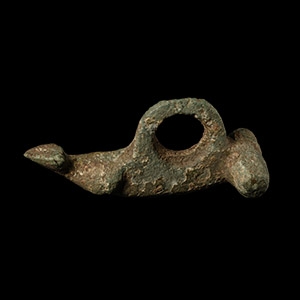
Roman Bronze Phallic Pendant
1st-3rd century A.D.Sold for (Inc. bp): £59
With large suspension loop, curved shank and leaf-shaped finial. 8.61 grams, 35 mm
Acquired on the German art market around 2000. From the collection of a Surrey, UK, gentleman. -
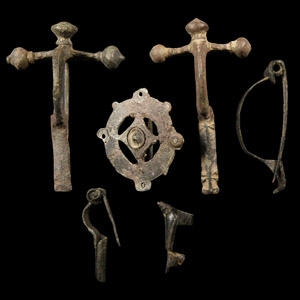
Roman And Other Bronze Brooch Group
Circa 1st century B.C.-5th century A.D.Sold for (Inc. bp): £143
Comprising complete and incomplete examples, including crossbow brooches; decorated openwork brooches; a zoomorphic brooch; a Celtic fibula, together with others. 61 grams total, 27-68 mm
Ex important Spanish collection, formed 1970s.
